EMEA organizations are primed for widespread AI adoption, and see enterprise open source as an important success factor; however, their ability to scale is challenged by skills gaps, high costs and shadow AI. That’s the headline finding of our latest survey of over 900 IT leaders and AI engineers in nine countries1.
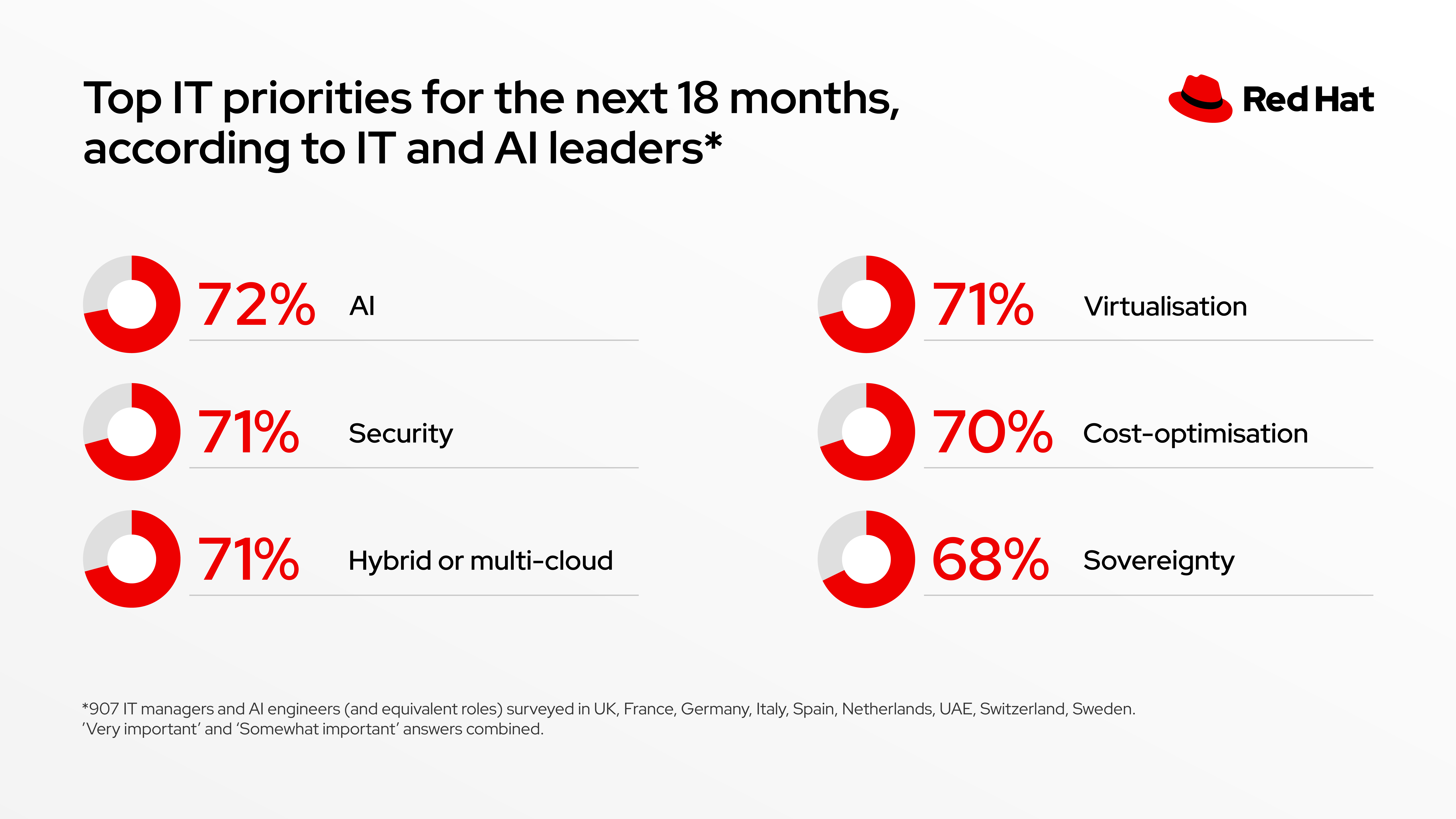
According to the survey AI is a core strategic priority for 72%2 of organizations in Europe, the Middle East, and Africa, and they have plans to increase their AI investments by an average of 32% by 20263.
The focus on AI is clear, yet the data also reveals a stark gap between ambition and reality: only 7% of organisations report “driving customer value” at scale from their AI investments today4. This is a crucial challenge for leaders who need to translate significant investment into tangible business outcomes.
So what is preventing organisations moving from small-scale pilots to enterprise-wide value?
Tackling the barriers to scale AI
Our survey data outlines the extent of the talent shortage faced, with 70% of respondents agreeing there is an urgent AI skills gap3. The most significant gaps cited by those respondents are in the practical application of AI, such as connecting AI to enterprise data (49%), and making efficient use of AI capabilities (48%). Nearly as many (47%) report difficulty educating the business to use AI effectively, which complicates organisation-wide adoption.
As the role of AI in the workplace is established, another layer of complexity emerges. ‘Shadow AI’, the use of unsanctioned AI tools by employees, is becoming a significant challenge to effective governance and scalable adoption.
The vast majority of responding EMEA organisations (91%5) admit their organisation is experiencing a shadow AI problem. This should serve as a wake-up call: AI is being adopted with or without IT teams’ authorisation. This introduces new risks and underscores the need for internal education and guardrails, supported by platforms that are accessible, governed, and designed with users in mind.
The solution: a platform approach built on open source
Overcoming these barriers requires moving from a collection of fragmented tools to a unified platform strategy. IT leaders and AI developers in EMEA already recognise the path forward, as 92% agree that enterprise open source is important to their AI strategy6. An enterprise open source AI platform can offer the consistency and control needed to build, deploy, and manage AI across any hardware and any cloud.
Organisations need a governed environment where teams can access the tools they need to experiment and build with confidence. Rather than spinning up lots of different systems in departmental silos (the top rated barrier to AI adoption7), the use of an open source platform helps replicate success rather than reinvent the wheel. This approach allows IT to enable innovation, not block it, helping to fulfill a major AI priority for 75%2 of respondents: transparency and openness. Open source provides this transparency as well as increasing standardization, helping enterprises retain control over AI and data decision-making. This control and flexibility is also vital to provide AI sovereignty, which is a priority for 74%2 of respondents.
An enterprise open source platform like Red Hat OpenShift AI also helps address the skills gap. By providing data scientists and developers with common tools and streamlined MLOps and LLMOps workflows, it boosts productivity as well as allowing organisations to tap into the broad range of talent and innovation within the open source ecosystem. It also simplifies connecting models to enterprise data to help solve the integration challenges that are top of mind7. Meanwhile Red Hat AI Inference Server optimizes inference for faster, more cost-effective model deployments, which helps surmount the cost barrier cited by 29%7 of respondents.
By standardising on robust, open platforms, leaders can better control and govern AI, de-risk scale, and turn transparency into a competitive advantage.
From ambition to value
To close the AI value gap, organisations must match their ambition with an IT platform strategy that prioritises innovation, choice and scale – much as hybrid cloud platforms have borne out to be the most sustainable model for the cloud world. The path from pilot to production relies on the flexibility to adapt and the ability to scale when ready.
With a platform like Red Hat AI, EMEA enterprises have the foundation to do exactly that - scale and manage AI with confidence on their own terms.
1 Methodology: the research, conducted by Censuswide, surveyed 909 IT managers and directors (including infrastructure and cloud infrastructure roles) and AI engineers (including software engineers in AI/ML, NLP and LLM engineers and data scientists) from companies with 500+ employees across EMEA (in France, Germany, Italy, the Netherlands, Spain, Sweden, Switzerland, the UAE and the UK). Of these, 100 are from the UK. Censuswide abides by and employs members of the Market Research Society and follows the MRS code of conduct and ESOMAR principles. Censuswide is also a member of the British Polling Council.
2 ‘Strongly agree’ and ‘Somewhat agree’ responses combined
3 Almost one-fifth of respondents (17%) expect to increase investment by 51–75% while almost half expect increases of 21–50% (45%) and almost two-fifths expect increases of 5–20% (36%). Less than 1% plan above 75% increase, less than 1% plan no investment increase or sub-5% investment increase and less than 1% were unsure.
4 Respondents were asked to select the phase that most applies to their organisation:
16% of EMEA respondents are in phase 1 - building awareness of AI
26% of EMEA respondents are in phase 2 - preparing for AI
34% of EMEA respondents are in phase 3 - exploring AI use cases
16% of EMEA respondents are in phase 4 - maximising AI investment
7% of EMEA respondents are in phase 5 - driving customer value.
When asked about the future, 21% of respondents answered that they hope to be driving customer value in five years’ time.
5 All ‘Yes’ answer options combined in response to the question ‘Do you believe your organisation is experiencing a 'shadow AI' problem - i.e., unauthorised use of AI tools by employees?’
6 ‘Very important’ and ‘Somewhat important’ responses combined
7 For the 98% of organizations who come up against barriers when adopting AI, when asked to select a top three the most common responses were: AI departments siloed from IT departments (30%), high costs of implementation and maintenance (29%), data privacy and security concerns (28%), integration challenges with existing systems (27%).
Sobre o autor

Mais como este
Connect, collaborate, and grow: Your guide to Ecosystem Success Day at Red Hat Summit 2026
233% 3-year return on investment and 13 months to payback with Red Hat AI
Collaboration In Product Security | Compiler
Keeping Track Of Vulnerabilities With CVEs | Compiler
Navegue por canal

Automação
Últimas novidades em automação de TI para empresas de tecnologia, equipes e ambientes

Inteligência artificial
Descubra as atualizações nas plataformas que proporcionam aos clientes executar suas cargas de trabalho de IA em qualquer ambiente

Nuvem híbrida aberta
Veja como construímos um futuro mais flexível com a nuvem híbrida

Segurança
Veja as últimas novidades sobre como reduzimos riscos em ambientes e tecnologias

Edge computing
Saiba quais são as atualizações nas plataformas que simplificam as operações na borda

Infraestrutura
Saiba o que há de mais recente na plataforma Linux empresarial líder mundial

Aplicações
Conheça nossas soluções desenvolvidas para ajudar você a superar os desafios mais complexos de aplicações

Virtualização
O futuro da virtualização empresarial para suas cargas de trabalho on-premise ou na nuvem
