
This article discusses how to export and import Collections from one automation hub to another.
Ansible automation hub stores Collections within repositories and the Collections are versioned by the curator, so therefore many versions of the same Collection can exist in the same or different repositories at the same time.
Ansible automation hub repositories store Collections as TAR files, as created by ansible-galaxy during the curation and publishing process. This makes for easy downloading and transportation, especially during import and export workflows. You can be assured that the Collection you are importing to the new repository is the same one that was exported, or originally created by ansible-galaxy (assuming nothing malicious has happened to it; for that level of protection we have digital collection signing and can discuss that in a future article).
There are many reasons why you may wish to export or import Collections from one automation hub to another, so here are some common use cases.
Your production automation hub is on a disconnected network
This scenario means that you need to move content from an internet connected automation hub to another automation hub over an air gap. This could be done using a USB stick or other physical media to bridge the air gap.
As a content curator, you wish to deliver your final content
A content curator will publish Collections they are working on into their own personal private automation hub, testing the Collections as they go. Once they are happy with the Collection, they will deliver it to its final destination, which could be a GitHub repo, a content management system or another automation hub such as one in production or quality control.
Various methods
This document describes the following methods for importing and exporting Collection content:
- Exporting via the UI
- Exporting via the API
- Importing via the UI
- Importing via the CLI
Exporting a Collection via the UI
To export a Collection via the user interface (UI), simply locate the Collection you wish to export and select the download as TAR option. Upon doing this, you will have the tar downloaded to your default browser downloads folder where you can move the TAR to its next destination.
Here are examples of where the download tarball option is for:
- Console.redhat.com - Red Hat Ansible Certified Content
- Galaxy.ansible.com - Community Content
- Private automation hub - Red Hat Ansible Certified Content (change repository filter for certified, published or other repositories)
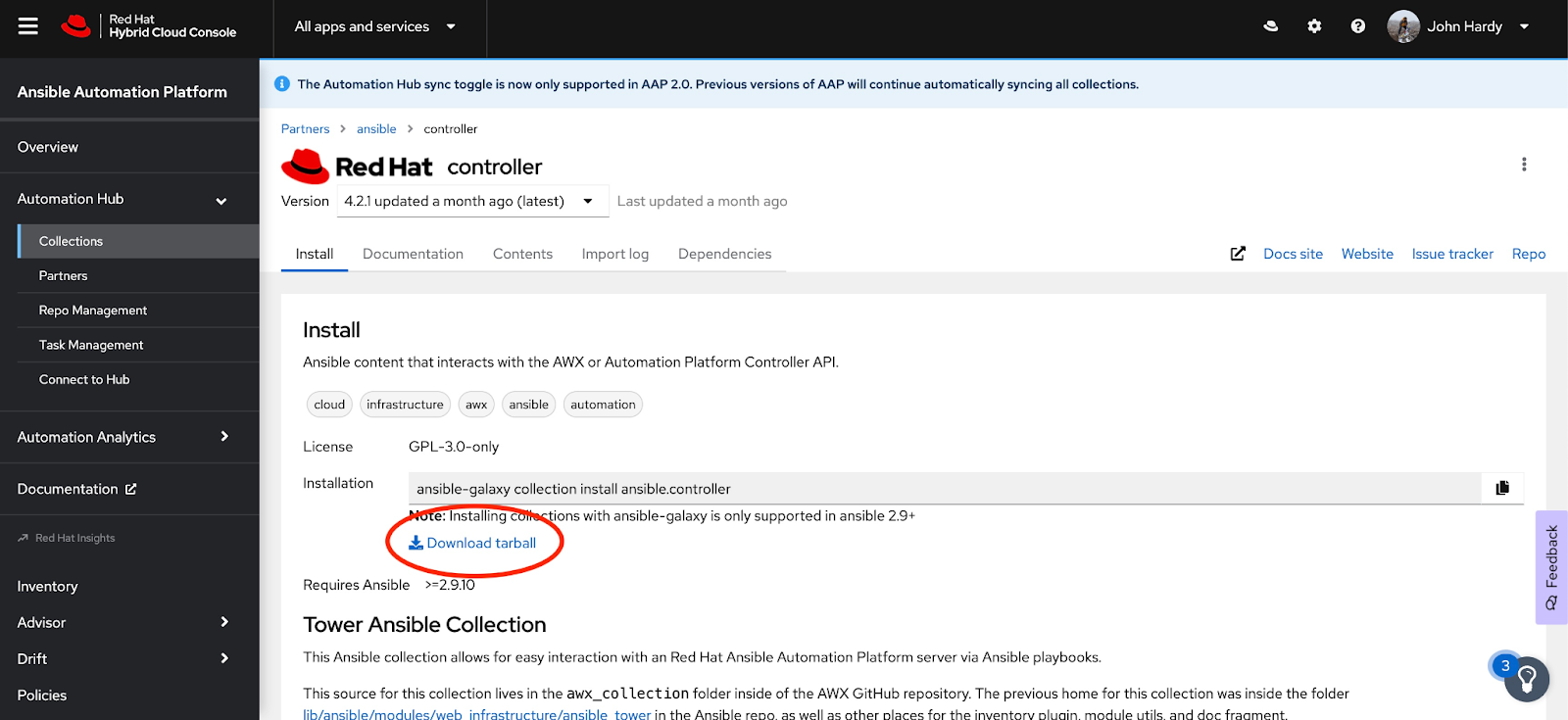
Example: console.redhat.com certified content.
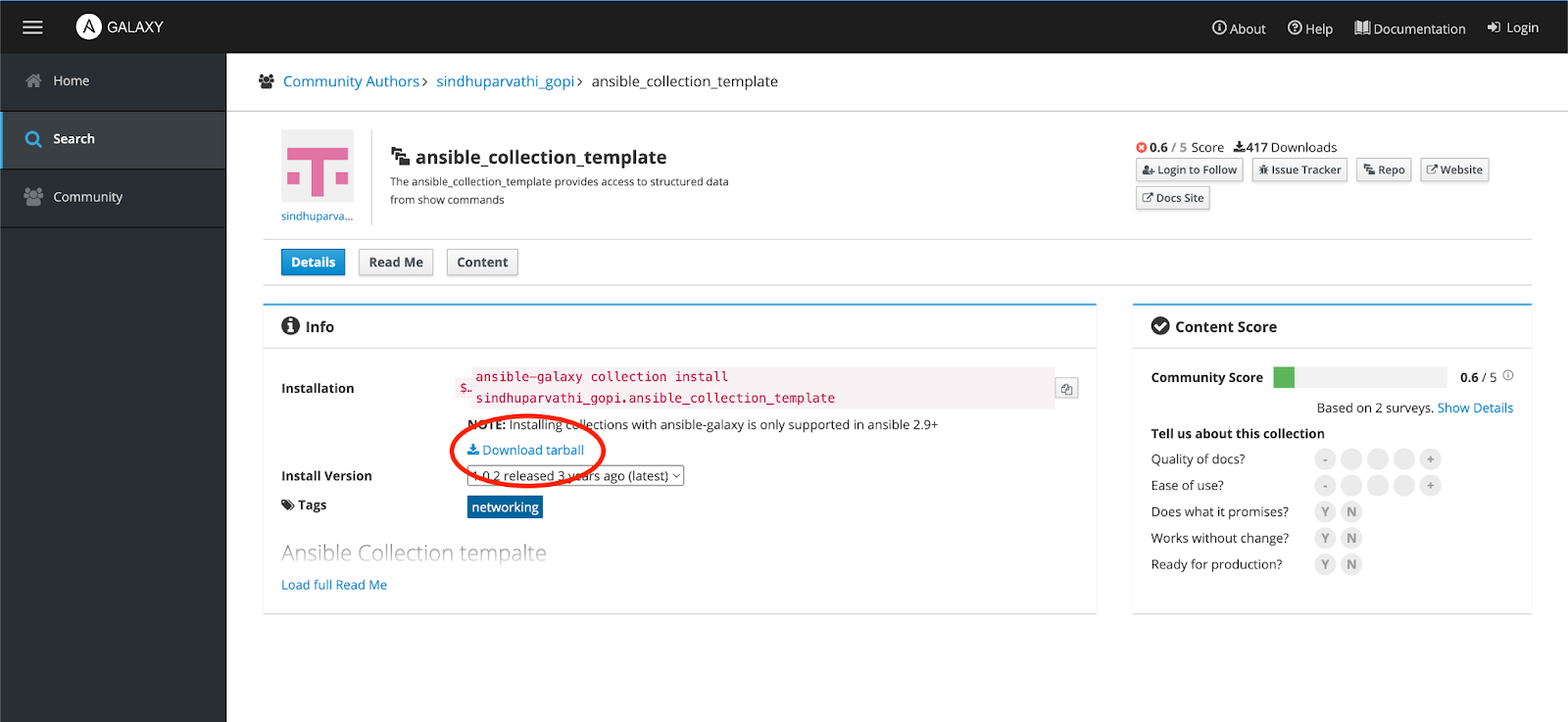
Example: galaxy.ansible.com community content
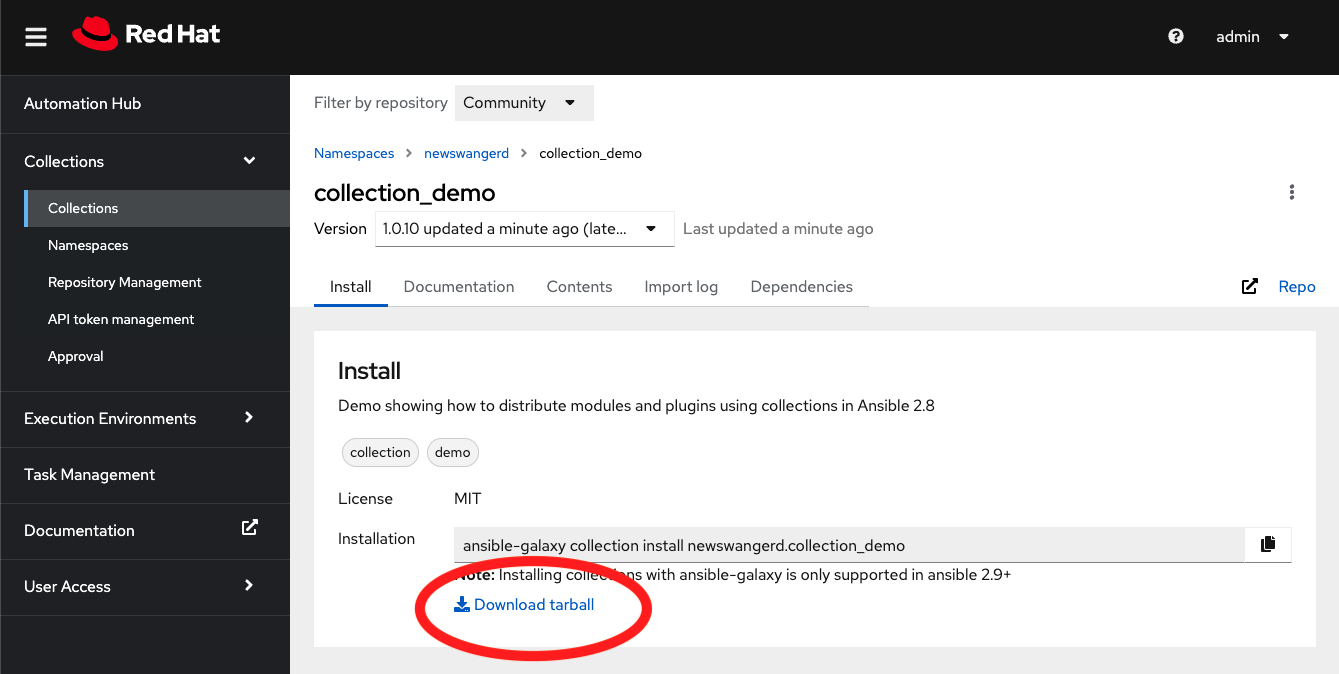
Example: private automation hub community content
Change repository filter for certified, published or others.
Exporting a Collection via the API
Collections can also be exported using the API, you can automate via Ansible Playbooks or other methods for use in continuous pipelines.
A prerequisite is that you have the Collection ready to import on a machine that can run curl.
The command to run will include the following items:
{username} - A user defined in automation hub for downloading content
{password} - {username}’s password
{host} - The IP address/hostname of the automation hub you wish to download from.
{repository} - The repository name (community, certified, published etc…)
{namespace}-{name}-{version} - The collection fully qualified name, example “redhat-ansible-1.0.0”
Command
curl -L -u {username}:{password} {host}/api/galaxy/v3/plugin/ansible/content/{repository}/collections/artifacts/{namespace}-{name}-{version}.tar.gz --output {namespace}-{name}-{version}.tar.gzImporting a Collection via the UI
Importing a Collection from the UI is very easy, you will need your tarball to complete this.
A prerequisite for this is that the Namespace for the Collection must exist in private automation hub. You need to remember to approve your Collection post import for it to show in the published repository.
Step 1
Create your namespace, you can find this in the name of the tarball itself such as:
awx-awx-21.6.0.tar = namespace-collectionname-versions.tar
So our namespace is “awx”.
Step 2

Click “upload collection”
Step 3
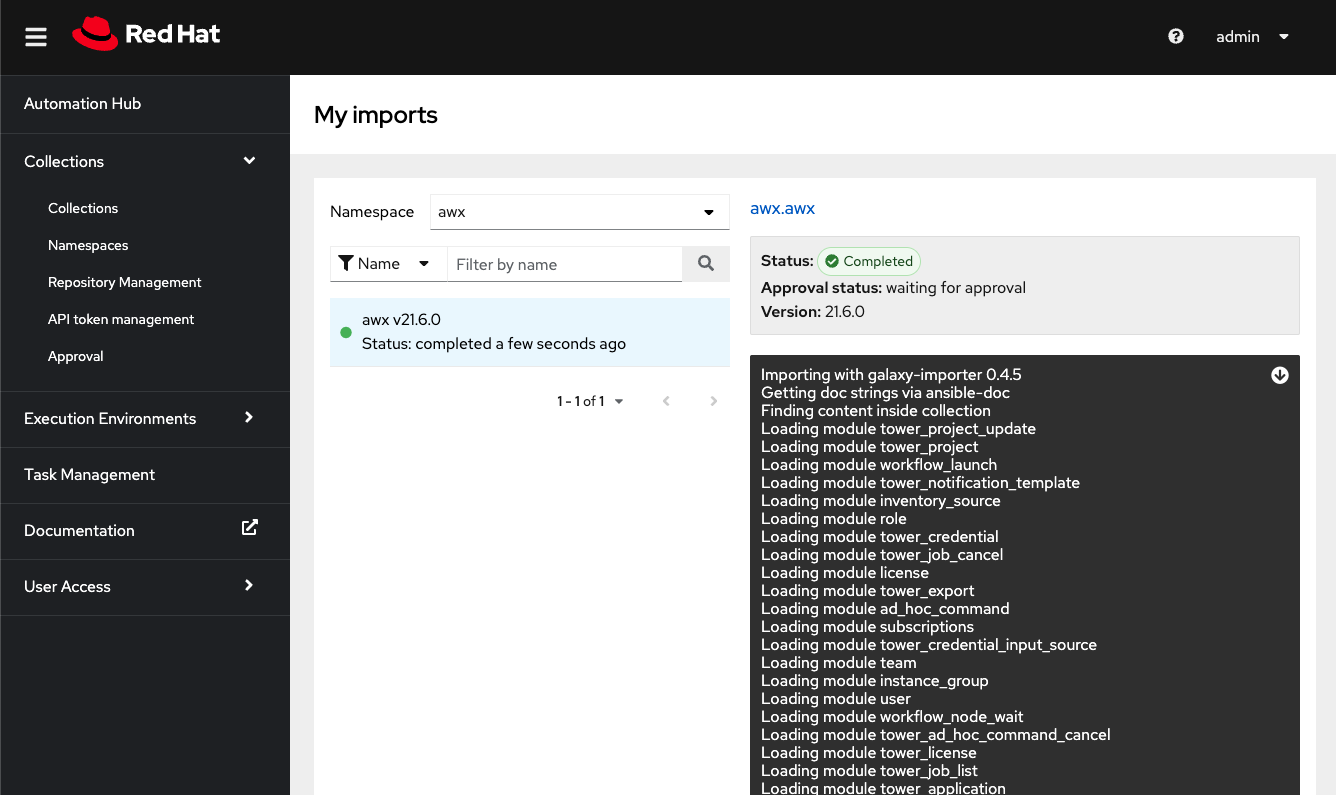
Watch the progress through to completion
Post Import Task
Make sure the approval setting is enabled and click on approval to either approve or reject the Collection import.
Completed Approved Collection
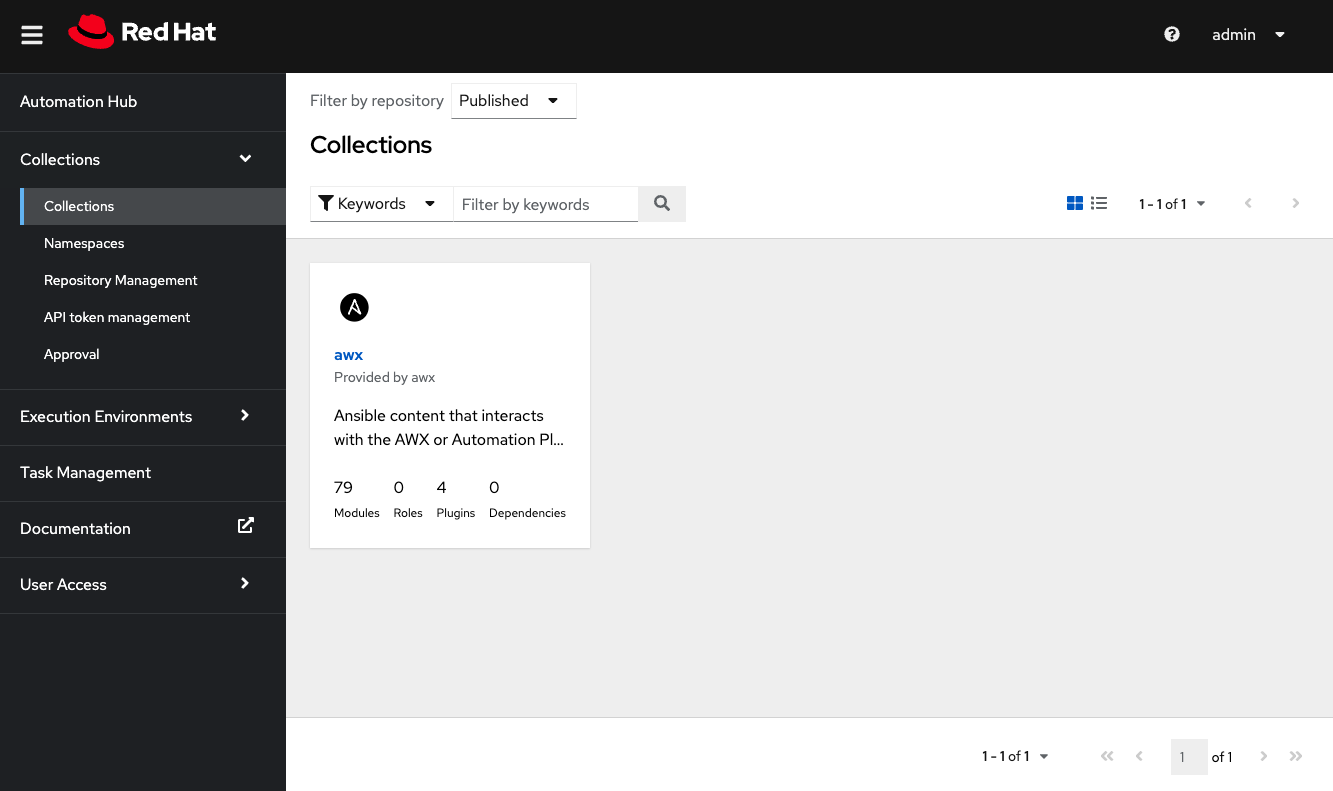
Importing a Collection using CLI
The ansible-galaxy CLI can be used to publish/import Collections as follows. Prerequisites are that you need your tarball file, the namespace pre-created in automation hub, your ansible.cfg configured for publish and access to ansible-galaxy cli.
Step 1
Create the namespace and configure the ansible.cfg to accept the upload. A tip here is after you have created the namespace, click on CLI configuration and copy the URL to your ansible.cfg, along with the token detail too that can be found on the remotes page.
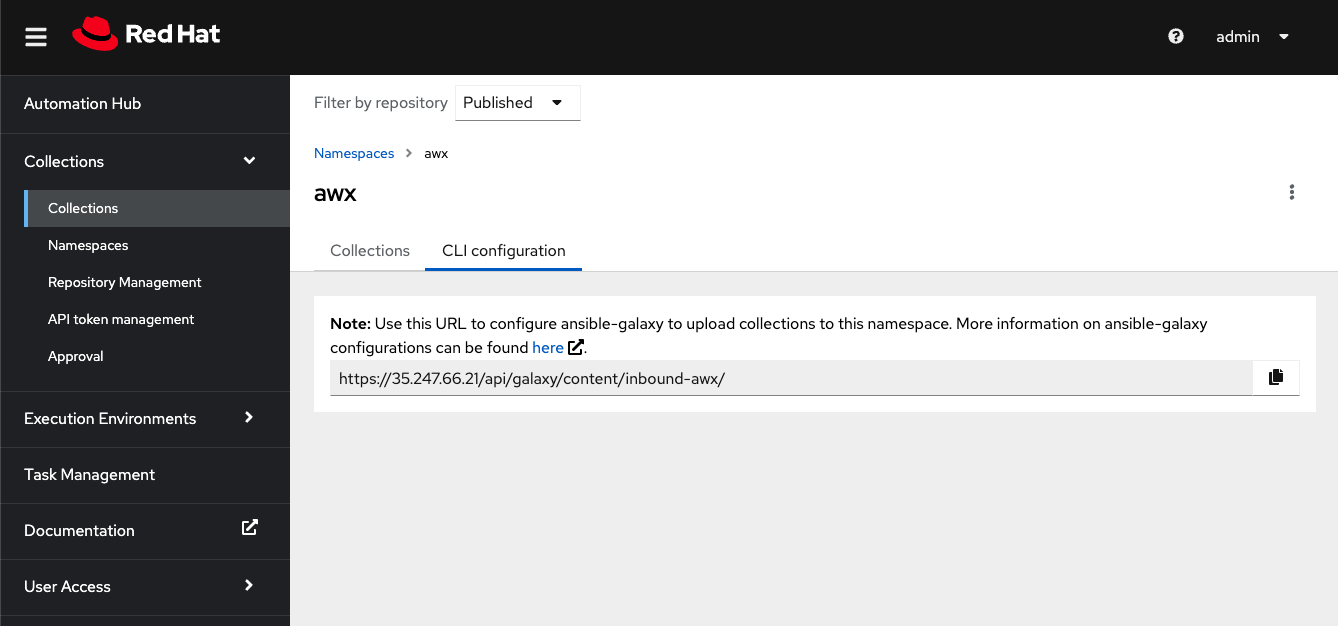
ansible.cfg as follows:
[galaxy]
server_list = staging_repo
[galaxy_server.staging_repo]
url=https://35.247.66.21/api/galaxy/content/inbound-awx/
token=1a38f6572ece08c6bf8ab9de8cdd1a122c3adf5a
Step 2
Run ansible-galaxy collection publish <name of tarball>
Example as follows:
[hubadmin@pah ~]$ ansible-galaxy collection publish awx-awx-21.6.0.tar.gz
Publishing collection artifact '/home/johnhardy/awx-awx-21.6.0.tar.gz' to staging_repo https://35.247.66.21/api/galaxy/content/inbound-awx/
Collection has been published to the Galaxy server staging_repo https://35.247.66.21/api/galaxy/content/inbound-awx/
Waiting until Galaxy import task https://35.247.66.21/api/galaxy/content/inbound-awx/v3/imports/collections/2ca6507c-13f9-40f3-bc47-c49e05aa1d52/ has completed
Collection has been successfully published and imported to the Galaxy server staging_repo https://35.247.66.21/api/galaxy/content/inbound-awx/
Post Import Task
Again, make sure approval is enabled to click on approval and either approve or reject the Collection import.
Completed Approved Collection
Importing a Collection via the API
Importing Collections using the API whilst can be technically achieved it is highly recommended to use the ansible-galaxy command line tool as described in the previous section.
When importing Collection, the ansible-galaxy cli sets up the task in automation hub and polls until it's done, none of which is done when using the API endpoint directly.
What can I do next?
Whether you are beginning your automation journey or a seasoned veteran, there are a variety of resources to enhance your automation knowledge:
- Self-paced exercises - We have interactive, in-browser exercises to learn and dive into Red Hat Ansible Automation Platform.
- Trial subscription - Are you ready to install on-premises? Get your own trial subscription for unlimited access to all the components of Ansible Automation Platform.
- Follow Red Hat Ansible Automation Platform on Twitter - Do you have questions or an automation project you want to show off? Tweet at us!
Sobre o autor
Mais como este
O paradoxo agêntico e o argumento a favor da IA híbrida
Pare de gerenciar o passado e comece a construir o futuro da TI
Technically Speaking | Inside open source AI strategy
Collaboration In Product Security | Compiler
Navegue por canal

Automação
Últimas novidades em automação de TI para empresas de tecnologia, equipes e ambientes

Inteligência artificial
Descubra as atualizações nas plataformas que proporcionam aos clientes executar suas cargas de trabalho de IA em qualquer ambiente

Nuvem híbrida aberta
Veja como construímos um futuro mais flexível com a nuvem híbrida

Segurança
Veja as últimas novidades sobre como reduzimos riscos em ambientes e tecnologias

Edge computing
Saiba quais são as atualizações nas plataformas que simplificam as operações na borda

Infraestrutura
Saiba o que há de mais recente na plataforma Linux empresarial líder mundial

Aplicações
Conheça nossas soluções desenvolvidas para ajudar você a superar os desafios mais complexos de aplicações

Virtualização
O futuro da virtualização empresarial para suas cargas de trabalho on-premise ou na nuvem
