

This is a guest post from Redis Labs. Vick Kelkar is a Global Technology Manager on Partnerships team at Redis Labs. In the last few years, he has focused on developing product and partnerships for microservice and platforms like OpenShift, PCF, PKS, Docker, and Kubernetes.
During the last few releases of Kubernetes, the Kubernetes community has managed to optimize the running of stateful applications by releasing new core primitives. For instance, the general availability of StatefulSet allows users to run stateful applications like databases on a Kubernetes and or Red Hat OpenShift cluster. OpenShift, Red Hat’s enterprise distribution of Kubernetes, has also introduced persistent volumes, which allow users to persist data across pod and/or service restarts. The introduction of the new core primitives allows OpenShift users to bring different application workloads onto a single OpenShift cluster. However, running complex use cases and or stateful applications via the built-in Kubernetes primitives continues to be a challenge.
Enter the Operator Framework
This is where the Kubernetes Operators come into the picture. Operators allow users to extend the Kubernetes primitives using custom resources and custom controllers. In May 2018, Red Hat released the Operator SDK as part of the Operator Framework. The Operator Framework essentially focuses on deploying and managing a stateful application by extending the Kubernetes application programming interfaces (APIs). The Operator SDK allows an application developer, such as a database vendor, to embed the domain-specific logic into the operator and extend the Kubernetes API. Red Hat has also included a few custom resources and operators in OpenShift release 3.11.
Why an Operator?
Operators are becoming a standard way of deploying complex stateful applications in Kubernetes. Redis Labs adopted the Operator Framework to enable our users to more efficiently deploy and manage the lifecycle of their Redis Enterprise clusters. The Operator Framework allowed us to introduce a Custom Resource Definition (CRD) called redisenterprisecluster or rec. The custom controller, which is a Redis Enterprise operator written in the Go programming language, allows us to embed application-specific lifecycle management logic into the operator. Using the operator, we are able to validate the state of the Redis Enterprise cluster.
OpenShift Specific Features
We take advantage of the multi-tenancy features offered by projects in the OpenShift platform and use the security context constraint it provides. We have published our sample security context constraint (SCC) deployment files for the OpenShift platform. Additionally, our Redis Enterprise and operator images are in Red Hat’s OpenShift container registry.
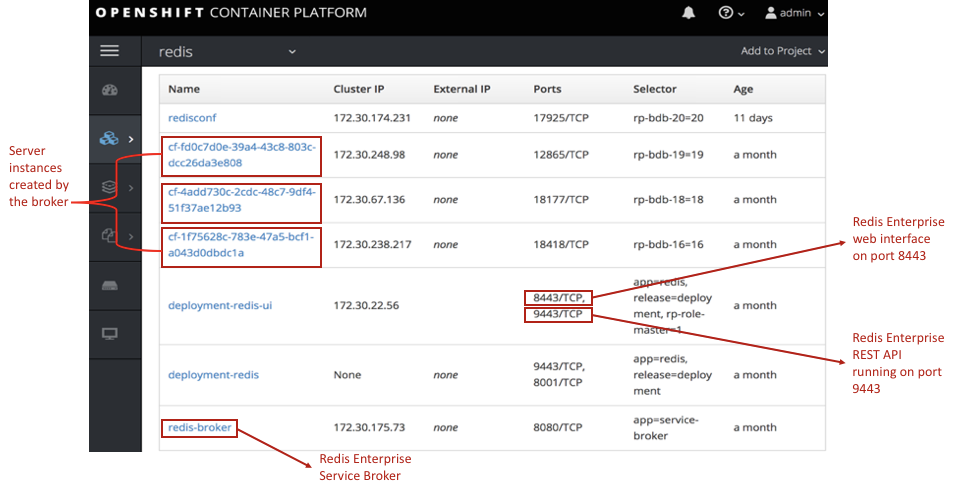
Figure 1: Redis Enterprise on the OpenShift container platform
Since adopting the Operator Framework, we continued to work with Red Hat to continually improve and enhance solutions like an ingress controller, which we currently plan to integrate with the OpenShift router.
Resources:
- Download the Operator-based deployment files for OpenShift here
- Learn How to Install Redis Enterprise Clusters Using Operators on OpenShift here
- Learn More about the Operator Framework here
- Find more Community Operators here
If you have any further questions, please don’t hesitate to contact one of our Redis experts.
Sobre el autor
Red Hatter since 2018, technology historian and founder of The Museum of Art and Digital Entertainment. Two decades of journalism mixed with technology expertise, storytelling and oodles of computing experience from inception to ewaste recycling. I have taught or had my work used in classes at USF, SFSU, AAU, UC Law Hastings and Harvard Law.
I have worked with the EFF, Stanford, MIT, and Archive.org to brief the US Copyright Office and change US copyright law. We won multiple exemptions to the DMCA, accepted and implemented by the Librarian of Congress. My writings have appeared in Wired, Bloomberg, Make Magazine, SD Times, The Austin American Statesman, The Atlanta Journal Constitution and many other outlets.
I have been written about by the Wall Street Journal, The Washington Post, Wired and The Atlantic. I have been called "The Gertrude Stein of Video Games," an honor I accept, as I live less than a mile from her childhood home in Oakland, CA. I was project lead on the first successful institutional preservation and rebooting of the first massively multiplayer game, Habitat, for the C64, from 1986: https://neohabitat.org . I've consulted and collaborated with the NY MOMA, the Oakland Museum of California, Cisco, Semtech, Twilio, Game Developers Conference, NGNX, the Anti-Defamation League, the Library of Congress and the Oakland Public Library System on projects, contracts, and exhibitions.
Más como éste
Gestión de máquinas virtuales en Red Hat OpenShift con Service Mesh
¿No puedes aplicar parches con la suficiente rapidez? La confianza cero como última línea de defensa
Scaling with Orchestrators | Compiler
Container Roundup | Compiler
Navegar por canal

Automatización
Las últimas novedades en la automatización de la TI para los equipos, la tecnología y los entornos

Inteligencia artificial
Descubra las actualizaciones en las plataformas que permiten a los clientes ejecutar cargas de trabajo de inteligecia artificial en cualquier lugar

Nube híbrida abierta
Vea como construimos un futuro flexible con la nube híbrida

Seguridad
Vea las últimas novedades sobre cómo reducimos los riesgos en entornos y tecnologías

Edge computing
Conozca las actualizaciones en las plataformas que simplifican las operaciones en el edge

Infraestructura
Vea las últimas novedades sobre la plataforma Linux empresarial líder en el mundo

Aplicaciones
Conozca nuestras soluciones para abordar los desafíos más complejos de las aplicaciones

Virtualización
El futuro de la virtualización empresarial para tus cargas de trabajo locales o en la nube
