
Red Hat Enterprise Linux (RHEL) gets updates and support through a subscription service. There are different subscription levels, and which you choose depends on the purpose of a particular system. For a cluster of mission-critical servers, you'd obviously invest in Red Hat support, while for a test server you might choose self-support.
Regardless of what level of support you invest in, it's important to register the computer running RHEL so that you can manage it from your central Red Hat account and you receive important software updates.
[ Free download: Advanced Linux commands cheat sheet. ]
Register RHEL during installation
The first chance you get to register your RHEL operating system (OS) is during installation.
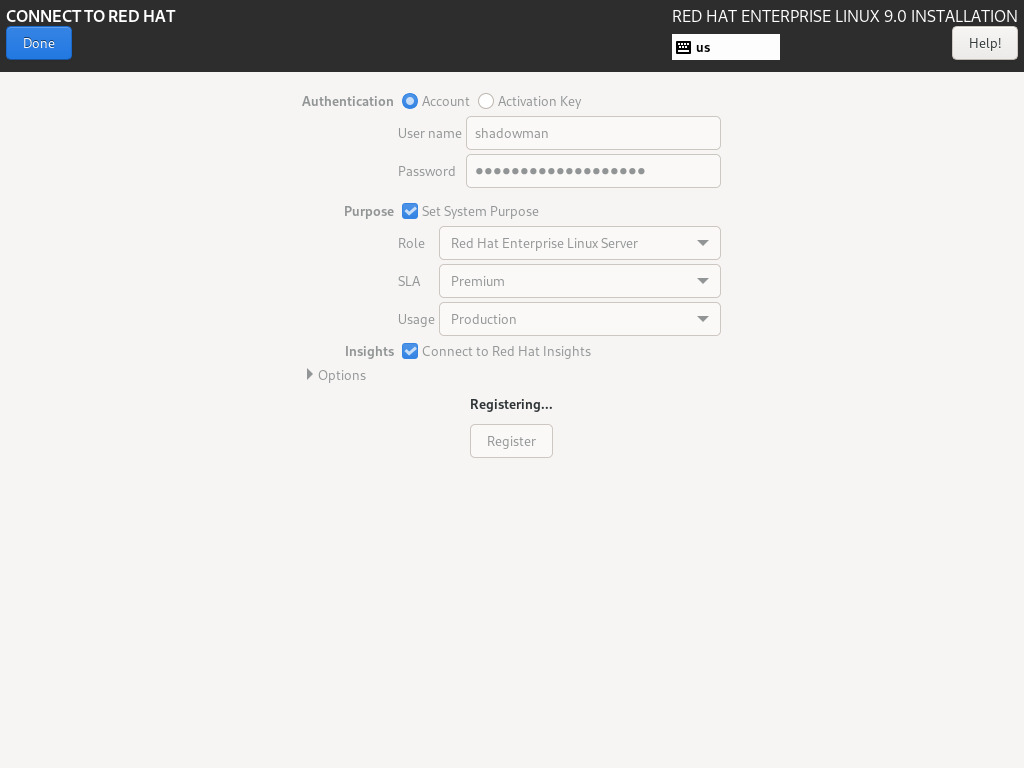
Once a system is attached to your account, you can set the system's purpose. This is a useful way to influence what kinds of software repositories are activated for you, and what kinds of updates are significant to that computer.
This is an easy way to get your system registered early, and it means some sensible defaults are set once you're ready to use your new OS for the first time.
Register in the terminal
Using the subscription-manager command, you can register a new RHEL system with the register subcommand along with your Red Hat account username:
$ sudo subscription-manager register --username shadowman
Define the system's purpose
Once you've attached a computer to your Red Hat account, you can also define that system's purpose. This can help you organize your own data about your active machines, but it also helps the OS make intelligent decisions about some system preferences. For instance, if you set a purpose of "Red Hat Enterprise Linux Server," then a subscription for that role is used when auto-attaching subscriptions.
First, look at your current settings. There may not be any, depending on who installed the OS and what information they configured during that process. My system was configured in advance, so my terminal returns this:
$ sudo subscription-manager syspurpose
[sudo] password for shadowman:
{
  "addons": [],
  "role": "Red Hat Enterprise Linux Workstation",
  "service_level_agreement": "Premium",
  "usage": "Production"
}
There are four attributes to a system's purpose: addons, role, service-level, and usage. You can use any of these key terms to see the options available for them. For instance, to see available options for the system's role:
$ sudo subscription-manager syspurpose role --list
[sudo] password for shadowman:
+-------------------------------------------+
               Available role
+-------------------------------------------+
 - Red Hat Enterprise Linux Workstation
 - Red Hat Enterprise Linux Server
 - Red Hat Enterprise Linux Compute Node
What's available depends, in part, on your service level agreement (SLA). If you're using RHEL with self-support only, then the only usage setting available is "Development/Test." If you want to increase your level of support, log into the Red Hat website or speak to sales.
[ Free online course: Red Hat Enterprise Linux technical overview. ]
To set a value for system purpose, use the --set option:
$ sudo subscription-manager syspurpose role --set \
"Red Hat Enterprise Linux Server"

[sudo] password for shadowman:
role set to "Red Hat Enterprise Linux Server".
Manage systems
When you're responsible for any number of computers, it's important to understand how they're being maintained and updated. Using the Subscription Manager ensures that your computers are visible to your team and that mission-critical machines are signed up for vital updates. Whether you interact with subscriptions at installation, from the terminal, or through Cockpit, Subscription Manager is an important component of a well-organized fleet.
저자 소개
Seth Kenlon is a Linux geek, open source enthusiast, free culture advocate, and tabletop gamer. Between gigs in the film industry and the tech industry (not necessarily exclusive of one another), he likes to design games and hack on code (also not necessarily exclusive of one another).
유사한 검색 결과
Red Hat Enterprise Linux Long-Life Add-On: 지원 종료 걱정 없는 RHEL 소개
인프라를 Red Hat Lightspeed에 어떻게 연결해야 할까요?
Infrastructure At The Edge | Compiler
Operating System Management | Compiler
채널별 검색

오토메이션
기술, 팀, 인프라를 위한 IT 자동화 최신 동향

인공지능
고객이 어디서나 AI 워크로드를 실행할 수 있도록 지원하는 플랫폼 업데이트

오픈 하이브리드 클라우드
하이브리드 클라우드로 더욱 유연한 미래를 구축하는 방법을 알아보세요

보안
환경과 기술 전반에 걸쳐 리스크를 감소하는 방법에 대한 최신 정보

엣지 컴퓨팅
엣지에서의 운영을 단순화하는 플랫폼 업데이트

인프라
세계적으로 인정받은 기업용 Linux 플랫폼에 대한 최신 정보

애플리케이션
복잡한 애플리케이션에 대한 솔루션 더 보기

가상화
온프레미스와 클라우드 환경에서 워크로드를 유연하게 운영하기 위한 엔터프라이즈 가상화의 미래
