
Red Hat and Cockroach Labs have been working together to perform a survey of 202 enterprise architects, CTOs and senior grade engineers. The goal has been to determine how they are using Kubernetes, and where they are in their adoption journey. Of those 202 surveyed, 94% were using Kubernetes, but it's how they use it where things start to diverge.
For those users of Kubernetes, 46% said that data-intensive workloads are their first priority in Kubernetes, and almost half of those folks said that transactional workloads were a concern. Another priority was the migration of complex workloads, which was cited by 44% of those in the survey.
And while the road to cloud is often paved with SaaS, of the 202 respondents, 95% said they manage their own cloud IT infrastructure. Beyond that layer of the digital transformation, 88% of our surveyed respondents said that they were embracing serverless workloads and infrastructure as well. Of that number, 39% are already using serverless, while 49% indicated that they are planning to adopt it in the future.
Just over half of those in our survey said they were actively working on their migration to a multi-cloud infrastructure, while 15% have no plans, and the rest are expecting to be using multi-cloud within 3 to 12 months.

While the traditional wisdom about cloud-based computing has been that transactional databases aren’t the sort to be cloud-ified, it turns out that 59% of the folks in our survey who are using transactional and analytic workloads in their Kubernetes installations. 28% are running transactional only, and 13% are running analytical workloads only.
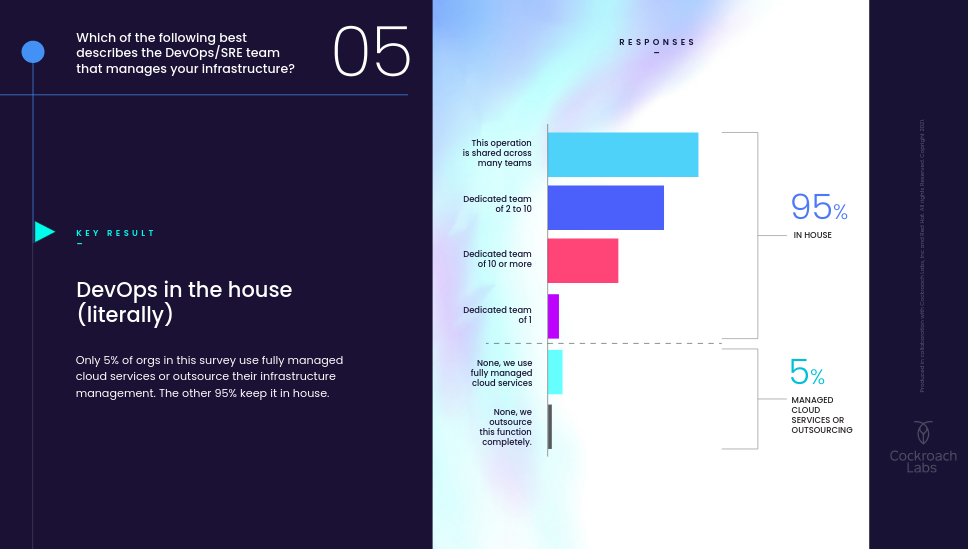
Teams are also showing that managing Kubernetes internally is the preferred way to run it. 95% of those in the survey said they manage their own Kubernetes, with 5% saying they outsource their management.
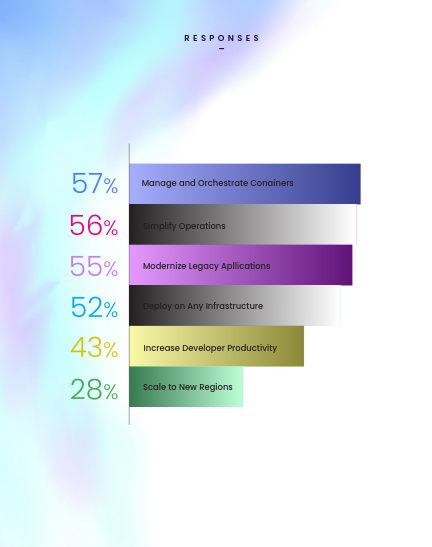
When we straight out asked why these users were adopting Kubernetes, the answers they gave were clustered together fairly well. Management and orchestration of containers is a noble goal to which most of our respondents aspired, but at 57% it was only barely above other goals, like simplifying operations, modernizing legacy applications and easing deployment across infrastructure.
If you’d like to learn more about the results and what other organizations are planning to do on Kubernetes, register for the Kubernetes Adoption Trends Webinar happening on 9/15.
If you’d like to see more of the results from this survey, head over to the survey results page and register to get the info.
Sobre o autor

Red Hatter since 2018, technology historian and founder of The Museum of Art and Digital Entertainment. Two decades of journalism mixed with technology expertise, storytelling and oodles of computing experience from inception to ewaste recycling. I have taught or had my work used in classes at USF, SFSU, AAU, UC Law Hastings and Harvard Law.
I have worked with the EFF, Stanford, MIT, and Archive.org to brief the US Copyright Office and change US copyright law. We won multiple exemptions to the DMCA, accepted and implemented by the Librarian of Congress. My writings have appeared in Wired, Bloomberg, Make Magazine, SD Times, The Austin American Statesman, The Atlanta Journal Constitution and many other outlets.
I have been written about by the Wall Street Journal, The Washington Post, Wired and The Atlantic. I have been called "The Gertrude Stein of Video Games," an honor I accept, as I live less than a mile from her childhood home in Oakland, CA. I was project lead on the first successful institutional preservation and rebooting of the first massively multiplayer game, Habitat, for the C64, from 1986: https://neohabitat.org . I've consulted and collaborated with the NY MOMA, the Oakland Museum of California, Cisco, Semtech, Twilio, Game Developers Conference, NGNX, the Anti-Defamation League, the Library of Congress and the Oakland Public Library System on projects, contracts, and exhibitions.
Mais como este
Stop managing the past and start building IT’s future
The agentic paradox and the case for hybrid AI
You Can’t Automate Expectations | Code Comments
Can Kubernetes Help People Find Love? | Compiler
Navegue por canal

Automação
Últimas novidades em automação de TI para empresas de tecnologia, equipes e ambientes

Inteligência artificial
Descubra as atualizações nas plataformas que proporcionam aos clientes executar suas cargas de trabalho de IA em qualquer ambiente

Nuvem híbrida aberta
Veja como construímos um futuro mais flexível com a nuvem híbrida

Segurança
Veja as últimas novidades sobre como reduzimos riscos em ambientes e tecnologias

Edge computing
Saiba quais são as atualizações nas plataformas que simplificam as operações na borda

Infraestrutura
Saiba o que há de mais recente na plataforma Linux empresarial líder mundial

Aplicações
Conheça nossas soluções desenvolvidas para ajudar você a superar os desafios mais complexos de aplicações

Virtualização
O futuro da virtualização empresarial para suas cargas de trabalho on-premise ou na nuvem
