
This blog post was contributed by Craig Peters, Director of Product at JFrog.
Red Hat OpenShift is an enterprise-grade platform designed to automate the build, deployment, scaling, and management of container applications on Kubernetes. It allows development teams to focus on software innovation, while enabling them to build and deliver them faster.
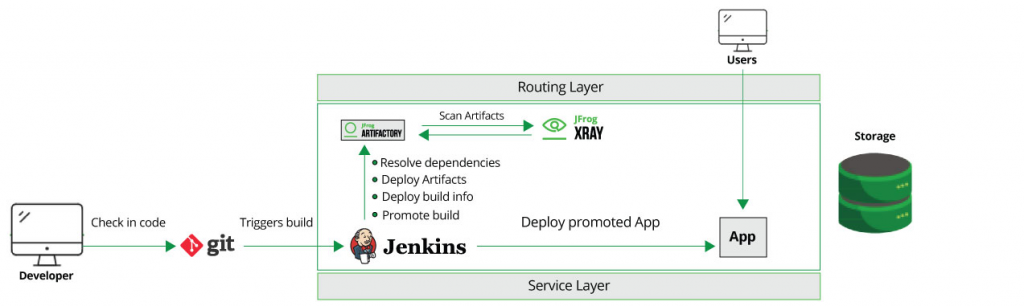
Back in January of this year, we announced the integration of JFrog Artifactory with OpenShift, the repository manager, with the Red Hat OpenShift Container platform for Kubernetes. Together they provide developers a way to help streamline and optimize their CI/CD workflow from source to Kubernetes cluster.
The August release of Artifactory 6.2 can make it easier to take advantage of the benefits Artifactory offers to the OpenShift Container platform by removing the setup constraint initially encountered when utilizing Artifactory with Red Hat OpenShift. The Artifactory Docker containers can now be installed and operate under an Artifactory user and no longer requires root access. This means you no longer need to be a cluster administrator to install Artifactory.
So now you can use Artifactory as your Kubernetes registry to identify and deploy artifacts into your OpenShift Online continuous integration (CI) environment.
Why Use Artifactory

JFrog’s Artifactory can play the artifact registry role that can help make the DevOps pipeline more scalable, flexible, accessible and reliable.
Artifactory can free your Red Hat OpenShift deployment’s dependency on network speed or connection to external resources. By caching binaries downloaded from external public repositories (such as the Red Hat Container Catalog, the Red Hat RPM repository, Docker Hub or npmjs.com), binaries and Docker images for containerized microservices can be drawn locally from Artifactory for distribution. And by managing these dependencies in a private repository you have the ability to gain visibility and governance over what open source and third party packages you’re using.
Installation
Templates available on JFrog’s GitHub repository can make deployment of both Artifactory and Xray with OpenShift Container Platform easier to get started.
With the release of Artifactory 6.2, cluster administrator rights are no longer required, enabling its use on OpenShift Online.
Build Promotion
Artifactory’s Build Promotion feature helps you to stage different versions of each application for DevOps stages (such as for development, testing, or production) that share the same service layer. Keeping these in a single OpenShift namespace helps deploy the right version for each audience, which can make the validation tasks more effective and safer.

Package Management
Artifactory integrates with the Red Hat OpenShift ecosystem to support end-to-end binary management that is designed to overcome the complexity of working with different software package management systems, like Docker, npm, rpm and Maven helping to provide greater consistency to your CI/CD workflow.
Protection Capabilities from Vulnerabilities
Using Xray with Artifactory helps alert developers to security issues in their applications, so that Artifactory can quarantine them within testing stages.
Xray scans binaries to find potential vulnerabilities and tags them with metadata to identify those issues. Artifactory can then use that metadata to aid developers in tracing the offending CI job, identify how many microservices are impacted, and help prevent the damage from spreading to other vulnerable components.
Start a Trial
These are just a few of the ways that JFrog Artifactory can bring enterprise-grade repository management to your Red Hat OpenShift cluster to help optimize your CI/CD workflow.
You can download a trial from JFrog and try the new Java and JavaScript samples for Red Hat OpenShift to see how it works.
Sobre el autor
Más como éste
Gestión de máquinas virtuales en Red Hat OpenShift con Service Mesh
¿No puedes aplicar parches con la suficiente rapidez? La confianza cero como última línea de defensa
Scaling with Orchestrators | Compiler
Container Roundup | Compiler
Navegar por canal

Automatización
Las últimas novedades en la automatización de la TI para los equipos, la tecnología y los entornos

Inteligencia artificial
Descubra las actualizaciones en las plataformas que permiten a los clientes ejecutar cargas de trabajo de inteligecia artificial en cualquier lugar

Nube híbrida abierta
Vea como construimos un futuro flexible con la nube híbrida

Seguridad
Vea las últimas novedades sobre cómo reducimos los riesgos en entornos y tecnologías

Edge computing
Conozca las actualizaciones en las plataformas que simplifican las operaciones en el edge

Infraestructura
Vea las últimas novedades sobre la plataforma Linux empresarial líder en el mundo

Aplicaciones
Conozca nuestras soluciones para abordar los desafíos más complejos de las aplicaciones

Virtualización
El futuro de la virtualización empresarial para tus cargas de trabajo locales o en la nube
