
Maybe you’re planning your migration right now, or you’ve done it (congratulations!) Joining industry leaders in the strategic move to Red Hat OpenShift Virtualization gives you the best of both worlds: The operational familiarity of a virtual machine (VM) combined with the agility and scalability of a Kubernetes-native platform. You're running critical workloads in a modern, efficient way. But have you stopped to ask the crucial question: "How are we protecting them?"
If your answer involves traditional, hypervisor-level backup tools, you might have a significant gap in your data protection strategy. The simple truth is that a VM running on OpenShift is fundamentally different from one on a legacy hypervisor, and it demands a modern approach to backup and recovery.
Why old backup models break
In a traditional virtualization stack, a VM is a relatively self-contained unit. Backing it up usually meant taking an agent-based or hypervisor-level snapshot of a VMDK or VHDX file on a datastore. Simple enough.
But in OpenShift Virtualization, a VM is much more than a virtual disk file. It's a composite application defined by a collection of interdependent Kubernetes resources. This includes the VirtualMachineInstance (VMI) itself, its DataVolumesand PersistentVolumeClaims (PVCs), along with associated ConfigMaps, Secrets, and network services that allow it to function.
Backing up only the persistent volume is like saving your car's engine but throwing away the chassis, wheels, and control system. You have a critical component, but you can't actually rebuild the car. To ensure true recoverability, you must capture the entire application context, and that's where legacy tools fall short.
A solution for a modern platform
If you’ve read my previous post, then you’re already familiar with NetApp’s certified OpenShift operator for Trident. Building on that foundation, they’ve sought to solve the challenge of VM backup with the technology preview of NetApp Backup and Recovery. This offering delivers a true, application-centric data protection solution for OpenShift VMs as first-class citizens, along with the rest of your containerized applications.
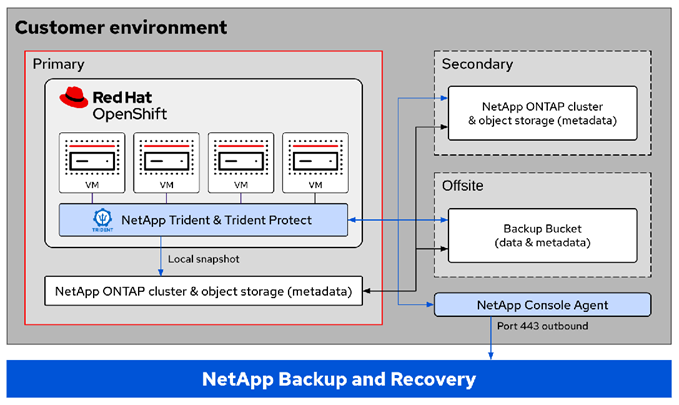
Instead of trying to refit existing methods into a new paradigm, NetApp Backup and Recovery was designed to be Kubernetes-native. Here's why that matters for your OpenShift Virtualization environment:
- Application aware: NetApp understands that your VM is a collection of Kubernetes resources. It intelligently discovers and backs up every required component, ensuring a consistent and complete capture of the entire application. When you need to restore, you get back a fully functional VM, not just a disk image.
- Resource friendly: Many powerful Kubernetes backup tools leverage open source data movers like Restic or Kopia to manage data protection within the cluster. NetApp Backup and Recovery provides a different architectural advantage by integrating with NetApp's SnapMirror technology, which offloads all the heavy lifting of data movement to the storage layer, preserving your cluster's compute resources for your applications.
- Centralized management: As you scale, managing protection across multiple OpenShift clusters can become a headache. NetApp Backup and Recovery provides a unified, SaaS-based control plane to define policies and manage backup and recovery operations across your entire hybrid cloud estate from a single interface.
Protect your investment, achieve resilience
OpenShift Virtualization modernizes and future-proofs your infrastructure. Your data protection strategy needs to be just as advanced. By pairing the power of OpenShift with the intelligent, storage-integrated protection of NetApp Backup and Recovery, you get a solution that respects your new architecture, helping to ensure your critical VM workloads are secure, resilient, and always recoverable.
Further discovery
To hear more about this solution, listen to Red Hat's Peter Lauterbach and NetApp's Bhavin Shah deliver a joint presentation at NetApp Insight 2025, where they take a deep dive into this exact topic.
You can also get hands-on experience:
- Explore and deploy Red Hat OpenShift Virtualization
- Ensure your storage is connected with NetApp Trident
- Take NetApp Backup and Recovery for a spin
See for yourself how simple and powerful protecting your modern workloads can be.
Recurso
Quince motivos para adoptar Red Hat OpenShift Virtualization
Sobre el autor
Shane Heroux is a Principal Engineering Partner Manager at Red Hat, working at the intersection of open technology and partner ecosystems. His first Linux install was Slackware in the mid-'90s, where he found something bigger than software: a way of building things together that actually holds up.
Since joining Red Hat in 2018, he's worked across hybrid cloud, AI, and modernization efforts, translating technical complexity into outcomes that make sense for partners and customers. He works across product, engineering, and alliance leadership to align partner capabilities with what customers are actually trying to do, helping organizations build architectures that are open, adaptable, and built to last.
His approach combines technical depth with systems thinking and a humanities instinct. Open collaboration doesn't just scale platforms; it makes the whole ecosystem more useful.
Más como éste
Maneras en que la recuperación automatizada de nodos protege la integridad de los datos
Razones por las que se sigue posponiendo la decisión sobre la virtualización
Virtualization Is (Still) King | Compiler
Navegar por canal

Automatización
Las últimas novedades en la automatización de la TI para los equipos, la tecnología y los entornos

Inteligencia artificial
Descubra las actualizaciones en las plataformas que permiten a los clientes ejecutar cargas de trabajo de inteligecia artificial en cualquier lugar

Nube híbrida abierta
Vea como construimos un futuro flexible con la nube híbrida

Seguridad
Vea las últimas novedades sobre cómo reducimos los riesgos en entornos y tecnologías

Edge computing
Conozca las actualizaciones en las plataformas que simplifican las operaciones en el edge

Infraestructura
Vea las últimas novedades sobre la plataforma Linux empresarial líder en el mundo

Aplicaciones
Conozca nuestras soluciones para abordar los desafíos más complejos de las aplicaciones

Virtualización
El futuro de la virtualización empresarial para tus cargas de trabajo locales o en la nube
