
Having a grasp of common architectural patterns is essential to designing software architecture at scale. Using them not only saves time but also ensures a reliable implementation of your design. There’s no need to reinvent the wheel when there’s an architectural pattern available that applies to an architecture you’re developing.
The following is a brief overview of the CQRS architectural pattern.
[ Download An architect's guide to multicloud infrastructure. ]
Understanding the CRQS pattern
The Command Query Responsibility Segregation (CQRS) pattern separates a service’s write tasks from its read tasks. While reading and writing to the same database is acceptable for small applications, distributed applications operating at web-scale require a segmented approach. Typically there’s more read activity than write activity. Also, read activity is immutable. Thus, replicas dedicated to reading data can be spread out over a variety of geolocations. This approach allows users to get the data that closest to them. The result is a more efficient enterprise application.
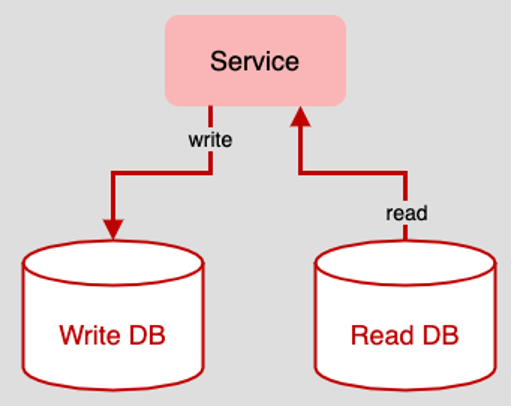
Separating write from read activity also allows Enterprise Architects to create a variety of read databases, with each database optimized for a specific purpose.
Pros
- Separating write activity from ready activities allows you to use the best database technology for the task at hand, for example, a SQL database for writing and a non-SQL database for reading.
- Read activity tends to be more frequent than writing, thus you can reduce response latency by placing read data sources in strategic geolocations for better performance.
- Separating write from read activity leads to more efficient scaling of storage capacity based on real-world usage.
Cons
- Supporting the CQRS pattern requires expertise in a variety of database technologies.
- Using the CQRS patterns means that more database technologies are required hence there is more inherent cost either in terms of hardware or if a cloud provider is used, utilization expense.
- Ensuring data consistency requires special consideration in terms of Service Level Agreements (see the CAP theorem).
- Using a large number of databases means more points of failure, thus companies need to have comprehensive monitoring and fail-safety mechanisms in place to provide adequate operation
[ A free guide from Red Hat: The automation architect's handbook. ]
Putting it all together
CQRS is a popular architecture pattern because it addresses a common problem to most enterprise applications. Separating write behavior from read behavior, which the essence of the CQRS architectural pattern, provides stability and scalability to enterprise applications while also improving overall performance. Choose it for those times when contention over read and write access overwhelms your systems and you're willing to make the investment that's necessary to address the issue. For a deeper dive, read our illustrated guide to CQRS.
Sobre el autor
Bob Reselman is a nationally known software developer, system architect, industry analyst, and technical writer/journalist. Over a career that spans 30 years, Bob has worked for companies such as Gateway, Cap Gemini, The Los Angeles Weekly, Edmunds.com and the Academy of Recording Arts and Sciences, to name a few. He has held roles with significant responsibility, including but not limited to, Platform Architect (Consumer) at Gateway, Principal Consultant with Cap Gemini and CTO at the international trade finance company, ItFex.
Más como éste
Red Hat Learning Subscription Course reinventa la formación virtual
Red Hat Learning Subscription: aprendizaje continuo para tu equipo
Container Roundup | Compiler
Untangling Networks | Compiler
Navegar por canal

Automatización
Las últimas novedades en la automatización de la TI para los equipos, la tecnología y los entornos

Inteligencia artificial
Descubra las actualizaciones en las plataformas que permiten a los clientes ejecutar cargas de trabajo de inteligecia artificial en cualquier lugar

Nube híbrida abierta
Vea como construimos un futuro flexible con la nube híbrida

Seguridad
Vea las últimas novedades sobre cómo reducimos los riesgos en entornos y tecnologías

Edge computing
Conozca las actualizaciones en las plataformas que simplifican las operaciones en el edge

Infraestructura
Vea las últimas novedades sobre la plataforma Linux empresarial líder en el mundo

Aplicaciones
Conozca nuestras soluciones para abordar los desafíos más complejos de las aplicaciones

Virtualización
El futuro de la virtualización empresarial para tus cargas de trabajo locales o en la nube
