
Sometimes as admins, we need to share files across systems quickly. For whatever reason, we need to get a single tar or conf file from one system to another, or maybe copy a group of files between systems. We find that we need to install a package or utility to share the files, or we may need to enable a feature to share the content. Regardless of the situation, we can use Python's SimpleHTTPServer module as a quick web server.
Python -m SimpleHTTPServer
The SimpleHTTPServer module is a Python module that enables a developer to lay the foundation for developing a web server. However, as sysadmins, we can use the module to serve files from a directory.
Usage
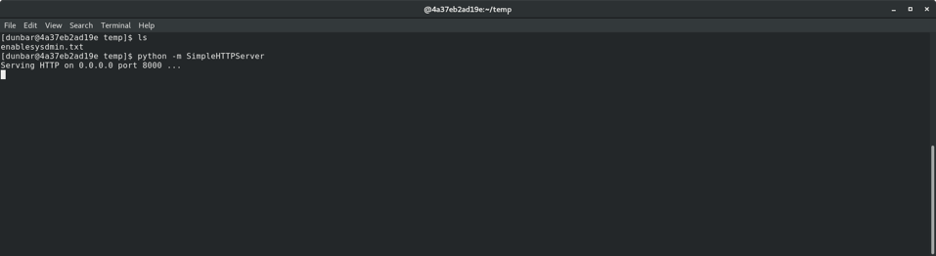
Python must be installed to use the SimpleHTTPServer module. Python may be installed as a dependency to an application or service that is already running on the system. Run python -V to verify its presence. To use the module for our purposes, run the following command from the directory with the files we want to share:
python -m SimpleHTTPServer
* Note: The module has been renamed http.server in python3
The module loads and serves any files within the directory on port 8000 by default.
From the remote system, browse to http://<ip> using your browser of choice. A directory listing will be displayed where you can open or download any file.

Another option is to use wget or curl to download the files to the remote system.
wget http://<ip>:8000/filename
curl http://<ip>:8000/filename
This simple local HTTP server is a nice little utility to use in those times when you need to transfer files quickly across systems.
Use cases
This tip is not a replacement for actual file-hosting solutions in business environments. The SimpleHTTPServer module is actually a development tool used as a framework tool to lay the foundation for a full-blown web server with all the necessary security features included. However, we can use the module for our purposes to:
- Quickly serve kickstart files in a pinch - Copy the
/root/anaconda-ks.cfgor/root/original-ks.cfgto a folder and serve withpython -m SimpleHTTPServer. Edit the grub config at boot, and away you go. - Share a file to/from a VM - Copy a file to a folder and serve with
python -m SimpleHTTPServer. - Serve a file on an allowed port of firewall - Copy a file to a folder and serve with
python -m SimpleHTTPServer port
Other options
You can also use a while loop with ncat or /dev/tcp/host/port for transport… but that is another article. I hope you find this option a useful tool in your toolbox.
Gotchas
You may need to open ports in your firewall:
# firewall-cmd --add-port=portnumber/tcp
[ Download now: A sysadmin's guide to Bash scripting. ]
À propos de l'auteur
Stephen Wilson is a Principal Architect at Red Hat and a seasoned subject matter expert who thrives at the intersection of open source innovation and mission-critical stability. With a career built on the bedrock of Red Hat Enterprise Linux, Stephen navigates the complexities of modern IT—from orchestrating massive Red Hat OpenShift deployments to streamlining legacy workloads through modern virtualization strategies.
As a strategic guide for organizations, Stephen helps enterprise architects and IT operations leaders bridge the gap between on-premises reliability and cloud agility. His approach focuses on building secure, scalable systems that allow customers to realize the full value of their technology investment. Whether he is hardening information systems or helping teams evolve toward cloud-native ecosystems, Stephen is committed to mentorship and sharing the expertise that comes directly from the source.
A dedicated family man, Stephen lives with his wife and three children. He finds that the principles of a good architect—patience, clear communication, and handling a bit of chaos—apply just as much to parenting as they do to a Kubernetes cluster.
Plus de résultats similaires
Red Hat Enterprise Linux Long-Life Add-On : votre solution RHEL sans date de fin prédéterminée
Comment votre infrastructure doit-elle se connecter à Red Hat Lightspeed ?
Infrastructure At The Edge | Compiler
Operating System Management | Compiler
Parcourir par canal

Automatisation
Les dernières nouveautés en matière d'automatisation informatique pour les technologies, les équipes et les environnements

Intelligence artificielle
Actualité sur les plateformes qui permettent aux clients d'exécuter des charges de travail d'IA sur tout type d'environnement

Cloud hybride ouvert
Découvrez comment créer un avenir flexible grâce au cloud hybride

Sécurité
Les dernières actualités sur la façon dont nous réduisons les risques dans tous les environnements et technologies

Edge computing
Actualité sur les plateformes qui simplifient les opérations en périphérie

Infrastructure
Les dernières nouveautés sur la plateforme Linux d'entreprise leader au monde

Applications
À l’intérieur de nos solutions aux défis d’application les plus difficiles

Virtualisation
L'avenir de la virtualisation d'entreprise pour vos charges de travail sur site ou sur le cloud
