To build on investing in the right things, at the right time, the enterprise should prioritize top strategic initiatives within the enterprise portfolio. Using data to inform prioritization decisions is key. Executives and senior leaders want top initiatives to align to strategy, objectives, measurable business outcomes and financial factors (defined in the business case, which was covered in my previous post).
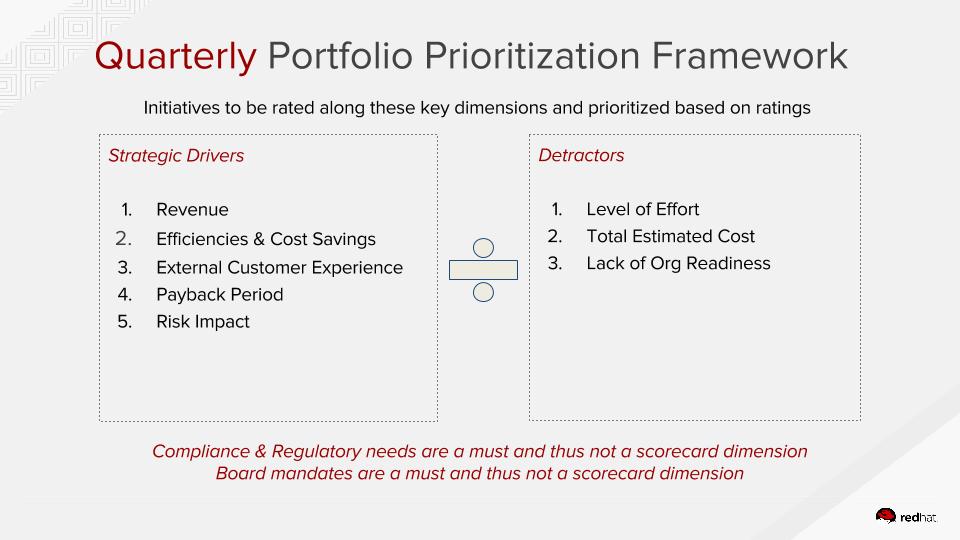
A Prioritization Scorecard calculates priority data that is needed to inform decisions, which are strategic drivers, or key values that align to strategic goals, and detractor information, key values that take away from the project. The data attributes for the key values should be taken directly from the business case. The key outcome is using this scorecard data to generate collective buy-in from senior leadership on top strategic priorities.
Table 1 below will help to model strategic drivers as examples of how the enterprise can build a Prioritization Scorecard:
Table 1
| Scorecard Measures | Driver 1 | Driver 2 | Range 3 |
| Definition - Use for the defining the meaning of the driver. | Definition | Definition | Definition |
| Measure - Use for defining the how the driver will be measured. | Measure | Measure | Measure |
| Range - Use for defining the normalized range for a quantifiable score (keep it simple, eg. 1-3) | Range | Range | Range |
| Initiative 1 | Score (1-3) | Score (1-3) | Score (1-3) |
| Initiative 2 | Score (1-3) | Score (1-3) | Score (1-3) |
Example Drivers include:
- Revenue - Does the program generate net new revenue?
- Cost Savings - Does Initiative automate processes to promote business efficiencies?
- Customer Experience - Does the Initiative affect external customer experience?
- Payback Period - How long will it take for benefits to exceed to the initial investment cost?
- Risk Impact - What is the key impact to the business if the project is not worked on? There can be any of a variety of reasons, such as risk avoidance, loss of revenue, increased costs, or company exposure.
Table 2 below helps to model the detractors as examples of how the enterprise can further build out the Prioritization Scorecard:
Table 2
| Scorecard Measures | Detractor 1 | Detractor 2 | Detractor 3 |
| Definition - Use for the defining the meaning of the detractor. | Definition | Definition | Definition |
| Measure - Use for defining the how the detractor will be measured. | Measure | Measure | Measure |
| Range - Use for defining the normalized range for a quantifiable score (keep it simple, eg. 1-3) | Range | Range | Range |
| Initiative 1 | Score (1-3) | Score (1-3) | Score (1-3) |
| Initiative 2 | Score (1-3) | Score (1-3) | Score (1-3) |
Example Detractors include:
- Level of Effort - Time taken to complete the initiative
- Estimate Costs - Total estimated cost of delivering the solution plus estimated ongoing operational expenses over a 3-5 year period
- Lack of Organizational Readiness - Initiative is able to complete successfully in terms of resourcing capacity (people, infrastructure, environment)
To score the prioritization, take the Driver's total score divided by the Detractor’s total score. That’s the priority score.
The higher the priority score, the higher the initiative priority with the portfolio of work. The prioritization scorecard data will ensure the right initiatives are prioritized, utilizing finite budgets, resources and timelines. Using this data-driven approach to prioritization will solicit leadership agreement for the enterprise portfolio.
Other Posts in the Series
- Enterprise investment management simplified: Business case
- Enterprise investment management simplified: Prioritization
- Enterprise investment management simplified: Budget efficiencies
Sull'autore

Altri risultati simili a questo
Evolving our ServiceNow integration: Sunsetting the Notification Service for more capable alternatives
Beyond the horizon: Navigating the bridge between today's tech and tomorrow's AI
Communicating the Value of Connecting Systems | Code Comments
Ricerca per canale

Automazione
Novità sull'automazione IT di tecnologie, team e ambienti

Intelligenza artificiale
Aggiornamenti sulle piattaforme che consentono alle aziende di eseguire carichi di lavoro IA ovunque

Hybrid cloud open source
Scopri come affrontare il futuro in modo più agile grazie al cloud ibrido

Sicurezza
Le ultime novità sulle nostre soluzioni per ridurre i rischi nelle tecnologie e negli ambienti

Edge computing
Aggiornamenti sulle piattaforme che semplificano l'operatività edge

Infrastruttura
Le ultime novità sulla piattaforma Linux aziendale leader a livello mondiale

Applicazioni
Approfondimenti sulle nostre soluzioni alle sfide applicative più difficili

Virtualizzazione
Il futuro della virtualizzazione negli ambienti aziendali per i carichi di lavoro on premise o nel cloud
