

Whether you’re managing a few dozen servers or a massive, distributed Red Hat Enterprise Linux (RHEL) estate, Red Hat Satellite's architecture is engineered for growth. As an infrastructure expands, relying on a single, centralized Red Hat Satellite Server to handle every task can create significant resource constraints.
To truly achieve high scalability and keep your environment running smoothly, your organization needs Red Hat Satellite Capsule Server. The latest enhancements leading up to Red Hat Satellite 6.19 make expanding enterprise infrastructure more stable and efficient.
What is Red Hat Satellite Capsule Server?
Capsule Server acts as a specialized proxy for the primary Satellite Server. It’s a foundational component that allows the scalable, high-performance management of large-scale RHEL deployments across geographically dispersed environments.
By offloading resource-intensive tasks from the main server, Capsule Servers let the infrastructure grow alongside your organization. Managed hosts are configured to communicate directly with a local Capsule Server rather than the central Satellite Server. Because the Capsule Server maintains a local copy of content and repository metadata, it can serve client requests locally with minimal wide area network (WAN) latency.
Core services provided by the Capsule Server include:
- Content distribution: Localized caching of RPM Package Manager (RPM) packages, errata, and container images.
- Remote execution (ReX): Dispatching of shell scripts and Ansible Playbooks. Instead of the primary Satellite Server opening thousands of connections, the Capsule Server handles localized execution.
- Network services and provisioning: Support for bare-metal and virtual-machine deployments via integrated Domain Name System (DNS), Dynamic Host Configuration Protocol (DHCP), and local network management.
- Configuration and lifecycle management: Handling content views, lifecycle environments, and integrated Ansible or Puppet services.
Key technical benefits of Capsule Server architecture
1. Network optimization and caching
Capsule Servers drastically reduce WAN bandwidth and latency requirements between the main Satellite Server and remote locations by acting as a local cache.
Imagine you have a primary Satellite Server in New York and a remote office in London with 1,000 RHEL servers. You need to push a critical 100 MB security patch to every London server.
- Without a Capsule Server: The New York server would have to send 100 MB to 1,000 individual hosts over the WAN, consuming 100 GB of bandwidth.
- With a Capsule Server: The Satellite Server sends the 100 MB patch exactly once to the London Capsule Server. All 1,000 London hosts then pull the patch from the local Capsule Server on the internal local area network (LAN). WAN traffic drops to just 100 MB.
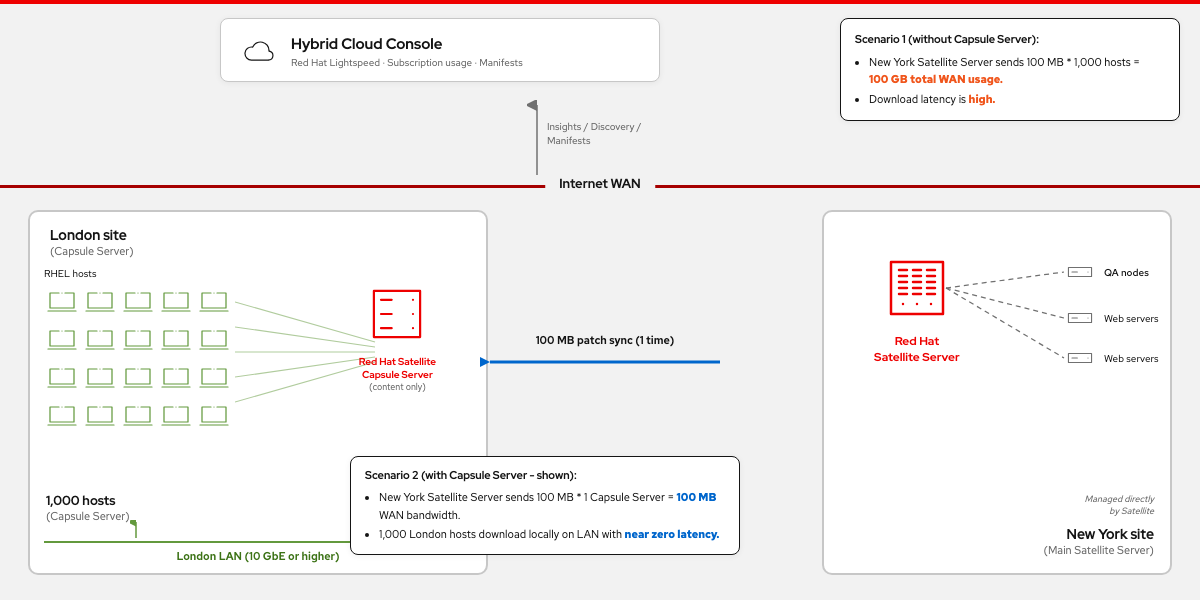
Figure 1. A network architecture diagram showing how Capsule Server reduces WAN bandwidth from 100 GB to 100 MB during content synchronization between the New York site (main Satellite Server) and the London site (Capsule Server with 1,000 managed RHEL hosts), while the Red Hat Hybrid Cloud Console provides centralized visibility.
2. Infrastructure resilience
Capsule Servers allow for "disconnected" local management. If the network link between the central Satellite Server and a remote datacenter fails, the local Capsule Server continues serving content to its registered content hosts. This architectural decoupling prevents WAN failures from disrupting critical local maintenance cycles, allowing operations like dnf update or dnf install to succeed uninterrupted.
3. High availability and load balancing
For improved horizontal scalability, multiple Capsule Servers can be deployed behind a load balancer. This configuration eliminates single points of failure for host check-ins and eases Capsule Server maintenance operations, such as performing step-by-step version upgrades and patching, without taking down host management entirely.
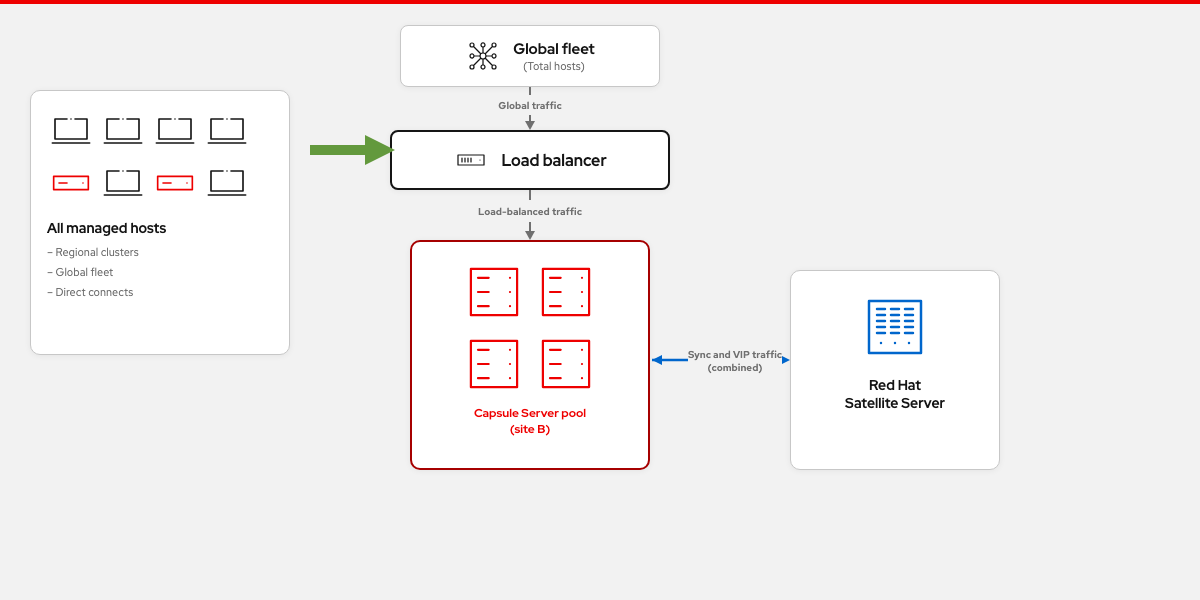
Figure 2. A simplified architectural flowchart showing a Satellite Server connected to a load-balanced Capsule Server pool (site B). Global fleet traffic passes through a load balancer to the Capsule Server pool, which serves all managed hosts across regional clusters and global fleet deployments.
Data-driven performance: Inside the scale testing
To support smooth operations at enterprise scale, the Red Hat Performance and Scale Team continually benchmarks Capsule Server synchronization speeds across engineering release cycles. Testing scenarios typically evaluate both manual syncs and automated Capsule Server syncs triggered when a content view (with multiple repositories) is promoted to a lifecycle environment (LCE) assigned to a Capsule Server.
With the arrival of Red Hat Satellite 6.19, testing has shifted toward modern, multimodal workloads, specifically focusing on how the underlying sync engine processes high-demand content footprints compared to previous versions.
Performance gains in Satellite 6.19
The latest telemetry reveals massive architectural optimizations for containerized environments and significant efficiency gains for RHEL repositories:
| Content type footprint | Performance effect in Satellite 6.19 | Engineering effect and core takeaway |
|---|---|---|
| Containerized content | Improved by more than 99% | A massive, near-instantaneous synchronization leap across both primary measurements, highlighting major back-end refactoring for container registries |
| Yum repositories | Improved by 9% | Significantly faster delivery for traditional, highly used RPM environments, saving heavy processing cycles on custom repositories |
| RHEL core content | Improved by 5% | Solid efficiency gains for primary enterprise operating system mirrors, cutting down daily sync windows for standard estates |
Takeaway
What do these numbers tell us? The massive more-than-99% improvement for containerized content and a nearly 10% jump for Yum repositories mean that for the vast majority of enterprise workloads, Satellite 6.19 delivers content to your localized Capsule Servers significantly faster.
By focusing engineering efforts on optimizing these high-frequency, heavy-payload content types, Satellite 6.19 greatly drops WAN use and speeds time to compliance across your global distributed environment.
Ready to drastically lower your WAN burden and unlock these architectural scalability enhancements?
Plan your upgrade to Red Hat Satellite 6.19 today. To get started safely and minimize downtime:
- Map out your customized path: Use the interactive Red Hat Satellite Upgrade Helper on Red Hat Customer Portal to generate a step-by-step instruction checklist tailored directly to your current environment and version.
- Review the official guidelines: Dive into the official Red Hat Satellite 6.19 upgrade guidance to review prerequisites, breaking changes, and lifecycle support windows.
제품 체험판
Red Hat Enterprise Linux | 제품 체험판
저자 소개
Imaanpreet Kaur joined Red Hat in 2017 and is a software engineer with Red Hat's Performance and Scale Engineering team. Kaur does performance testing, reviews, and checks on Red Hat Satellite and Ansible Tower.
IT-plumber and LLM-sepherder
유사한 검색 결과
Red Hat Ansible 올스타: 네트워크 및 인프라 자동화의 미래를 주도합니다
AI 시대 인프라 자동화의 진화: Red Hat Summit 2026의 4가지 핵심 내용
Random Acts Of Automation | Compiler
Untangling Networks | Compiler
자세히 알아보기
- E-book: 클라우드 스케일에 따른 인프라 관리
- E-book: 현대화된 비즈니스 성공을 위한 효율적인 IT 기반 구축
- 체험판 시작하기: Red Hat Enterprise Linux
채널별 검색

오토메이션
기술, 팀, 인프라를 위한 IT 자동화 최신 동향

인공지능
고객이 어디서나 AI 워크로드를 실행할 수 있도록 지원하는 플랫폼 업데이트

오픈 하이브리드 클라우드
하이브리드 클라우드로 더욱 유연한 미래를 구축하는 방법을 알아보세요

보안
환경과 기술 전반에 걸쳐 리스크를 감소하는 방법에 대한 최신 정보

엣지 컴퓨팅
엣지에서의 운영을 단순화하는 플랫폼 업데이트

인프라
세계적으로 인정받은 기업용 Linux 플랫폼에 대한 최신 정보

애플리케이션
복잡한 애플리케이션에 대한 솔루션 더 보기

가상화
온프레미스와 클라우드 환경에서 워크로드를 유연하게 운영하기 위한 엔터프라이즈 가상화의 미래
