


Red Hat OpenShift uses TLS certificates across many platform components to establish trust and secure communications. As platforms grow and evolve over years of operation, managing these certificates consistently becomes increasingly difficult.
For years, Red Hat and NEC have worked together to understand and address certificate management challenges in Red Hat OpenShift. Through that collaboration, TLS Registry emerged as a mechanism to make certificate management observable and verifiable across the platform.
TLS Registry is integrated into Red Hat OpenShift engineering workflows to detect certificate management gaps before they become production issues.
Challenges of Certificate Management
A production Red Hat OpenShift platform is expected to operate continuously for years. During that time, new operators, platform services, and workloads are introduced. Certificates expire, are renewed or replaced, and may be reissued under new certificate authorities (CAs).
Like many modern distributed systems, Red Hat OpenShift relies on TLS not only for externally exposed services but also for secure communication between internal platform components. Because Red Hat OpenShift integrates a broad set of platform services and operators, these trust relationships extend across many independently managed components. Our analysis of Red Hat OpenShift components identified more than 200 certificates and related TLS artifacts. These artifacts are stored in different locations, managed by different components, and renewed or reloaded through different procedures. Managing certificates independently within each component may work locally, but it may not work reliably to track ownership, dependencies, or the impact of changes across the platform.
As a result, seemingly simple questions become increasingly difficult to answer:
- Where is the certificate stored?
- Which component owns it?
- Which CA issued it?
- Which components consume it?
- How is it renewed or replaced?
- Which services must reload it after renewal or replacement?
These questions may remain unanswered until a certificate expires, a transition to a new CA occurs, or a platform upgrade reveals previously unknown certificate dependencies.
Need for a common source of truth
Without a shared view of certificate ownership and trust relationships, component developers, reviewers, and release engineers lack the information needed to apply certificate management requirements consistently. It also becomes difficult to determine how a change in one component may affect other components across the platform. Certificate management therefore becomes a concern for the entire platform rather than something each component can address independently.
These challenges create a need for a common source of truth that can be validated as the platform evolves. Red Hat and NEC collaborated to address this need by improving certificate visibility and validation across Red Hat OpenShift.
Introducing TLS Registry
TLS Registry provides a common inventory of certificate information and a framework for validating it across Red Hat OpenShift. Its goal is to make certificate management processes observable and verifiable throughout the development lifecycle.
TLS registry is integrated into Red Hat OpenShift engineering workflows to track certificate information and detect changes before they impact users. Component owners register reference information describing expected certificate properties and their relationships. That information is compared against information gathered from test environments during development, CI, QA, and release processes to validate certificate configurations.
TLS registry does not replace component-specific mechanisms for issuing, renewing, replacing, or reloading certificates. It complements them by providing a platform-wide view of certificates, related TLS artifacts, and their relationships.

Figure 1. Certificate information tracked by TLS Registry
Figure 1 illustrates how certificates, certificate authorities, and other TLS artifacts form dependency chains across the platform. As you can see, changes to a single certificate or trust relationship can affect multiple dependent components and services. TLS Registry tracks these relationships in a common machine-readable registry and a human-readable report, making certificate information observable and verifiable across the platform.
Typical information includes:
- Location
- Owner
- Issuer
- Purpose
- Validity period
- Cryptographic attributes
- Consumer relationships
- Renewal, replacement, and reload behavior
The information tracked in TLS Registry can be used throughout development, CI, and QA validation processes.
Key capabilities
TLS Registry provides the following capabilities that help maintain consistent certificate management across Red Hat OpenShift.
- Ownership and relationship tracking
TLS Registry tracks certificate ownership and dependency information. By maintaining this information in a common format, component developers, reviewers, and release engineers can more easily determine which components may be affected by certificate or CA changes. - Policy validation in CI/QA testing
Validation checks can be incorporated throughout the development lifecycle, as shown in Figure 2. Certificate information observed during CI and QA testing is stored in TLS Registry and compared against the expected information registered by component owners during policy validation. If a component introduces or modifies a certificate or trust relationship without updating the expected information in TLS Registry, the inconsistency can be detected before release.
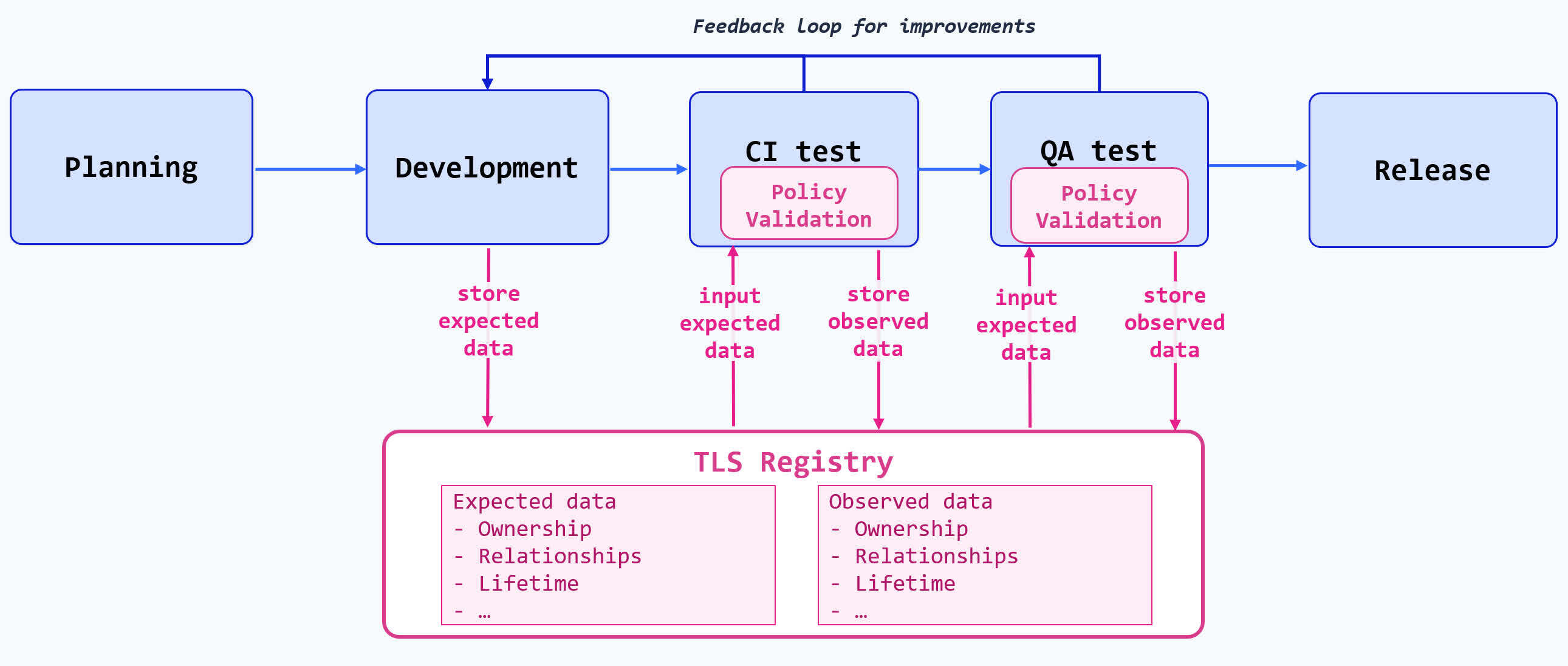
Figure 2. TLS Registry integration throughout the development lifecycle
Who benefits from TLS Registry?
- Component developers and reviewers gain better visibility into certificate ownership, relationships, and dependencies.
- Release engineers gain a consistent mechanism for validating certificate information across components before release.
- Red Hat OpenShift users and platform operators can use TLS Registry information to understand certificate ownership, dependencies, and affected components when troubleshooting certificate-related issues.
Wrap-up
Certificate management becomes increasingly challenging as platforms grow and operate over long periods of time. TLS Registry provides stakeholders with a shared view of certificate information, enabling them to validate certificate management policies and detect issues early in the development lifecycle. The information maintained by TLS Registry also supports more efficient troubleshooting. These benefits contribute to the long-term reliability of Red Hat OpenShift.
By choosing Red Hat OpenShift, organizations gain a fully supported enterprise application platform designed to support secure, reliable operations at scale, backed by a broad ecosystem of integrated technologies and expertise. The long-standing collaboration between Red Hat and NEC combines deep Red Hat OpenShift engineering knowledge with NEC’s experience in solving complex enterprise infrastructure challenges. TLS Registry is one example of how that partnership turns real operational requirements into practical capabilities for customers, helping make certificate dependencies more visible, manageable, and predictable across the platform lifecycle. To learn more about NEC’s solutions for Red Hat, explore NEC on the Red Hat Ecosystem Catalog.
Teste de produto
Red Hat OpenShift Container Platform | Teste de solução
Sobre os autores
Naoya is a Senior Software Engineer at NEC Corporation of America with over 15 years of experience in Red Hat-NEC technical collaboration. He has contributed to the development and maintenance of the Linux kernel and RHEL, focusing primarily on the memory error handling subsystem. Currently, he works to drive technical collaboration across Red Hat's latest platform technologies, including OpenShift, OpenShift Virtualization, and Red Hat AI, to deliver more robust platform services to Japanese customers.
Masaki is a Senior Specialist with nearly two decades of experience supporting mission-critical enterprise systems across commercial Unix, Linux, and cloud platforms. He has been driving the adoption of Red Hat OpenShift for enterprise workloads in Japan while working closely with Red Hat on technologies such as certificate management, disconnected installation, logging, virtualization, and high-availability solutions to improve the quality, reliability, and operational readiness.
Navegue por canal

Automação
Últimas novidades em automação de TI para empresas de tecnologia, equipes e ambientes

Inteligência artificial
Descubra as atualizações nas plataformas que proporcionam aos clientes executar suas cargas de trabalho de IA em qualquer ambiente

Nuvem híbrida aberta
Veja como construímos um futuro mais flexível com a nuvem híbrida

Segurança
Veja as últimas novidades sobre como reduzimos riscos em ambientes e tecnologias

Edge computing
Saiba quais são as atualizações nas plataformas que simplificam as operações na borda

Infraestrutura
Saiba o que há de mais recente na plataforma Linux empresarial líder mundial

Aplicações
Conheça nossas soluções desenvolvidas para ajudar você a superar os desafios mais complexos de aplicações

Virtualização
O futuro da virtualização empresarial para suas cargas de trabalho on-premise ou na nuvem
