
Toward the Cloud: The Past, The Present & The Future
On April 18th, Augustin Husson (Principal Engineer) and Alban Hurtaud (Observability Architect) from Amadeus IT Group joined Red Hatters at the OpenShift Commons gathering in Amsterdam, a co-located event of KubeCon + CloudNativeCon Europe 2023. The pair spoke about the journey that Amadeus took to become a cloud-native open source-fueled organization. Watch the full recording of the presentation below:
Amadeus is the leading technology company in the travel industry, with more than 690 million passengers boarded in 2020 thanks to Amadeus and Navitaire solutions, and more than 646 million bookings processed and recorded in 2019. Given those numbers, it is no mystery that incident management, powered by Observability, is non-negotiable for Amadeus. Let’s take a look at the company’s journey to the cloud, which we here divide into four different stages:
Stage 1
The journey to the cloud for Amadeus started in 2016. Back then, the organization was heavily reliant on logs and a homegrown observability solution - where metrics and traces were built by computing logs (see figure #1 for reference). Nonetheless, the complexity of the system made it difficult for engineers to install it from scratch.
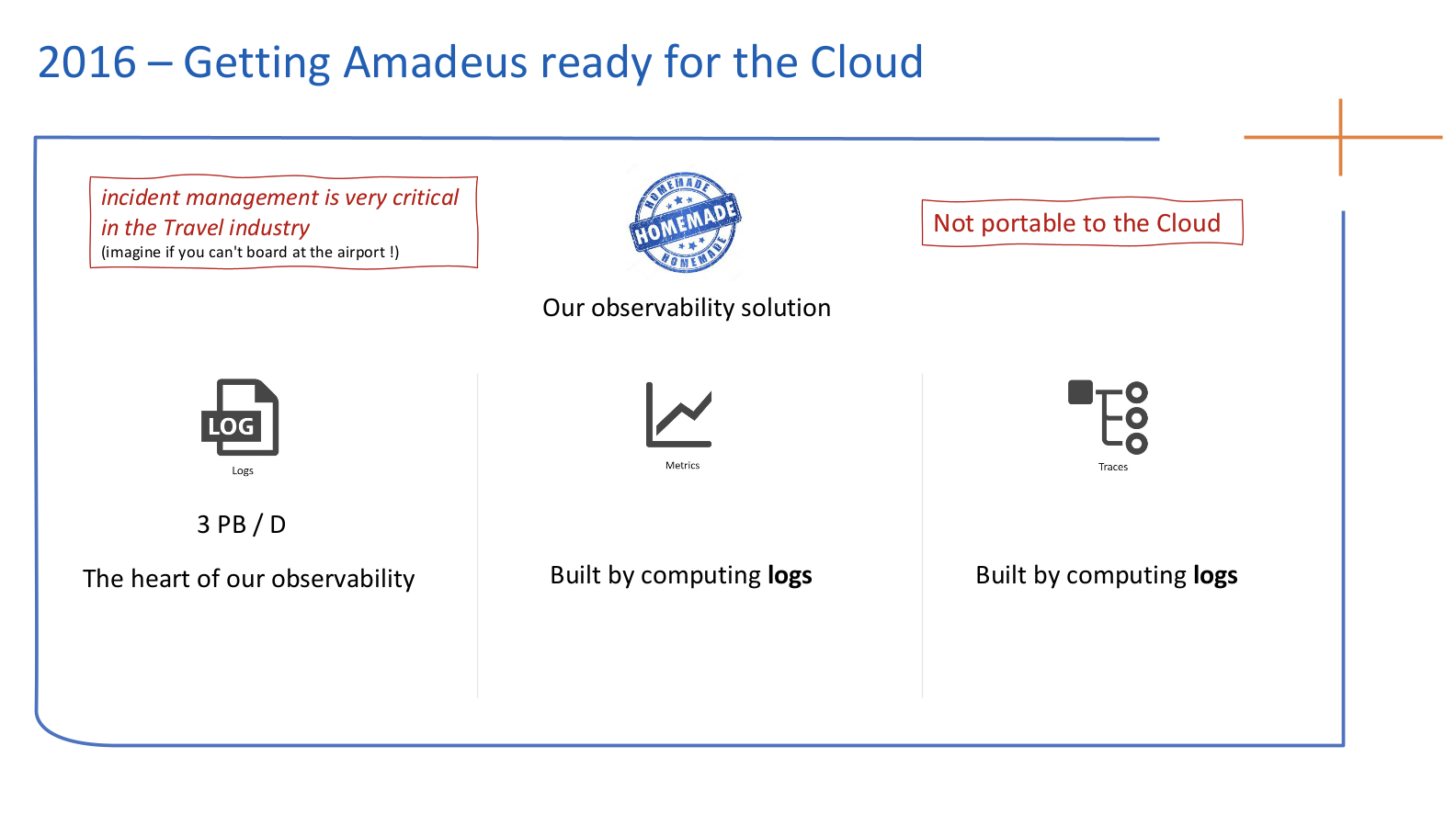
Figure #1
Stage 2
Given the intricacy of the legacy solution (VMs-based) outlined above, Amadeus started to prepare to transition to the cloud. And that is where OpenShift came into play. Everything started by spinning up four OpenShift clusters on-premises (OpenShift 3.5), and deploying Prometheus on top of them. These four data sources were manually added to Grafana for visualization purposes (see figure #2 for reference). Despite those changes, timeseries were exponentially increasing and needed to be better handled. That is when stage #3 started.
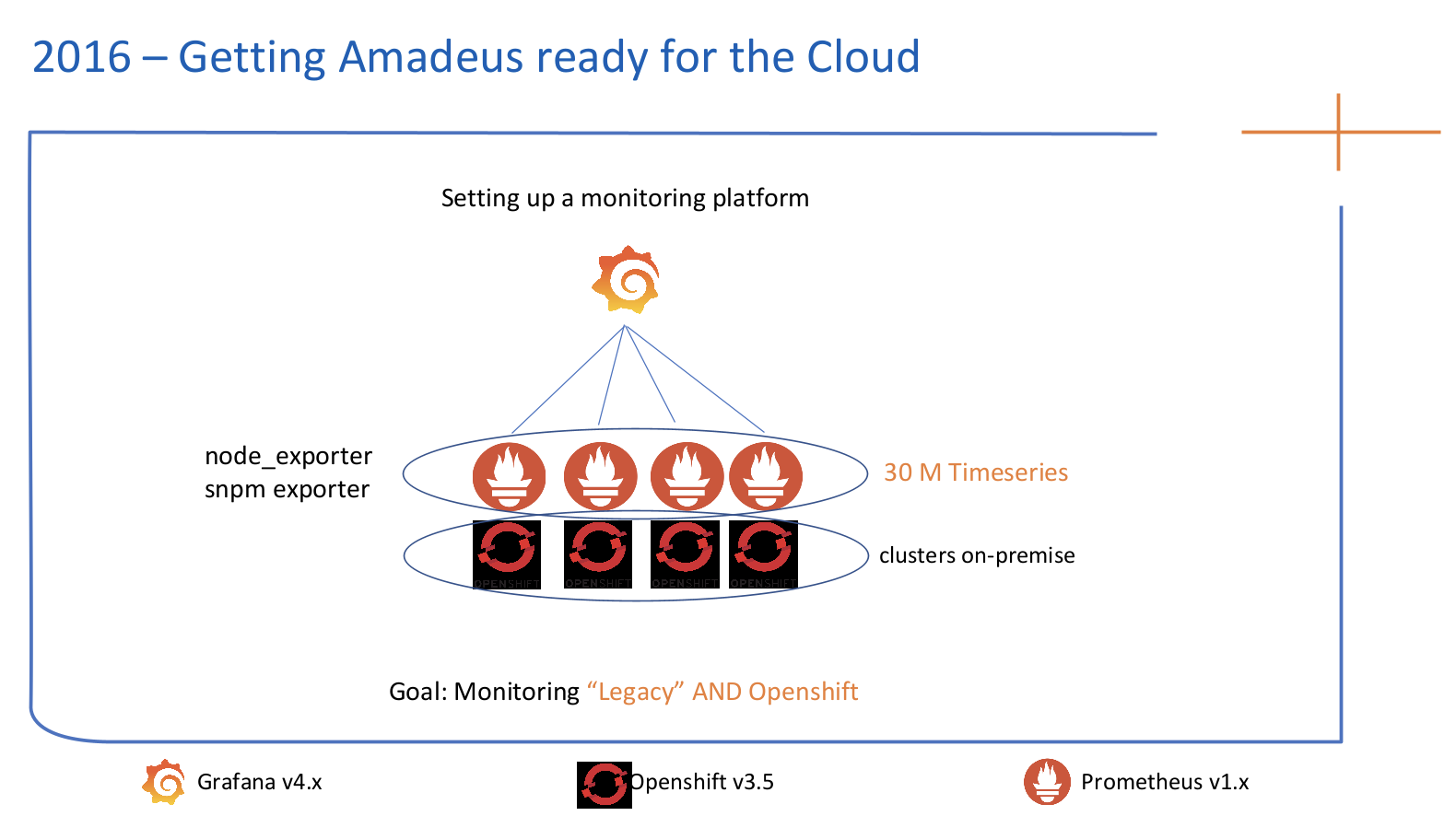
Figure #2
Stage 3
Monitoring Amadeus’ private datacenter and its legacy workload also became a must for the team, in order to compare the response time of applications running in the cloud and the one of applications running on the legacy VMs. In 2019, thanks to Thanos being introduced on top of Prometheus, Amadeus was able to achieve one single data source, managing 300 million timeseries (see figure #3 for reference).

Figure #3
Stage 4
In 2021, thanks to the flexibility and automated installations provided by OpenShift v.4.0, Amadeus could deploy 70 OpenShift clusters on Azure public cloud, and 10 on-premises.To manage all these clusters, Amadeus uses an operator that triggers the installation of OpenShift clusters, its Azure subscription, and internal middleware - required to deploy the actual applications. OpenShift 4.0 truly became an enabler, as it has allowed the organization to run applications everywhere: on public clouds, but also on a self-managed basis (in this case on-premises) - empowering Amadeus to handle more than 1 billion timeseries events. To recap, with the goal of developing and scaling its applications more efficiently, everything as code and automation everywhere have become the motto of Amadeus IT Group (see figure #4 for reference).
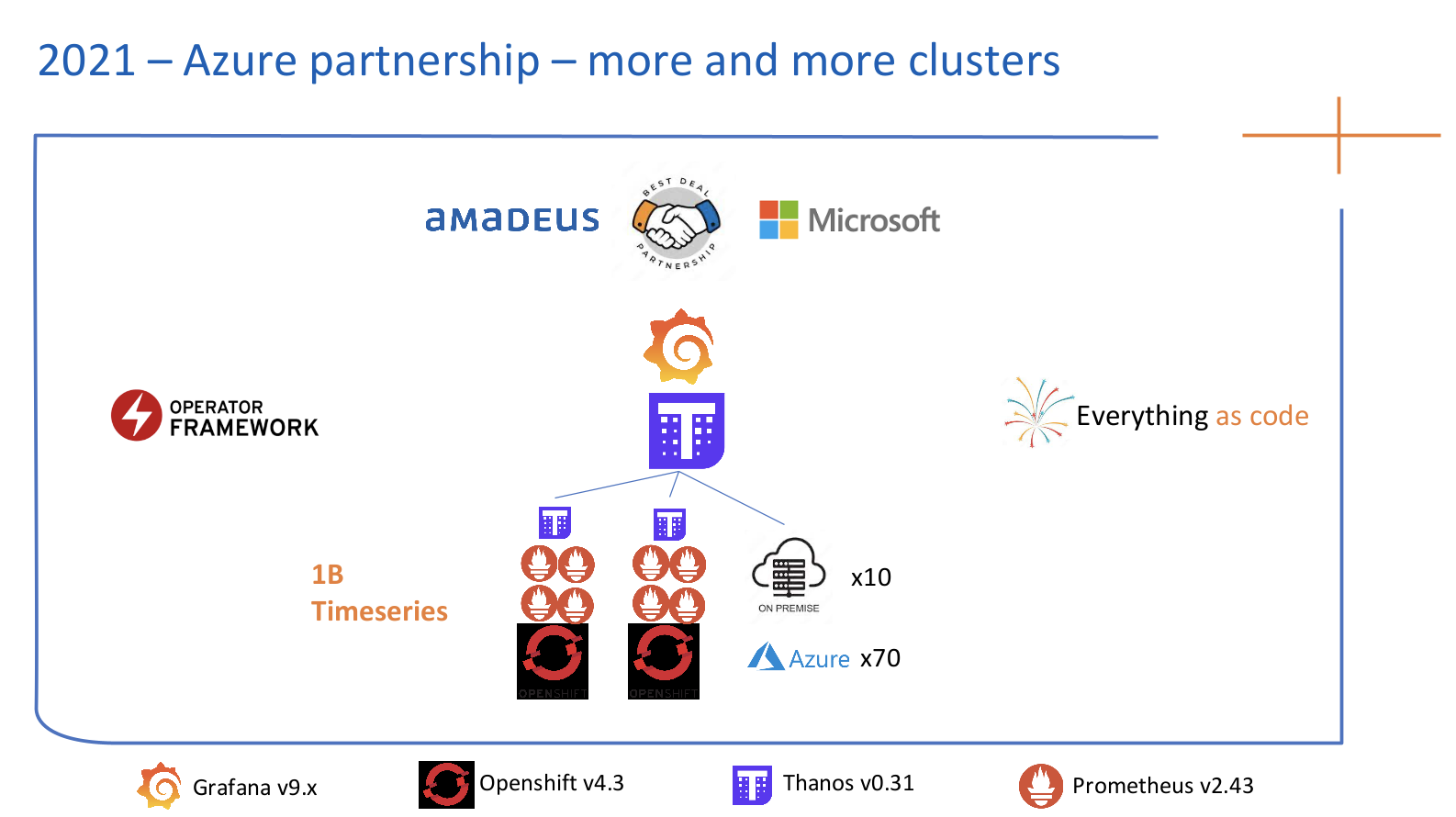
Figure #4
Working on a Single-Pane of Glass: An Open Source Alternative
Visualization is an essential part of any Observability experience. Grafana is traditionally being used as the standard visualization tool for Observability signals. However, despite the multiple backends currently available in the CNCF landscape, displaying Observability data is a piece of the puzzle currently missing. Amadeus, together with Chronosphere, have been working on Perses with the goal of open sourcing a single Observability visualization experience that can consume a variety of different data sources (traces, logs, and metrics). Perses wants to fill the current gap, being GitOps compatible, thus enabling dashboards as code and allowing users to embed charts and dashboards in any UI (see figure #5 and #6 for reference).
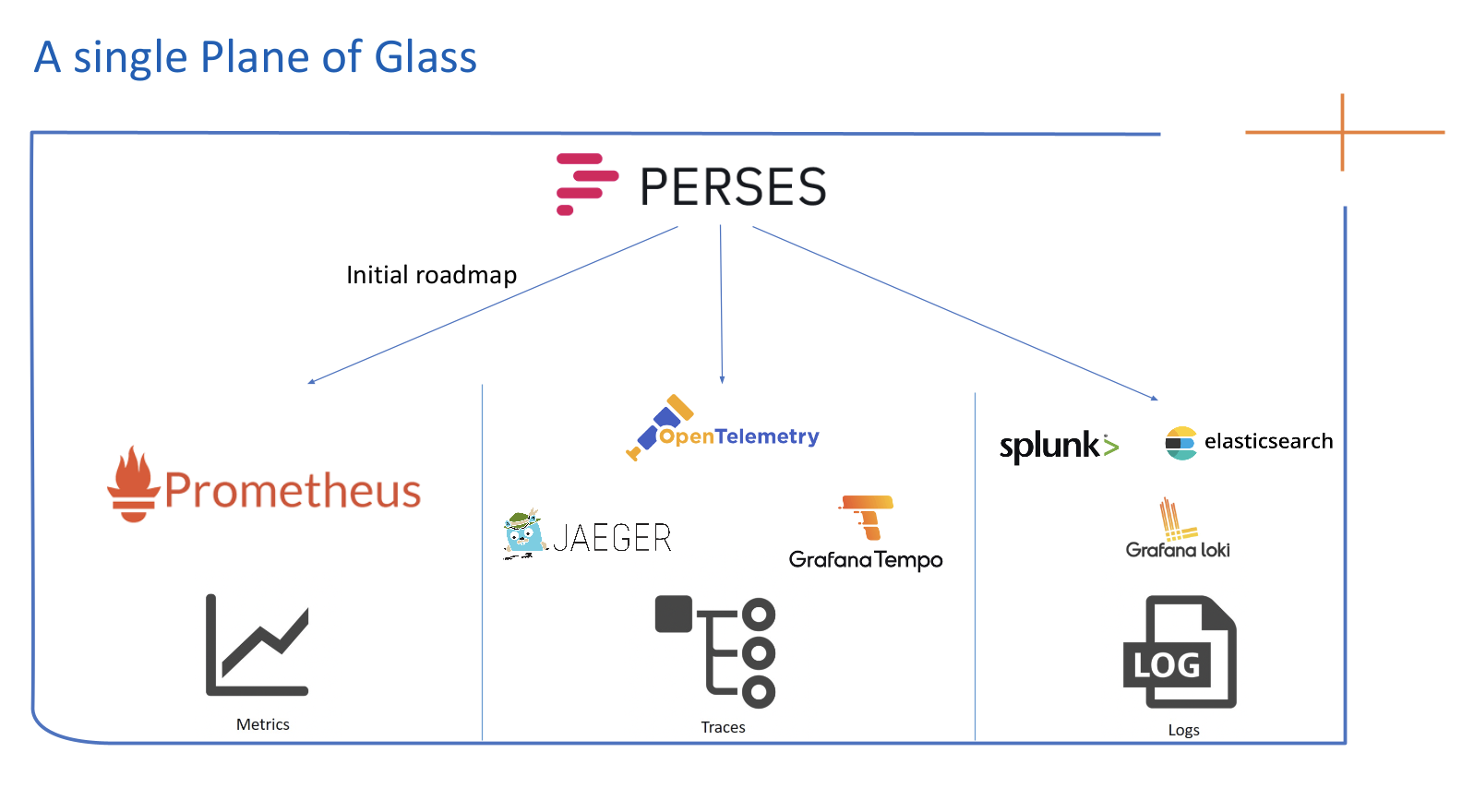
Figure #5
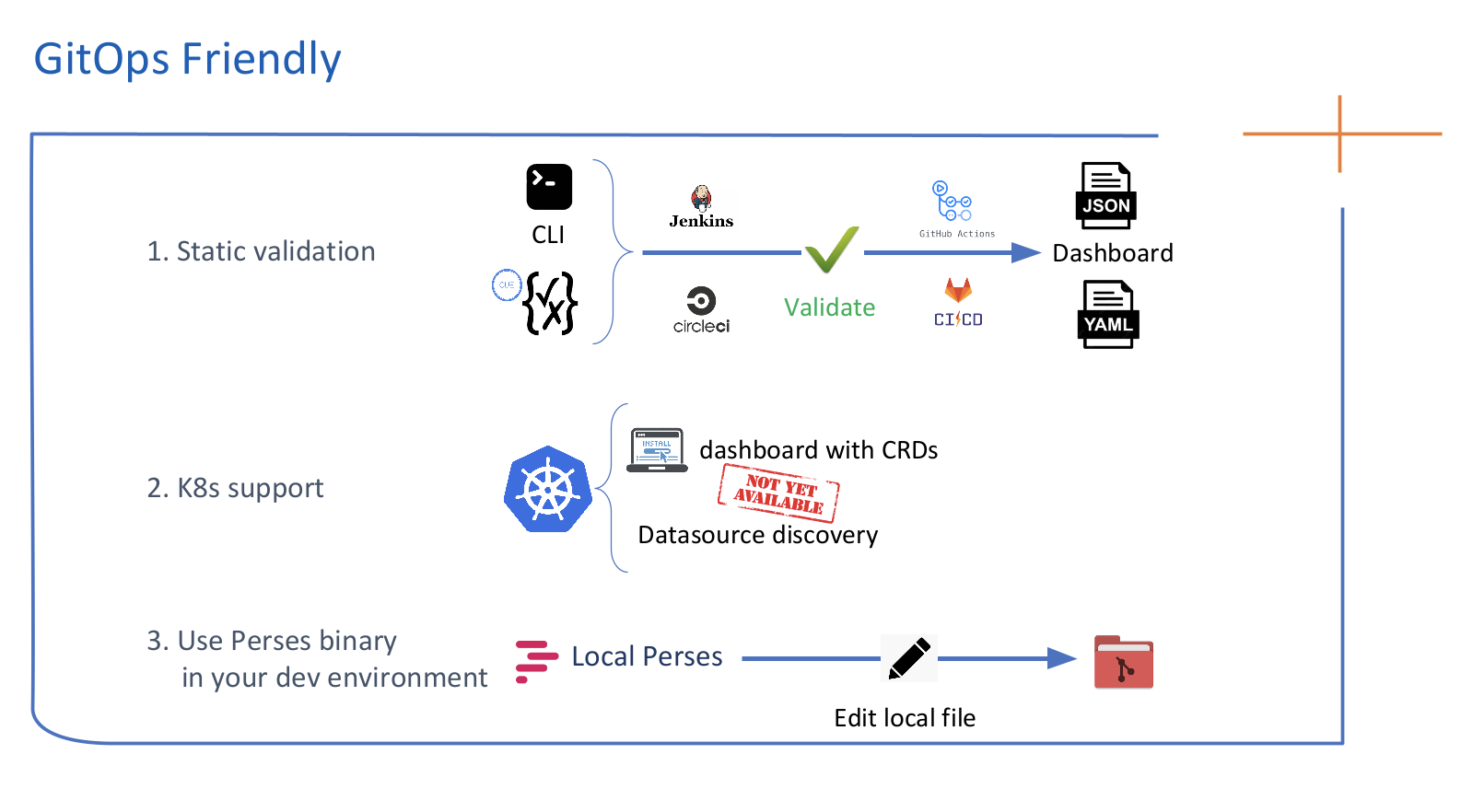
Figure #6
Takeaways
Amadeus is a big player in the Observability space, largely adopting open source. Integrating with OpenShift has given Amadeus the flexibility it needs to run and scale its applications everywhere, efficiently managing its workloads. Nonetheless, Observability can benefit everyone. That is why the collaboration between Red Hat and Amadeus does not stop with OpenShift, as it intensifies with Observability-related projects. Stay tuned to learn more about how the OpenShift Web Console>Observe section could benefit from adopting Perses.
À propos de l'auteur
Vanessa is a Senior Product Manager in the Observability group at Red Hat, focusing on both OpenShift Analytics and Observability UI. She is particularly interested in turning observability signals into answers. She loves to combine her passions: data and languages.
Plus de résultats similaires
Red Hat Ansible All-Stars : piloter l'avenir de l'automatisation du réseau et de l'infrastructure
Un prestataire de services migre des milliers de charges de travail vers une plateforme d'applications unifiée
Crack the Cloud_Open | Command Line Heroes
Edge computing covered and diced | Technically Speaking
Parcourir par canal

Automatisation
Les dernières nouveautés en matière d'automatisation informatique pour les technologies, les équipes et les environnements

Intelligence artificielle
Actualité sur les plateformes qui permettent aux clients d'exécuter des charges de travail d'IA sur tout type d'environnement

Cloud hybride ouvert
Découvrez comment créer un avenir flexible grâce au cloud hybride

Sécurité
Les dernières actualités sur la façon dont nous réduisons les risques dans tous les environnements et technologies

Edge computing
Actualité sur les plateformes qui simplifient les opérations en périphérie

Infrastructure
Les dernières nouveautés sur la plateforme Linux d'entreprise leader au monde

Applications
À l’intérieur de nos solutions aux défis d’application les plus difficiles

Virtualisation
L'avenir de la virtualisation d'entreprise pour vos charges de travail sur site ou sur le cloud
