This is a guest post by John Janetos, Tigera
Tigera and Red Hat have partnered to deliver an integrated Security and Observability solution for Kubernetes networking and microservices that empowers developers to innovate and ship faster with the leading hybrid and multi-cloud and container platform, while providing fine-grained security and compliance controls to protect Kubernetes workloads.
Red Hat OpenShift, the leading Kubernetes platform, is designed to help organizations implement a Kubernetes infrastructure that enables rapid application development and deployment. OpenShift has been engineered to address the complexity of managing containerized applications in production, and designed as a self-managing platform with automatic software updates and life cycle management across on-prem and cloud environments.
All applications are vulnerable to cyber attack, and Kubernetes workloads and apps are no exception. Effectively deploying microservices on OpenShift introduces new implementation demands on infrastructure, network security, and compliance. The combination of Calico Enterprise and Red Hat OpenShift addresses these new challenges.
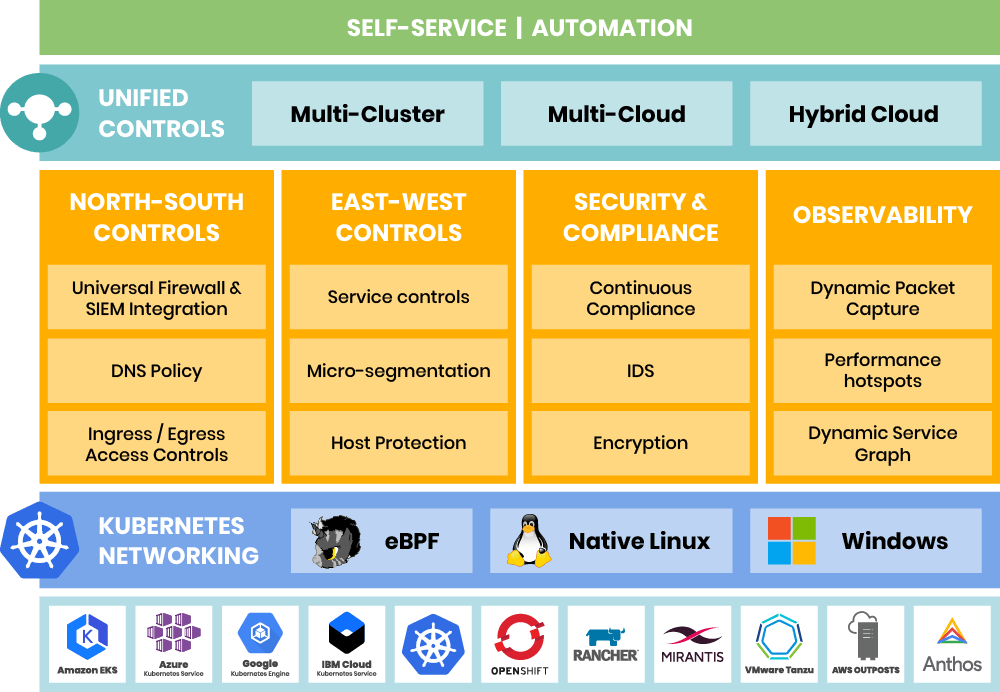 Calico Enterprise from Tigera provides a rich super set of capabilities that significantly extend security and observability capabilities for Kubernetes networking and microservices in OpenShift.
Calico Enterprise from Tigera is the only Kubernetes-native solution that is deeply embedded within the Kubernetes environment to provide robust security controls, real-time observability, and troubleshooting data from the inside across heterogeneous environments. Calico Enterprise builds on open source Project Calico, the most widely adopted Kubernetes CNI, powering more than one million nodes every day.
Traditional networking tools, which were designed for relatively static IP environments, don’t have the context necessary to identify Kubernetes traffic flows, making it nearly impossible to effectively perform essential functions like workflow monitoring, packet capture, and troubleshooting, for example. Integrating Calico Enterprise natively within the OpenShift platform offers multiple advantages, including:
- Centralized control across heterogenous Kubernetes environments with consistent policy management for containers and VMs, on-prem and across multiple public clouds
- Kubernetes-native security and compliance, including intrusion detection, L3 to L7 protection, and integration with existing firewalls
- Purpose-built observability and problem resolution for Kubernetes, including automated tools for DNS, application and network troubleshooting, flow log visualization, and policy staging
Want to learn more? Stay tuned for future blogs and learn new skills such as how to implement fine-grained egress access from your OpenShift clusters. And check out these resources:.
- Free Online Training - Access Live and On-Demand Kubernetes Training
- Calico Enterprise Free Trial on OpenShift - Security, Networking and Observability for Microservices Running on Kubernetes
- Installing Calico on OpenShift - documentation for installing Calico/Calico Enterprise on an OpenShift 4 cluster
À propos de l'auteur

Red Hatter since 2018, technology historian and founder of The Museum of Art and Digital Entertainment. Two decades of journalism mixed with technology expertise, storytelling and oodles of computing experience from inception to ewaste recycling. I have taught or had my work used in classes at USF, SFSU, AAU, UC Law Hastings and Harvard Law.
I have worked with the EFF, Stanford, MIT, and Archive.org to brief the US Copyright Office and change US copyright law. We won multiple exemptions to the DMCA, accepted and implemented by the Librarian of Congress. My writings have appeared in Wired, Bloomberg, Make Magazine, SD Times, The Austin American Statesman, The Atlanta Journal Constitution and many other outlets.
I have been written about by the Wall Street Journal, The Washington Post, Wired and The Atlantic. I have been called "The Gertrude Stein of Video Games," an honor I accept, as I live less than a mile from her childhood home in Oakland, CA. I was project lead on the first successful institutional preservation and rebooting of the first massively multiplayer game, Habitat, for the C64, from 1986: https://neohabitat.org . I've consulted and collaborated with the NY MOMA, the Oakland Museum of California, Cisco, Semtech, Twilio, Game Developers Conference, NGNX, the Anti-Defamation League, the Library of Congress and the Oakland Public Library System on projects, contracts, and exhibitions.
Plus de résultats similaires
Red Hat Device Edge désormais disponible sur NVIDIA Jetson Orin
Votre plateforme d'applications est-elle prête pour l'avenir ?
Collaboration In Product Security | Compiler
Keeping Track Of Vulnerabilities With CVEs | Compiler
Parcourir par canal

Automatisation
Les dernières nouveautés en matière d'automatisation informatique pour les technologies, les équipes et les environnements

Intelligence artificielle
Actualité sur les plateformes qui permettent aux clients d'exécuter des charges de travail d'IA sur tout type d'environnement

Cloud hybride ouvert
Découvrez comment créer un avenir flexible grâce au cloud hybride

Sécurité
Les dernières actualités sur la façon dont nous réduisons les risques dans tous les environnements et technologies

Edge computing
Actualité sur les plateformes qui simplifient les opérations en périphérie

Infrastructure
Les dernières nouveautés sur la plateforme Linux d'entreprise leader au monde

Applications
À l’intérieur de nos solutions aux défis d’application les plus difficiles

Virtualisation
L'avenir de la virtualisation d'entreprise pour vos charges de travail sur site ou sur le cloud
