
For the past several years, Red Hat and Microsoft have worked together to co-develop hybrid cloud solutions intended to enable greater customer innovation. Last year, at Red Hat Summit 2019, Red Hat and Microsoft announced the general availability of Azure Red Hat OpenShift, the industry’s first jointly-engineered, managed and supported OpenShift service on a leading public cloud.
Further extending our work together in the hybrid cloud, today at the Red Hat Summit virtual experience, Microsoft and Red Hat announced the general availability of Azure Red Hat OpenShift on OpenShift 4.

Azure Red Hat OpenShift web console
Azure Red Hat OpenShift enables you to create clusters in minutes, in a self-service fashion. Because this is a fully managed service, there are no VMs for you to manage. Patching, upgrading, repair, and disaster recovery are all handled for you as part of the service with best in class proactive 24/7 management and support from both Microsoft and Red Hat.
With this release, we’re adding key features to Azure Red Hat OpenShift, including:
- Cluster-admin support: We’ve enabled the cluster-admin role on Azure Red Hat OpenShift clusters, enabling full cluster customization capabilities, such as running privileged containers and installing Custom Resource Definitions (CRDs).
- Cluster Autoscaling: Use the ClusterAutoscaler and MachineAutoscalers to automatically adjust the size of your cluster to meet current demand. Mix and match virtual machine sizes to your workloads.
- Multi-Availability Zones clusters: To deliver high levels of resiliency, cluster components are now deployed across 3 Azure Availability Zones in supported Azure regions to maintain high availability for your most demanding mission-critical applications and data. Azure Red Hat OpenShift has a Service Level Agreement (SLA) of 99.9%.
- Industry compliance certifications: To help you meet your compliance obligations across regulated industries and markets worldwide, Azure Red Hat OpenShift is now PCI DSS, FedRAMP High and HITRUST certified. Azure maintains the largest compliance portfolio in the industry both in terms of total number of offerings, as well as number of customer-facing services in assessment scope.
- Bring your own identity provider: In addition to supporting authentication and authorization using Azure Active Directory, customers can now connect their supported identity providers, for example using OpenID Connect.
- Azure Monitor support: Microsoft Azure is now extending monitoring support for Red Hat OpenShift 4 clusters hosted on Azure Red Hat OpenShift and on OpenShift Container Platform running on Azure or on-premises with Azure Monitor for containers. This support is currently in public preview.
- Private API and ingress endpoints: Customers can now choose between public and private cluster management (API) and ingress endpoints. With private endpoints and Azure Express Route support we’re enabling private hybrid clusters, allowing our mutual customers to extend their on-premises solutions to Azure.
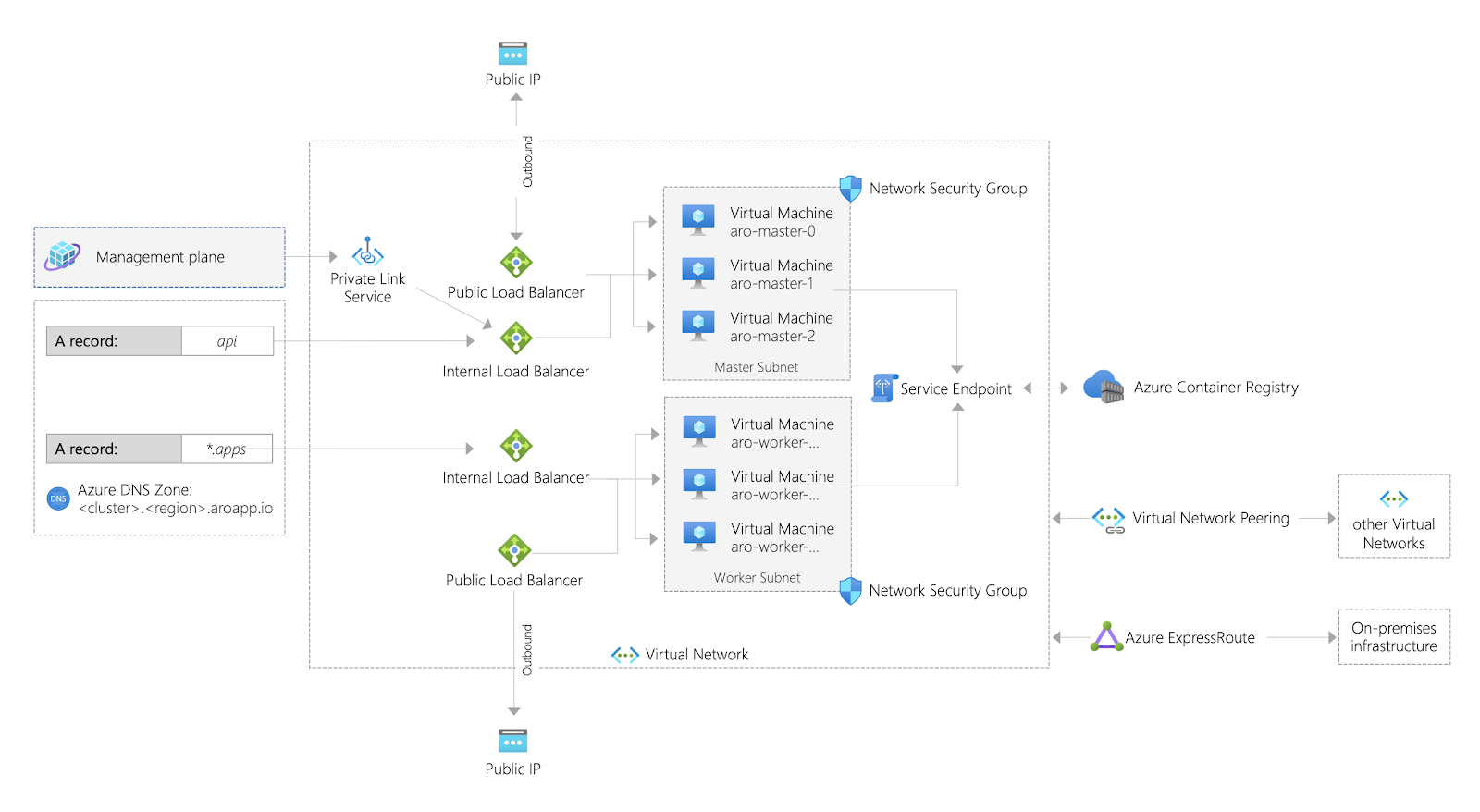
Azure Red Hat OpenShift with private endpoints
OpenShift 4 is the industry’s most comprehensive enterprise Kubernetes platform, driven by the innovation of Kubernetes Operators to deliver full-stack automation from top to bottom. From Kubernetes to the core services that support OpenShift clusters to the application services deployed by end users; everything is managed with Operators. This release also brings key innovations from Red Hat OpenShift 4 to Azure Red Hat OpenShift such as:
- Kubernetes 1.16 on Red Hat Enterprise Linux CoreOS: RHEL CoreOS provides a fully immutable, container optimized, operating system built from the world’s leading enterprise Linux platform, delivered and installed as a component of OpenShift.
- OperatorHub.io: Red Hat launched OperatorHub.io to provide a registry where users can find curated Kubernetes Operators. Users can now access the Operator Hub through Azure Red Hat OpenShift console, which includes community as well as Red Hat OpenShift Certified Operators.
- OpenShift Service Mesh: Based on the Istio, Jaeger and Kali projects, OpenShift Service Mesh provides an integrated service mesh for enhanced security and network segmentation of microservices applications. This enables developers to focus on building business logic while letting the service mesh manage policy-defined microservice communications. They can also use integrated tracing and visualization capabilities to debug issues when they occur.
- OpenShift Serverless: Built on the Knative framework, OpenShift Serverless enables developers to build functions based applications that have the ability to scale to zero, and only consume compute resources when functions execute.
For more information, head over to the Azure Red Hat OpenShift product page and follow the documentation to get started.
À propos de l'auteur
Plus de résultats similaires
Vos correctifs sont trop lents ? Le Zero Trust comme dernière ligne de défense
Partenaires Red Hat : l'atout commercial ultime pour les télécommunications
Scaling with Orchestrators | Compiler
Container Roundup | Compiler
Parcourir par canal

Automatisation
Les dernières nouveautés en matière d'automatisation informatique pour les technologies, les équipes et les environnements

Intelligence artificielle
Actualité sur les plateformes qui permettent aux clients d'exécuter des charges de travail d'IA sur tout type d'environnement

Cloud hybride ouvert
Découvrez comment créer un avenir flexible grâce au cloud hybride

Sécurité
Les dernières actualités sur la façon dont nous réduisons les risques dans tous les environnements et technologies

Edge computing
Actualité sur les plateformes qui simplifient les opérations en périphérie

Infrastructure
Les dernières nouveautés sur la plateforme Linux d'entreprise leader au monde

Applications
À l’intérieur de nos solutions aux défis d’application les plus difficiles

Virtualisation
L'avenir de la virtualisation d'entreprise pour vos charges de travail sur site ou sur le cloud
