
Applications are increasingly built as discrete functional parts, each of which can be delivered as a container. That means for every application, there are more parts to manage. To handle this complexity at scale, teams need a policy-driven, automated solution that dictates how and where containers will run. Kubernetes is an open source, extensible container orchestrator designed to handle these challenges.
Pulse and Red Hat surveyed 100 enterprise tech leaders from multiple industries to find out what workloads they are deploying on containers and Kubernetes, and why and how they are deploying those workloads across hybrid cloud environments, including the usage of Kubernetes Operators and Helm charts to help achieve key business goals and objectives.
We've included some of the key findings below:
Tech Leaders are Deploying a Wide Variety of Mission-Critical Workloads on Kubernetes
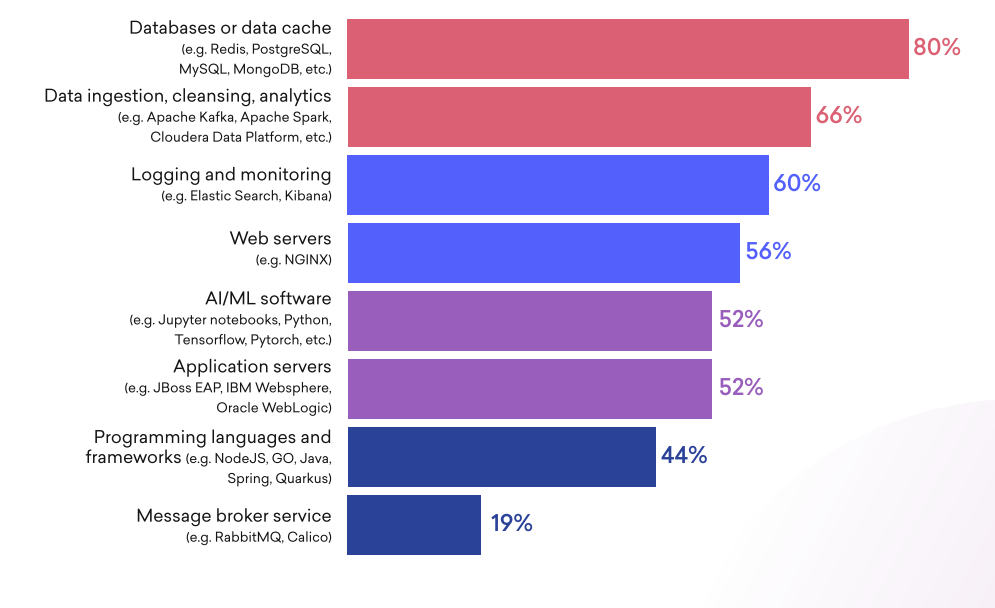
The top workloads tech leaders are deploying on Kubernetes are databases or data cache (80%), data ingestion, cleansing, and analytics (66%), and logging and monitoring (60%). We asked participants:
"Which of the following workloads are you currently deploying on Kubernetes containers?"
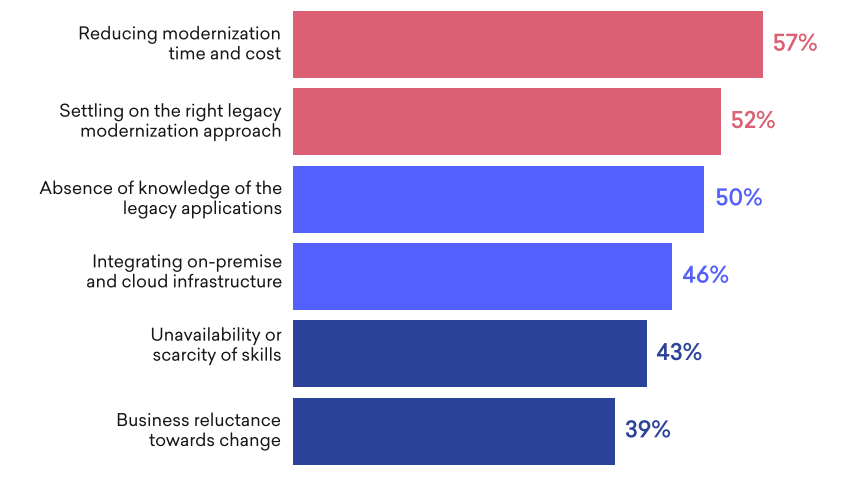
The challenges most associated with modernizing existing and legacy applications are reducing the time and cost of modernization (57%), settling on the right approach (52%), and absence of knowledge of the legacy applications (50%). We asked participants:
"What challenges have you experienced, or do you foresee in the modernization of your existing/legacy applications?"
Respondents who have used Kubernetes tools such as Operators and Helm charts say they saved developers’ time and reduced the need for a larger team (61%) and automated updates and upgrades (54%). we asked participants:
"If using Kubernetes Operators and Helm charts, what benefits are you achieving?"

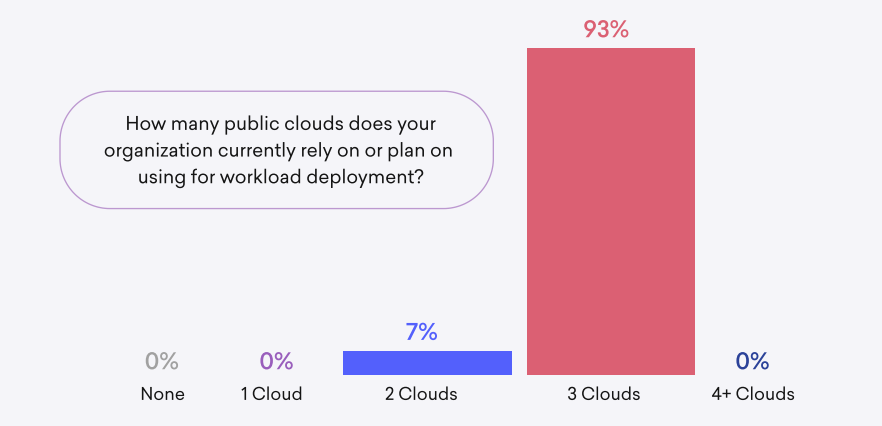
All respondents indicated they rely on multiple public clouds with 93% of tech leaders saying their organization relies on or plans to rely on three public clouds for workload deployment. The other 7% all indicate they are using two public clouds.
To see the full Infographic, click here.
À propos de l'auteur
Jehlum is a Product Manager in the Red Hat AI team. She's focused on building platforms for generative AI applications. I am especially interested in data processing, observability, safety, evaluation - all key components to build production-grade generative AI applications on platforms that scale.
Plus de résultats similaires
Gérer des machines virtuelles sur Red Hat OpenShift avec Service Mesh
Vos correctifs sont trop lents ? Le Zero Trust comme dernière ligne de défense
Scaling with Orchestrators | Compiler
Container Roundup | Compiler
Parcourir par canal

Automatisation
Les dernières nouveautés en matière d'automatisation informatique pour les technologies, les équipes et les environnements

Intelligence artificielle
Actualité sur les plateformes qui permettent aux clients d'exécuter des charges de travail d'IA sur tout type d'environnement

Cloud hybride ouvert
Découvrez comment créer un avenir flexible grâce au cloud hybride

Sécurité
Les dernières actualités sur la façon dont nous réduisons les risques dans tous les environnements et technologies

Edge computing
Actualité sur les plateformes qui simplifient les opérations en périphérie

Infrastructure
Les dernières nouveautés sur la plateforme Linux d'entreprise leader au monde

Applications
À l’intérieur de nos solutions aux défis d’application les plus difficiles

Virtualisation
L'avenir de la virtualisation d'entreprise pour vos charges de travail sur site ou sur le cloud
