
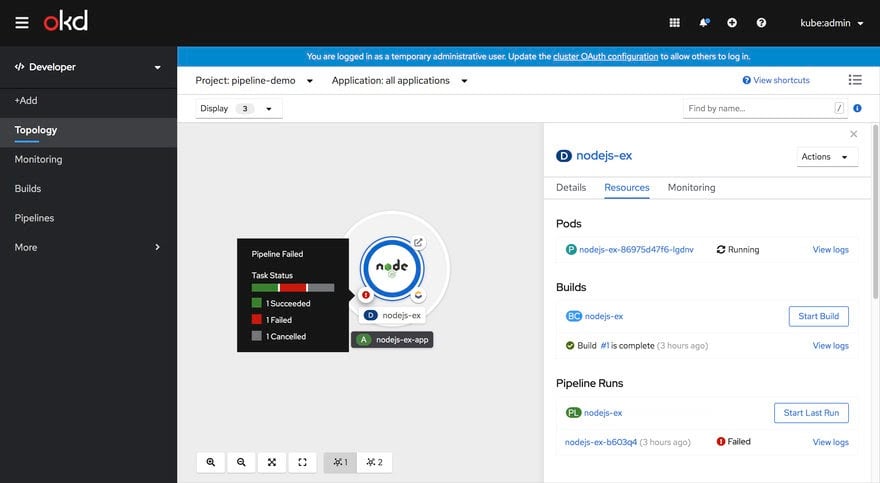
Update 6/13/2020: Our Topology View just won the Community Choice award! Thank you to all who voted!
We know you love the crazy-powerful command-line tools we offer for OpenShift, but we'd like to take a moment to toot our own horn over a UI win we had this past week. Yesterday, we learned that the Red Hat OpenShift Console Topology View placed as Runner-up in the Core77 Design Awards for 2020, Interaction Award category.
Just what are these awards? From the Core77 Design Awards Website:
Recognizing excellence in all areas of design enterprise, the Core77 Design Awards annually celebrates the richness of the design profession as well as the insight and perseverance of its practitioners. Now in its ninth year, the Awards program remains dedicated to excellence and inclusivity, offering both students and professionals the opportunity to promote their best work on a global scale across 18 distinct design disciplines.
The awards are split into 18 categories, covering everything from office design and layout, to industrial product design, to furniture and lighting.
Normally, we're used to winning awards for our infrastructure and IT software. Those tools, while powerful, are not typically known for their industry leading user experience: does anyone out there remark as to the incredible beauty of emacs, vi, awk or sed?
Not really. But that's not to say those tools aren't useful, they're just not really designed for non-hardcore IT users. And yet, as the open hybrid cloud takes hold inside enterprises around the globe, the consumption of our tools has expanded to more than just IT admins and architects.
And, of course, once you get the developers using your projects, you're going to have to start saving people time through UX improvements. After all, the one thing all developers, in all languages can agree on is that they never have enough time in the day to finish the things they need to get done.
The secret to improving developer productivity is making their jobs easier, and saving them time. That could be just 27 seconds shaved off of every build, or a few minutes saved every time the tests run. And while we strive to offer such improvements whenever possible, this particular award was targeted at the work we've done to help developers and administrators better understand the topology of their open hybrid clouds.
The benefits of OpenShift Topology View were explained by the awards committee for the Core77 Design Awards:
It surfaces details on the canvas that are most critical and vital to the health of the application. This eases developers into the detailed logs if they wish to drill down further. It also simplifies many day-to-day tasks by translating them into intuitive visual interactions that could be performed on the canvas, which reduces the odds of navigating away from the canvas.
Besides enriching the developer experience by providing more insight into the application architecture, Topology Views can help shape the future of development. Not only does this visual approach drastically bring down the dependence on code-heavy practices, but it also opens the door to developers of all abilities, especially those who aren't able to easily comprehend and use code-heavy operations.
Now, normally, we're not big fans of shouting out to the hills about our accomplishments, but in this case, we're extremely proud of our team: Veethika Mishra, Serena Nichols, Michael Celedonia, Steve Speicher, Jeff Phillips and Christian Vogt. The Core77 Design Awards are not just some enterprise software award, where the same software wins every year based on the amount of money paid for advertising or the number of conference booths purchased.
Instead, the Core77 Design Awards are wide reaching in their critique of modern design aesthetics. Other categories in this competition awarded chairs, lamps, offices and tools, showing the broad spread of design considered by the judges. The community prize for all of these categories is still open for voting, so go take a wander through the nominees and cast your vote! (Update: we won!) All the winners, runners-up, and special mentions are eligible for the community prize.
For our part, this is also the culmination of a great deal of work we've put into the UX overall across our platforms. Red Hat has a tradition of taking care of the deeply technical users, but we've realized for some time now that good UX and design makes for a much larger tent under which to gather users of all shades. Even the hardest of hardcore computer users appreciates easy and useful UI.
In OpenShift 4.2, for example, we introduced new ways for developers to interact with the open hybrid cloud, allowing them to build, test and deploy their applications faster. The Topology View also received recognition as it illustrates “the importance of visually guided development tools to contemporary development.” We've also got a number of initiatives across the company to improve user experience overall. Take, for example, our OpenShift Design Page. And our Customer Empathy Workshops.
It's a new day for us with this win. Our designers, engineers and product managers have worked very hard to improve those interfaces. That work is clearly paying off, now that we have started winning design awards! That's a big step for us and our teams, and we expect this continued focus on the user experience will help everyone in the Kubernetes community get more work done faster.
Sull'autore
Red Hatter since 2018, technology historian and founder of The Museum of Art and Digital Entertainment. Two decades of journalism mixed with technology expertise, storytelling and oodles of computing experience from inception to ewaste recycling. I have taught or had my work used in classes at USF, SFSU, AAU, UC Law Hastings and Harvard Law.
I have worked with the EFF, Stanford, MIT, and Archive.org to brief the US Copyright Office and change US copyright law. We won multiple exemptions to the DMCA, accepted and implemented by the Librarian of Congress. My writings have appeared in Wired, Bloomberg, Make Magazine, SD Times, The Austin American Statesman, The Atlanta Journal Constitution and many other outlets.
I have been written about by the Wall Street Journal, The Washington Post, Wired and The Atlantic. I have been called "The Gertrude Stein of Video Games," an honor I accept, as I live less than a mile from her childhood home in Oakland, CA. I was project lead on the first successful institutional preservation and rebooting of the first massively multiplayer game, Habitat, for the C64, from 1986: https://neohabitat.org . I've consulted and collaborated with the NY MOMA, the Oakland Museum of California, Cisco, Semtech, Twilio, Game Developers Conference, NGNX, the Anti-Defamation League, the Library of Congress and the Oakland Public Library System on projects, contracts, and exhibitions.
Altri risultati simili a questo
I partner di Red Hat sono una risorsa per i provider telco
Il paradosso degli agenti e il caso dell'IA ibrida
Crack the Cloud_Open | Command Line Heroes
Edge computing covered and diced | Technically Speaking
Ricerca per canale

Automazione
Novità sull'automazione IT di tecnologie, team e ambienti

Intelligenza artificiale
Aggiornamenti sulle piattaforme che consentono alle aziende di eseguire carichi di lavoro IA ovunque

Hybrid cloud open source
Scopri come affrontare il futuro in modo più agile grazie al cloud ibrido

Sicurezza
Le ultime novità sulle nostre soluzioni per ridurre i rischi nelle tecnologie e negli ambienti

Edge computing
Aggiornamenti sulle piattaforme che semplificano l'operatività edge

Infrastruttura
Le ultime novità sulla piattaforma Linux aziendale leader a livello mondiale

Applicazioni
Approfondimenti sulle nostre soluzioni alle sfide applicative più difficili

Virtualizzazione
Il futuro della virtualizzazione negli ambienti aziendali per i carichi di lavoro on premise o nel cloud
