
If you manage Red Hat Enterprise Linux (RHEL) systems connected to Red Hat Lightspeed, you're likely familiar with insights-client, the tool responsible for reading system information and reporting it to Red Hat Lightspeed's hosted services.
Starting with RHEL 9.8 and RHEL 10.2, Red Hat is changing how insights-core, one of the components of insights-client, delivers its updates. The change gives system administrators more control and predictability, with a delivery mechanism they already know and trust.
From runtime updates to RPM Package Manager (RPM) delivery
Insights-client is made up of 2 components: the insights-client package itself, which acts as the orchestrator, and insights-core, the engine that reads information from the system for analysis. When we refer to insights-client as a whole, we mean both.
Insights-client and insights-core previously followed different update paths. This model gave Red Hat the ability to ship updated analysis rules quickly, independent of the RHEL release cycle. Insights-client was always delivered as a standard RPM Package Manager (RPM). Insights-core, however, was distributed as a Python egg and updated itself automatically at runtime. This meant it downloaded the latest version available outside of your standard package management workflow.
With RHEL 9.8 and RHEL 10.2, that changes. Insights-core is now delivered as a standard RPM through the official RHEL repositories, using the same trusted content delivery pipeline used for every other RHEL package. Additionally, both components of insights-client now follow the same update model. They’re delivered through the AppStream repository, included with all standard RHEL subscriptions.
What this means for your team
Patch management that fits your workflow
Because insights-core is now an RPM, it slots directly into the update processes your team already has in place. You can apply it during your maintenance windows, test it in lower environments before promoting it, and track it in your change management system with no special handling required. It behaves like every other package on your RHEL systems.
While not mandatory, having the latest version of the package enables Red Hat Lightspeed to analyze your systems to its full potential. For teams that want insights-core to stay continuously up-to-date, automating the update with a daily cron job or systemd timer keeps analysis rules current with minimal overhead.
Updating insights-core with dnf on RHEL
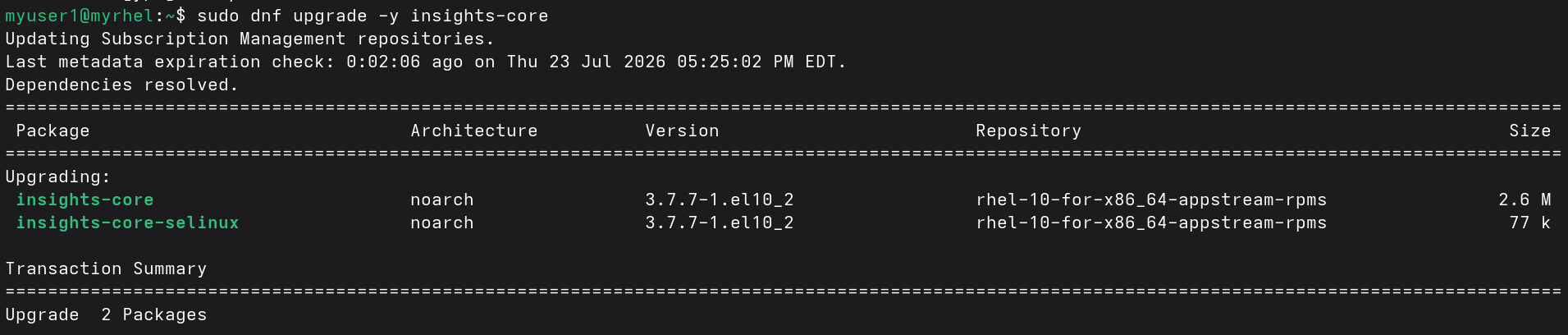
Terminal output showing the sudo dnf upgrade -y insights-core command successfully updating the insights-core package on a RHEL system
A natural fit for Red Hat Satellite
This change is particularly valuable for organizations managing RHEL through Red Hat Satellite. Previously, insights-core updated outside of Satellite's content management model. One small part of your RHEL stack was always operating on its own terms.
Now, insights-core is just another package in your content view. Sync it, promote it through your environments, and let Satellite deliver it to your managed hosts in exactly the same way you manage everything else. Simply ensure the AppStream repository is included in your content view, and insights-core will be available alongside the rest of your RHEL content. Organizations with strict change control policies gain full visibility into when and how insights-client's analysis rules change, without any additional tooling or process.
For Satellite-managed fleets, the result is a more consistent, more governable infrastructure with one less exception to manage.
No disruption, no migration
Adopting the new delivery model requires no special action. Fresh installations of RHEL 9.8 and RHEL 10.2 automatically include the new insights-core RPM. Systems upgraded from earlier versions switch to the RPM model as part of the standard upgrade process.
The Python egg update model remains in place for teams on RHEL 8, RHEL 9.0-9.7, or RHEL 10.0-10.1.
Part of a broader direction
These updates reflect our ongoing work to improve our client tools, focusing on standardization, predictability, and integration with the management platforms enterprises already use. As Red Hat continues to simplify and unify the client tools, these foundations, including standard RPM packaging, Satellite integration, and alignment with existing workflows, are what that next chapter is built on.
For full technical details, see the KBase article: Security improvements and new distribution method for insights-client (https://access.redhat.com/articles/7139622).
Prova prodotto
Red Hat Enterprise Linux | Versione di prova
Sull'autore
Christian Marineau is a Senior Product Manager at Red Hat working on client tools for Red Hat Enterprise Linux and Red Hat Lightspeed. A former sysadmin and DevOps engineer, he focuses on improving the ways users connect their systems to Red Hat. Outside of work, he enjoys hockey, skiing, and spending time with his dogs.
Altri risultati simili a questo
Red Hat Ansible All-Stars: alla guida del futuro dell'automazione delle reti e dell'infrastruttura
Unifica i flussi di lavoro IT in modo scalabile con il nuovo automation orchestrator per Ansible Automation Platform
Random Acts Of Automation | Compiler
Untangling Networks | Compiler
Scopri di più
- Ebook: Gestire l'infrastruttura composta da più ambienti cloud
- Ebook: Un framework IT efficiente come base per il successo dell'impresa moderna
- Inizia la tua prova: Red Hat Enterprise Linux
Ricerca per canale

Automazione
Novità sull'automazione IT di tecnologie, team e ambienti

Intelligenza artificiale
Aggiornamenti sulle piattaforme che consentono alle aziende di eseguire carichi di lavoro IA ovunque

Hybrid cloud open source
Scopri come affrontare il futuro in modo più agile grazie al cloud ibrido

Sicurezza
Le ultime novità sulle nostre soluzioni per ridurre i rischi nelle tecnologie e negli ambienti

Edge computing
Aggiornamenti sulle piattaforme che semplificano l'operatività edge

Infrastruttura
Le ultime novità sulla piattaforma Linux aziendale leader a livello mondiale

Applicazioni
Approfondimenti sulle nostre soluzioni alle sfide applicative più difficili

Virtualizzazione
Il futuro della virtualizzazione negli ambienti aziendali per i carichi di lavoro on premise o nel cloud
