
In this blog post, I explain how you can use Red Hat Offline Knowledge Portal to provide access to Red Hat documentation in environments with limited or no connectivity to the internet.
The Red Hat Offline Knowledge Portal is a secure offline version of Red Hat's proprietary knowledge content for our products. It's a pocket library of our award-winning knowledgebase, product documentation, CVEs, errata, and more that's light enough to run at the edge. Offline Knowledge Portal is useful anywhere Red Hat products are used where connectivity is limited, from intentionally disconnected secure sites to situations with planned intervals of low or no bandwidth. As a single small container image, it is easy to install and use, and is compatible with Red Hat OpenShift, Podman, or any OCI-compliant container runtime.
To get access to all the information included in the Offline Knowledge Portal, you need a Red Hat Satellite subscription to generate an access key.
However, even without a Satellite subscription, the Offline Knowledge Portal provides value to all Red Hat customers, as it provides access to the product documentation, security data API documentation, and product life cycle information, without any access key. All you need to do is:
1. Log in
2. Get the image
Use podman to get the image:
podman pull registry.redhat.io/offline-knowledge-portal/rhokp-rhel9:latest3. Transfer the image and run
Next, transfer the image to the host where you want to run the container. To run it, use podman:
podman run –rm –detach -p 8080:8080 registry.redhat.io/offline-knowledge-portal/rhokp-rhel9:latestAccess the Offline Knowledge Portal from your browser at http://localhost:8080.
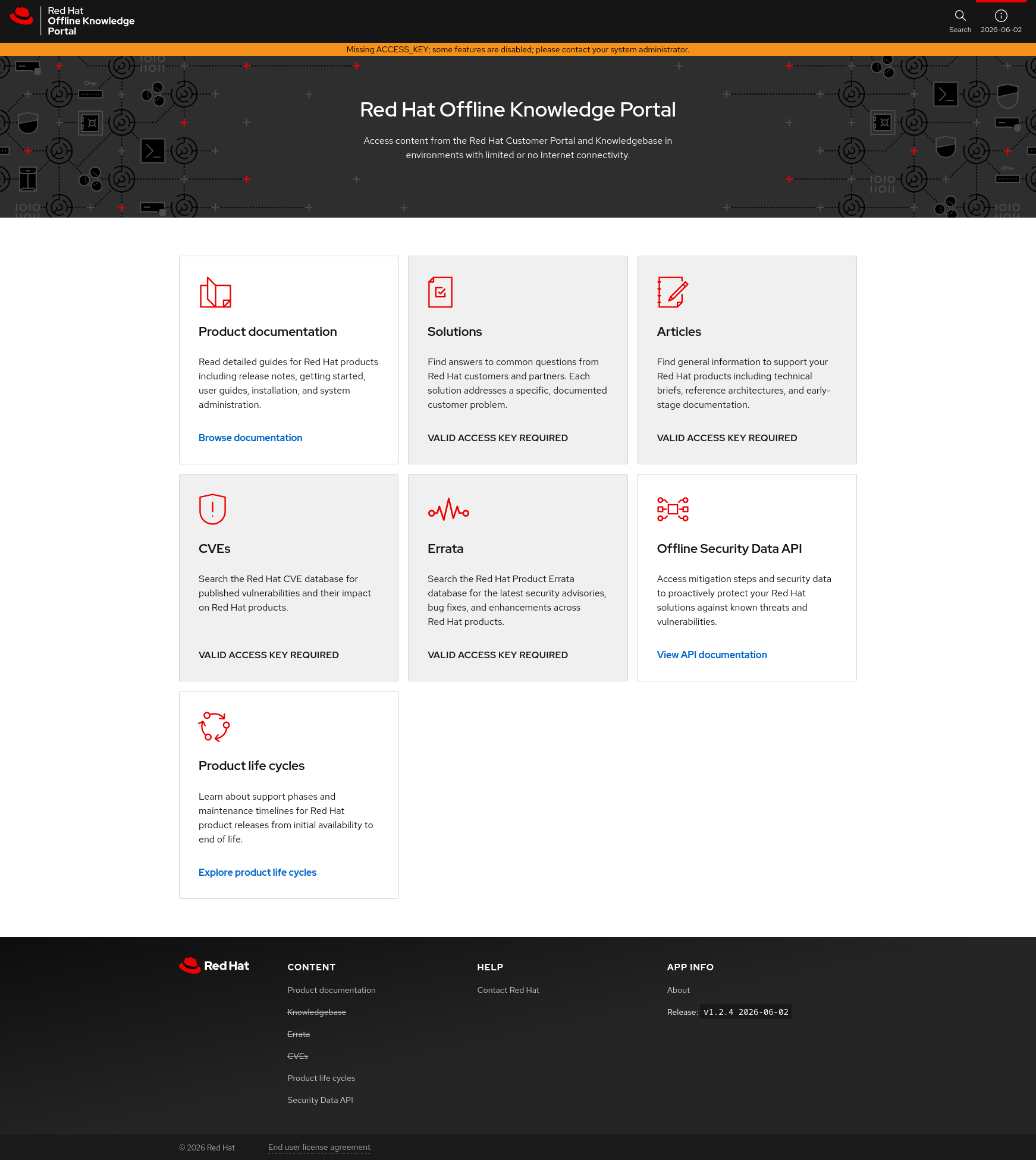
Screenshot of the Red Hat Offline Knowledge Portal with access to product documentation, offline security data API docs, and product life cycles only.
The content that requires a valid access key is marked with a grey background and the text “VALID ACCESS KEY REQUIRED”. You can access all remaining content without a key.
Using this method, you can provide access to Red Hat documentation for your users and peers without granting them internal access to an important system. If you find the content useful, reach out to your sales representative to learn more about Red Hat Satellite subscriptions.
Using Offline Knowledge Portal with an access key to enable all content
To enable access to proprietary content, you need an access key. When you have an active Satellite subscription, just follow the process outlined in our documentation. Those instructions will help you deploy the Offline Knowledge Portal, and it includes the steps to generate and use an access key.
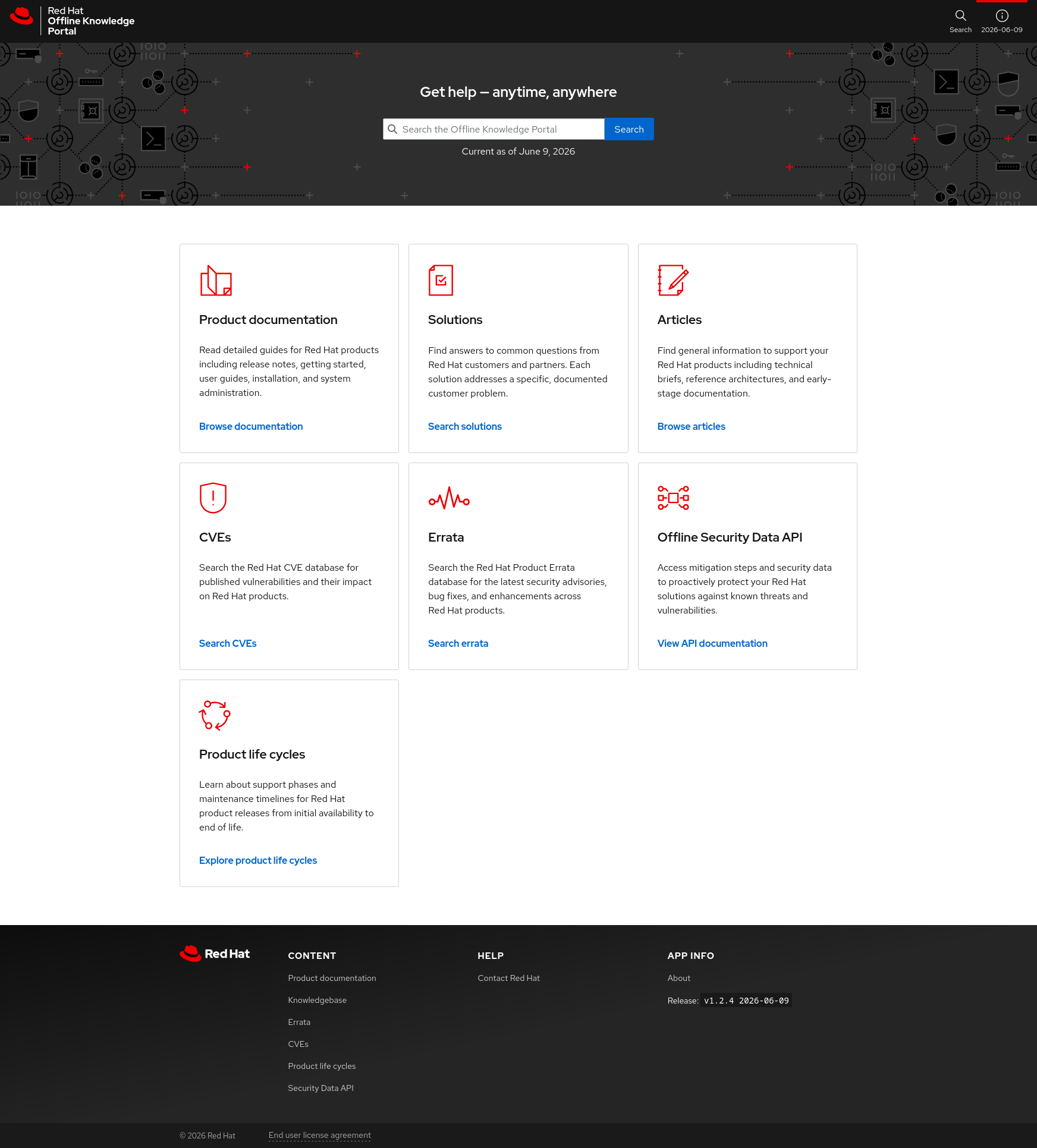
Screenshot of the Red Hat Offline Knowledge Portal with full access to all included content.
Conclusion
Whether or not you have an active Red Hat Satellite subscription, the Offline Knowledge Portal can provide value to all Red Hat customers in environments with restricted or limited network connectivity.
For more information:
Hatville: la città in miniatura in cui l'edge computing serve tutti gli scenari di utilizzo
Sull'autore
Husband, Father, Firefighter, 1x Engineer, Jedi and Trekkie.
Altri risultati simili a questo
Il tempo è prezioso: perché per il settore finanziario è necessario attivare subito la sicurezza post-quantistica
Red Hat Enterprise Linux Long-Life Add-On: un percorso verso RHEL senza una scadenza predeterminata
Infrastructure At The Edge | Compiler
Operating System Management | Compiler
Ricerca per canale

Automazione
Novità sull'automazione IT di tecnologie, team e ambienti

Intelligenza artificiale
Aggiornamenti sulle piattaforme che consentono alle aziende di eseguire carichi di lavoro IA ovunque

Hybrid cloud open source
Scopri come affrontare il futuro in modo più agile grazie al cloud ibrido

Sicurezza
Le ultime novità sulle nostre soluzioni per ridurre i rischi nelle tecnologie e negli ambienti

Edge computing
Aggiornamenti sulle piattaforme che semplificano l'operatività edge

Infrastruttura
Le ultime novità sulla piattaforma Linux aziendale leader a livello mondiale

Applicazioni
Approfondimenti sulle nostre soluzioni alle sfide applicative più difficili

Virtualizzazione
Il futuro della virtualizzazione negli ambienti aziendali per i carichi di lavoro on premise o nel cloud
