
According to the Sysdig 2021 Container Security and Usage Report, container security is a growing concern for many organizations. However, there are still some gaps. Container image scanning and privileged containers are two of the most crucial aspects.
Podman rootless containers (see Running rootless Podman as a non-root user and Rootless containers with Podman: The basics) and OpenShift Container Platform both implement the principle of least privilege by default, which helps administrators to enforce security best practices. Red Hat quay.io and Red Hat quay container registry offerings help administrators and developers incorporate image vulnerability scanning into their CI/CD pipelines.
[ You might also enjoy reading: Improved systemd integration with Podman 2.0 ]
Red Hat manages quay.io, a hosted public container registry. Individuals or enterprises can use the registry for storing and sharing container images (within an organization or to the general public). Red Hat Universal Base Images (UBI) are based on RHEL and offer a way to build and share your application images freely.
The registry has a built-in security scanner that checks the images for vulnerabilities, provides details about the packages in the image, and identifies the vulnerabilities with their associated fixes. It organizes the vulnerabilities into Low, Medium, and High severity categories. It also provides metadata like the CVE number and a link to the errata related to the vulnerabilities. As container images age, new CVEs are discovered, so for this article, we'll take a look at an older version of UBI. For example, at the time of writing this article, one of the specific builds of ubi8 (8.2-299) has the following output highlighting 178 packages (10 packages with High impact) and 38 vulnerabilities (10 High).

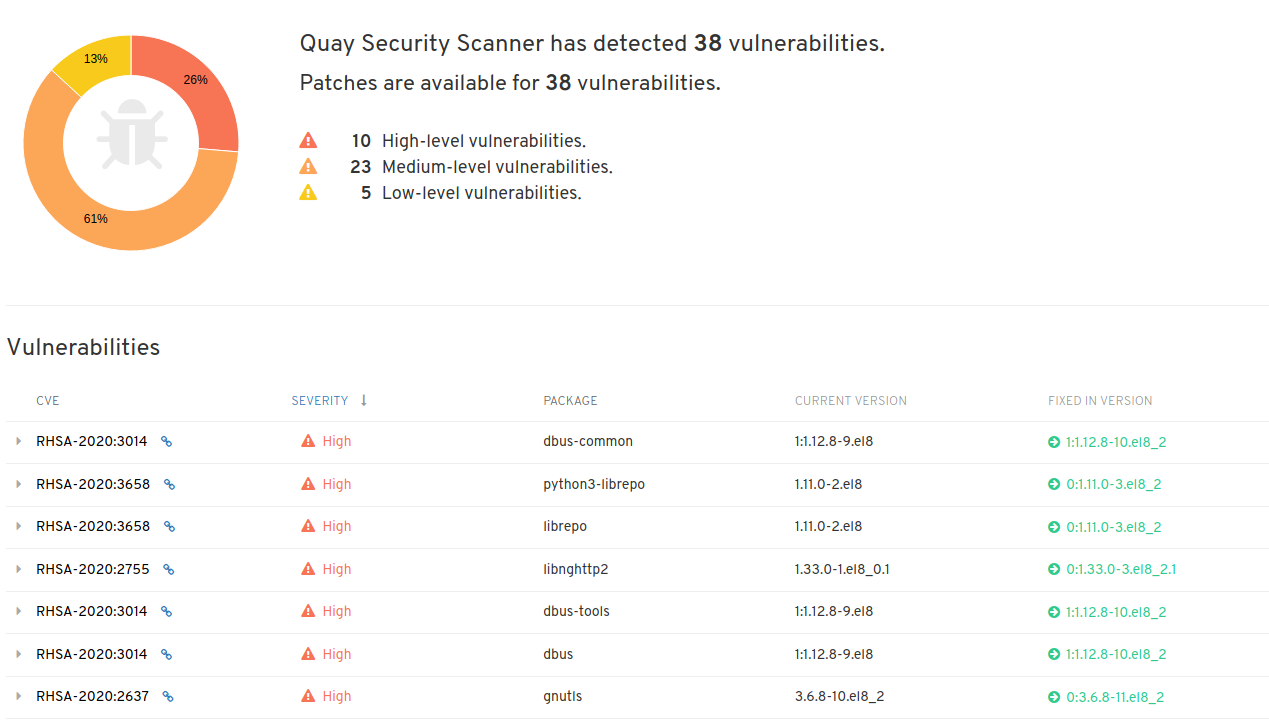
The quay.io UI provides the information related to the vulnerabilities in a user-friendly format. One can browse the list of packages, check the packages impacted, and view the vulnerability details. However, with organizations focused on DevSecOps, it is beneficial to get this information on the fly and utilize it before each deployment to ensure that only secure images make it to the production environment.
This article assumes some basic familiarity with quay.io concepts like repositories, robot accounts, and general tasks like image builds (using DockerFiles) and image tagging. In case you are interested in learning more about these concepts, you can refer to the quay.io User Guides.
In order to get the scanning information via the command line, use the skopeo and jq commands. Skopeo allows users to not only inspect images without downloading them onto a local machine first, but it also supports copying images from one repository (local or remote) to another.
The following command will fetch the image metadata similar to the docker inspect command executed against a local image:
# IMAGE_NAME='app-sre/ubi8-ubi'
# IMAGE_TAG='8.2-299'
# skopeo inspect docker://quay.io/$IMAGE_NAME:$IMAGE_TAG
To get the image's unique digest, we can parse the received json output using the jq command.
# IMAGE_DIGEST=`skopeo inspect docker://quay.io/$IMAGE_NAME:$IMAGE_TAG | jq -r .Digest`
With the digest, you can get the security report for the image by querying the quay.io APIs. We can store the output (json file) in a local file and utilize jq to filter for the desired content.
# curl -o `basename $IMAGE_NAME`.json https://quay.io/api/v1/repository/$IMAGE_NAME/manifest/$IMAGE_DIGEST/security?vulnerabilities=true
For example, to get the information pertaining to High severity vulnerabilities with the associated Advisory ID, Advisory URL, Package Name, its Affected version, and the version that contains the fixes, the following command can be utilized:
jq '.data.Layer.Features[]' `basename $IMAGE_NAME`.json | jq -c '{"Name":.Name,"Version":.Version,"Advisory":.Vulnerabilities[]} | select(.Advisory.Severity=="High") | {"Advisory":.Advisory.Name,"Link":.Advisory.Link,"PACKAGE":.Name,"CURRENT VERSION":.Version,"FIXED IN VERSION":.Advisory.FixedBy }'
The command produces an output like the following indicating that this UBI image (app-sre/ubi8-ubi) has 10 advisory notifications:
{"Advisory":"RHSA-2020:3014","Link":"https://access.redhat.com/errata/RHSA-2020:3014","PACKAGE":"dbus-tools","CURRENT VERSION":"1:1.12.8-9.el8","FIXED IN VERSION":"1:1.12.8-10.el8_2"}
{"Advisory":"RHSA-2020:3658","Link":"https://access.redhat.com/errata/RHSA-2020:3658","PACKAGE":"librepo","CURRENT VERSION":"1.11.0-2.el8","FIXED IN VERSION":"0:1.11.0-3.el8_2"}
{"Advisory":"RHSA-2020:3014","Link":"https://access.redhat.com/errata/RHSA-2020:3014","PACKAGE":"dbus-libs","CURRENT VERSION":"1:1.12.8-9.el8","FIXED IN VERSION":"1:1.12.8-10.el8_2"}
{"Advisory":"RHSA-2020:3014","Link":"https://access.redhat.com/errata/RHSA-2020:3014","PACKAGE":"dbus-common","CURRENT VERSION":"1:1.12.8-9.el8","FIXED IN VERSION":"1:1.12.8-10.el8_2"}
{"Advisory":"RHSA-2020:3014","Link":"https://access.redhat.com/errata/RHSA-2020:3014","PACKAGE":"dbus-daemon","CURRENT VERSION":"1:1.12.8-9.el8","FIXED IN VERSION":"1:1.12.8-10.el8_2"}
{"Advisory":"RHSA-2020:2755","Link":"https://access.redhat.com/errata/RHSA-2020:2755","PACKAGE":"libnghttp2","CURRENT VERSION":"1.33.0-1.el8_0.1","FIXED IN VERSION":"0:1.33.0-3.el8_2.1"}
{"Advisory":"RHSA-2020:5476","Link":"https://access.redhat.com/errata/RHSA-2020:5476","PACKAGE":"openssl-libs","CURRENT VERSION":"1:1.1.1c-15.el8","FIXED IN VERSION":"1:1.1.1g-12.el8_3"}
{"Advisory":"RHSA-2020:3658","Link":"https://access.redhat.com/errata/RHSA-2020:3658","PACKAGE":"python3-librepo","CURRENT VERSION":"1.11.0-2.el8","FIXED IN VERSION":"0:1.11.0-3.el8_2"}
{"Advisory":"RHSA-2020:2637","Link":"https://access.redhat.com/errata/RHSA-2020:2637","PACKAGE":"gnutls","CURRENT VERSION":"3.6.8-10.el8_2","FIXED IN VERSION":"0:3.6.8-11.el8_2"}
{"Advisory":"RHSA-2020:3014","Link":"https://access.redhat.com/errata/RHSA-2020:3014","PACKAGE":"dbus","CURRENT VERSION":"1:1.12.8-9.el8","FIXED IN VERSION":"1:1.12.8-10.el8_2"}
[ Free course: Red Hat Satellite Technical Overview. ]
Wrap up
In the next part of this article series, I incorporate the information from this article into a sample pipeline to make informed decisions about whether to proceed forward with this image and deploy applications into production.
Sull'autore
Vishal Bhatia is part of Red Hat’s Cloud Architects team for the MENA region. He is based in Dubai and is responsible for helping organizations with their digital transformation journey and adoption of open source technologies. Vishal has extensive experience in Linux Administration and Automation, Cloud Computing, OpenShift, and Scalable Web Architectures
Altri risultati simili a questo
Gestisci le macchine virtuali su Red Hat OpenShift con Service Mesh
Red Hat Enterprise Linux Long-Life Add-On: un percorso verso RHEL senza una scadenza predeterminata
Scaling with Orchestrators | Compiler
Container Roundup | Compiler
Ricerca per canale

Automazione
Novità sull'automazione IT di tecnologie, team e ambienti

Intelligenza artificiale
Aggiornamenti sulle piattaforme che consentono alle aziende di eseguire carichi di lavoro IA ovunque

Hybrid cloud open source
Scopri come affrontare il futuro in modo più agile grazie al cloud ibrido

Sicurezza
Le ultime novità sulle nostre soluzioni per ridurre i rischi nelle tecnologie e negli ambienti

Edge computing
Aggiornamenti sulle piattaforme che semplificano l'operatività edge

Infrastruttura
Le ultime novità sulla piattaforma Linux aziendale leader a livello mondiale

Applicazioni
Approfondimenti sulle nostre soluzioni alle sfide applicative più difficili

Virtualizzazione
Il futuro della virtualizzazione negli ambienti aziendali per i carichi di lavoro on premise o nel cloud
