
To effectively prioritize an organization’s collection of work, including operational services and projects to support products and innovation, leading organizations develop standard evaluation criteria to make data-driven decisions. These data-driven decisions help leadership make the right investments and ensure the organization is working on the most impactful work to improve competitive advantage. An organization’s decision makers should build simple and clear data requirements to enhance decision making and to better inform leadership and stakeholders.
Portfolio planning is the alignment of an organization's corporate strategy to data-driven decisions about capabilities and resources to achieve desired business outcomes. Effective portfolio planning and management capabilities should provide the organization with dashboards, reports, and analytics to inform better decision making.
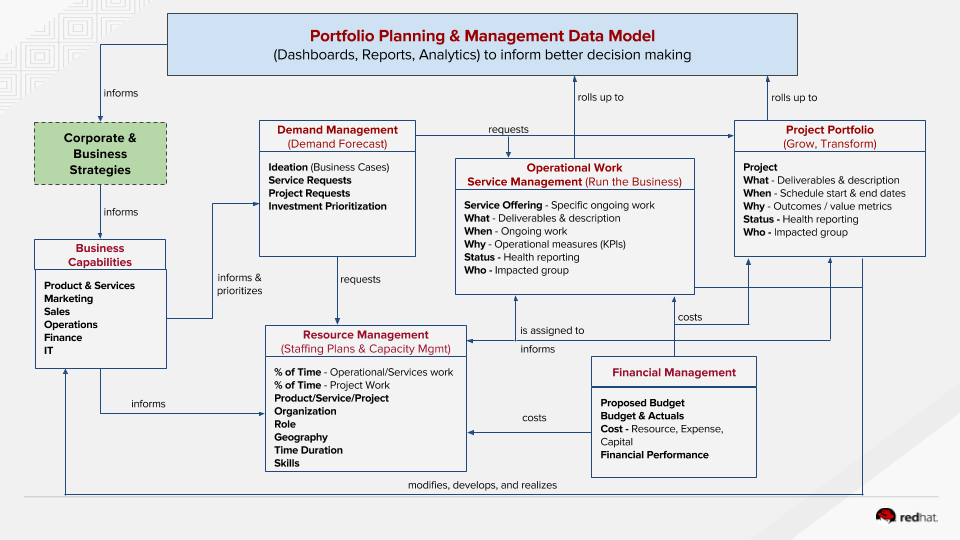
The portfolio planning and management data model in the figure is used to represent the primary data needed to provide the organization’s leadership and stakeholders with the right information about operational services, projects, resources, and financing. Corporate and business strategies inform what business capabilities are required to prioritize the new work requested of the organization.
The business capabilities and architecture overview was highlighted in the last blog, and it defines what the business needs to do to achieve its strategies and how the business operates to realize desired business outcomes or results.
Demand management includes the information and investment prioritization from business cases to prove why a new product, service, or project request is needed to modify, develop, or realize business capabilities.
The information needed for decision making is simplified and similar across the operational service data to run the business or project portfolio data to grow and transform the business. This data highlights what is being delivered with a concise description, when will the business and stakeholders receive the deliverable, and why it adds value to the organization in terms of operational KPIs or business value metrics. Additionally, the data should identify the impacted business and stakeholder groups and what costs are associated with the staffing resources, expenses, and capital required for the investments.
The primary data for the operational services and projects is important to establish in order to allocate staffing resources to each body of work. Resources are allocated to these bodies of work by a percentage of time, by organization, role, geography, time duration, and skills required to support the work. The allocation and capacity management of an organization's staffing resources ensures that the right people and roles, in the right geographies, at the right time, with the right skills are in place to effectively manage and execute the required work.
All of the data entities and attributes have associated costs and the organization should track and measure the data required to forecast, budget, and measure the financial performance associated with ongoing services, projects and staffing resources.
In conclusion, understanding the primary information about operational services and projects and the associated staffing and financing is paramount in order to effectively obtain and manage the data required to make better decision making for an organization’s portfolio planning and management practices.
Sull'autore
Altri risultati simili a questo
Oltre l'orizzonte: percorriamo il ponte tra la tecnologia di oggi e l'IA del futuro
Introducing Quarkus on Red Hat OpenShift
Communicating the Value of Connecting Systems | Code Comments
Ricerca per canale

Automazione
Novità sull'automazione IT di tecnologie, team e ambienti

Intelligenza artificiale
Aggiornamenti sulle piattaforme che consentono alle aziende di eseguire carichi di lavoro IA ovunque

Hybrid cloud open source
Scopri come affrontare il futuro in modo più agile grazie al cloud ibrido

Sicurezza
Le ultime novità sulle nostre soluzioni per ridurre i rischi nelle tecnologie e negli ambienti

Edge computing
Aggiornamenti sulle piattaforme che semplificano l'operatività edge

Infrastruttura
Le ultime novità sulla piattaforma Linux aziendale leader a livello mondiale

Applicazioni
Approfondimenti sulle nostre soluzioni alle sfide applicative più difficili

Virtualizzazione
Il futuro della virtualizzazione negli ambienti aziendali per i carichi di lavoro on premise o nel cloud
