Introduction
Mutual TLS (mTLS), which provides trusted communication between both a client and a server, is a primary motivation for using Red Hat Openshift Service Mesh. With a simple configuration all communication between services in a mesh can communicate with mTLS but if your organization has a requirement to implement Multicluster Service Meshes, you can still utilize mTLS for cross-cluster communication provided that both Service Mesh Control Planes (SMCPs) are configured to use the same root certificate authority (CA) when signing workload certificates. Additionally, mTLS can be performed directly from a sidecar to another control plane's ingress gateway. The result is federated trust between SMCPs.
Example
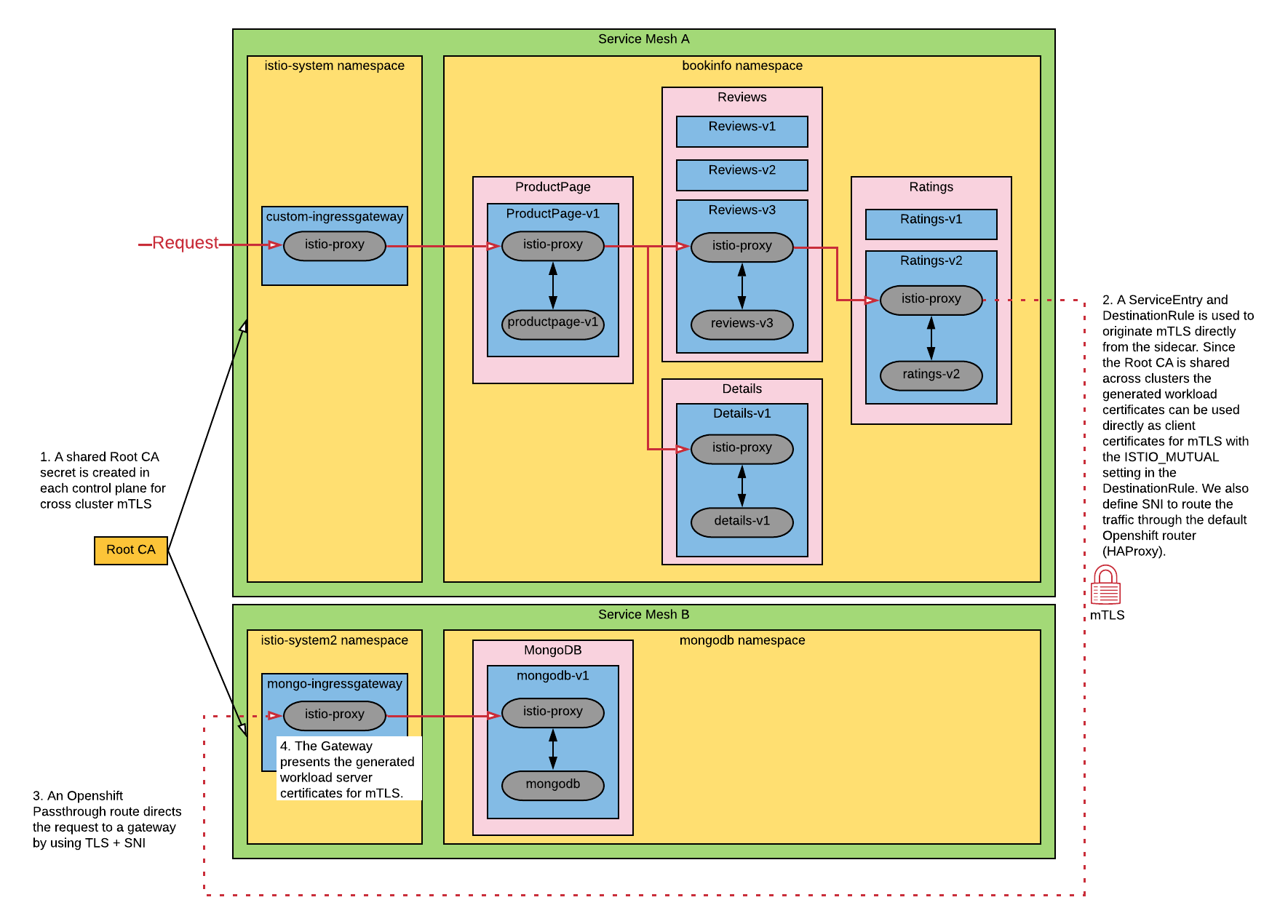
This example differs from Istio's Replicated control planes Multicluster Installation example in that we aren't configuring DNS since, as of this writing, the istiocoredns feature is not currently supported with Red Hat Openshift Service Mesh (though it is on the roadmap - see the slides on whats-new). For this reason, we need to manually create ServiceEntries because services are not auto-discovered between SMCPs without this feature.
We deploy the bookinfo application into a control plane and configure the ratings-v2 application to communicate to a mongo instance in a different control plane via an ingress gateway. A ServiceEntry and DestinationRule is used to instruct the sidecar to originate mTLS using the generated workload certificates from Citadel. The Gateway defined for the mongo ingress gateway within the other control plane is also configured to present its own generated workload certificates for mTLS.
A single OCP cluster is used to demonstrate this configuration, but since communication is performed via the exposed Openshift Route between control planes one could deploy the mongodb control plane and application in a different Openshift cluster with the same result.
Setup
This code is hosted in this GitHub repository.
#Service Mesh A
oc new-project istio-system
oc new-project bookinfo
oc new-project cert-manager

#Service Mesh B
oc new-project istio-system2
oc new-project mongodb
Deploy cert-manager (skip if already present in the cluster)
#Service Mesh A
oc apply --validate=false -f https://github.com/jetstack/cert-manager/releases/download/v0.15.0/cert-manager.yaml
Deploy local root CA to both control planes
#Service Mesh A
helm upgrade -i cert-manager -n istio-system helm/cert-manager

export tls_crt=$(oc get secret rootca -n istio-system -o jsonpath='{.data.tls\.crt}')
export tls_key=$(oc get secret rootca -n istio-system -o jsonpath='{.data.tls\.key}')

helm upgrade -i rootca helm/install-cacerts -n istio-system \
  --set rootca.tls_crt=${tls_crt} \
  --set rootca.tls_key=${tls_key}

#Service Mesh B
helm upgrade -i rootca helm/install-cacerts -n istio-system2 \
  --set rootca.tls_crt=${tls_crt} \
  --set rootca.tls_key=${tls_key}
Install control planes using common root cacerts
Note: with the below configuration defined in the SMCP, Citadel will use the cacerts secret (created in both control planes from previous commands) as the root certificate instead of its own self-signed certificate.
apiVersion: maistra.io/v1
kind: ServiceMeshControlPlane
metadata:
  name: basic-install
spec:
  istio:
    security:
      selfSigned: false
...
#Service Mesh A
helm upgrade -i istio-system-control-plane -n istio-system helm/istio-system-control-plane
#Service Mesh B
helm upgrade -i istio-system2-control-plane -n istio-system2 helm/istio-system2-control-plane
Install mongodb in istio-system2
#Service Mesh B
helm upgrade -i mongodb helm/mongodb -n mongodb --set mongodb.host=$(oc get route mongo -n istio-system2 -o jsonpath={.spec.host})
Create user and add ratings data to mongodb
#Service Mesh B
oc exec deploy/mongodb-v1 -c mongodb -n mongodb -i -t -- /bin/bash -c "cat <<EOF | mongo -u admin -p redhat --authenticationDatabase admin
use test
db.createUser(
   {
     user: \"bookinfo\",
     pwd: \"redhat\",
     roles: [ \"read\"]
   }
);
db.createCollection(\"ratings\");
db.ratings.insert(
  [{rating: 1},
   {rating: 1}]
);
db.ratings.find({});
EOF"
Install bookinfo in istio-system
Note: Service entries for TCP traffic should have CIDR addresses defined. The bookinfo ratings v2 application will use the mongodb ServiceEntry.
#Service Mesh B
export IP_ADDRESSES=$(echo "{$(echo $(host $(oc get route mongo -n istio-system2 -o jsonpath={'.spec.host'}) | cut -d" " -f4) | sed -e "s/ /,/g")}")
# or set manually, for example IP_ADDRESSES={3.131.22.164,3.129.227.164}
export MONGODB_HOST=$(oc get route mongo -n istio-system2 -o jsonpath={.spec.host})

#Service Mesh A
helm upgrade -i bookinfo helm/bookinfo -n bookinfo \
  --set mongodb.host=${MONGODB_HOST} \
  --set control_plane.ingressgateway.host=$(oc get route api -n istio-system -o jsonpath={'.spec.host'}) \
  --set mongodb.addresses=${IP_ADDRESSES}
Verify mTLS works between SMCP domains
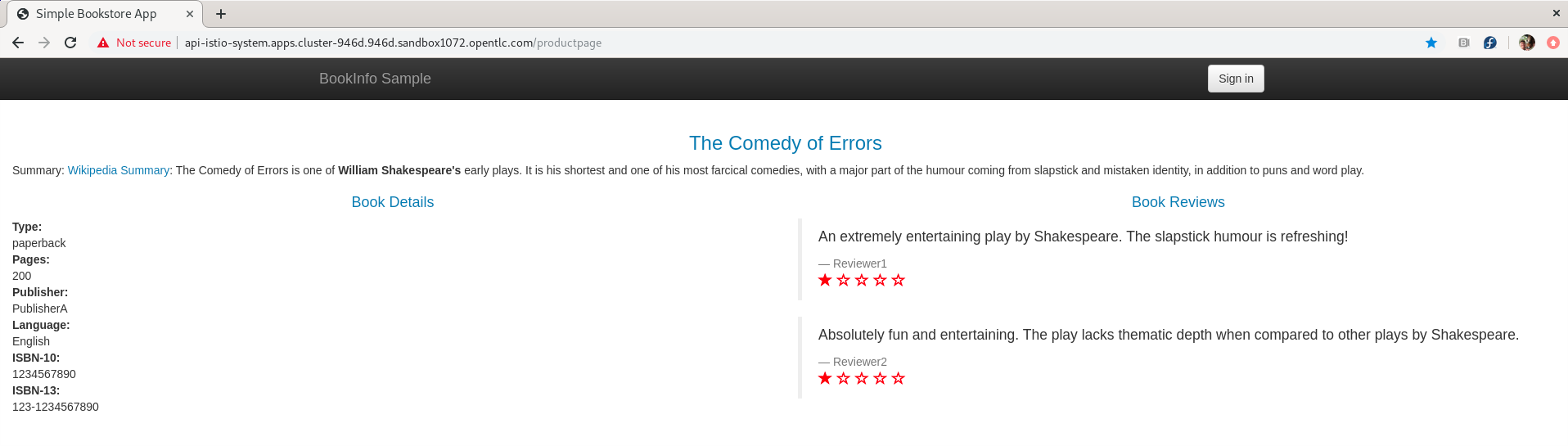
Open the following url in a web browser. If you get the single ratings star it works.
#Service Mesh A
echo "https://$(oc get route api -n istio-system -o jsonpath={'.spec.host'})/productpage"
Misc
How to regenerate Istio workload certificates in a namespace
SECRETS=$(oc get secrets -n istio-system -o name | egrep 'istio\.')
for s in $SECRETS; do oc delete $s -n istio-system; done
Sull'autore

Trevor Box has been a Red Hatter since 2018 and concentrates on container platforms and their adoption.
Altri risultati simili a questo
Smetti di gestire il passato e inizia a costruire il futuro dell'IT
Il prossimo punto di svolta dell'IA: trasformare gli agenti in superutenti aziendali
Collaboration In Product Security | Compiler
Keeping Track Of Vulnerabilities With CVEs | Compiler
Ricerca per canale

Automazione
Novità sull'automazione IT di tecnologie, team e ambienti

Intelligenza artificiale
Aggiornamenti sulle piattaforme che consentono alle aziende di eseguire carichi di lavoro IA ovunque

Hybrid cloud open source
Scopri come affrontare il futuro in modo più agile grazie al cloud ibrido

Sicurezza
Le ultime novità sulle nostre soluzioni per ridurre i rischi nelle tecnologie e negli ambienti

Edge computing
Aggiornamenti sulle piattaforme che semplificano l'operatività edge

Infrastruttura
Le ultime novità sulla piattaforma Linux aziendale leader a livello mondiale

Applicazioni
Approfondimenti sulle nostre soluzioni alle sfide applicative più difficili

Virtualizzazione
Il futuro della virtualizzazione negli ambienti aziendali per i carichi di lavoro on premise o nel cloud
