
Virtualization isn’t going away any time soon.
Alongside the ever-growing need to modernize and move towards a more elastic, agile, and scalable cloud native infrastructure, many organizations also need to run, maintain, and in a lot of cases grow their traditional virtualization environment.
As a leader in cloud infrastructure, with Red Hat OpenStack Platform and Red Hat OpenShift, Red Hat is in a unique position to offer an integrated approach for customers to enjoy the best of both worlds. How exactly? Let's see!
Red Hat OpenStack Platform Director Operator: What is it?
Director Operator is a Kubernetes Operator-backed deployment method which leverages Kubernetes CRDs, Multus 2nd interfaces, Metal3, Red Hat OpenShift Virtualization and TripleO-Ansible to provide a hybrid deployment solution for both container native workloads and traditional VMs side by side. This deployment methodology will future-proof the workload infrastructure for container-native applications while having it host the traditional VMs with Red Hat OpenStack Platform.
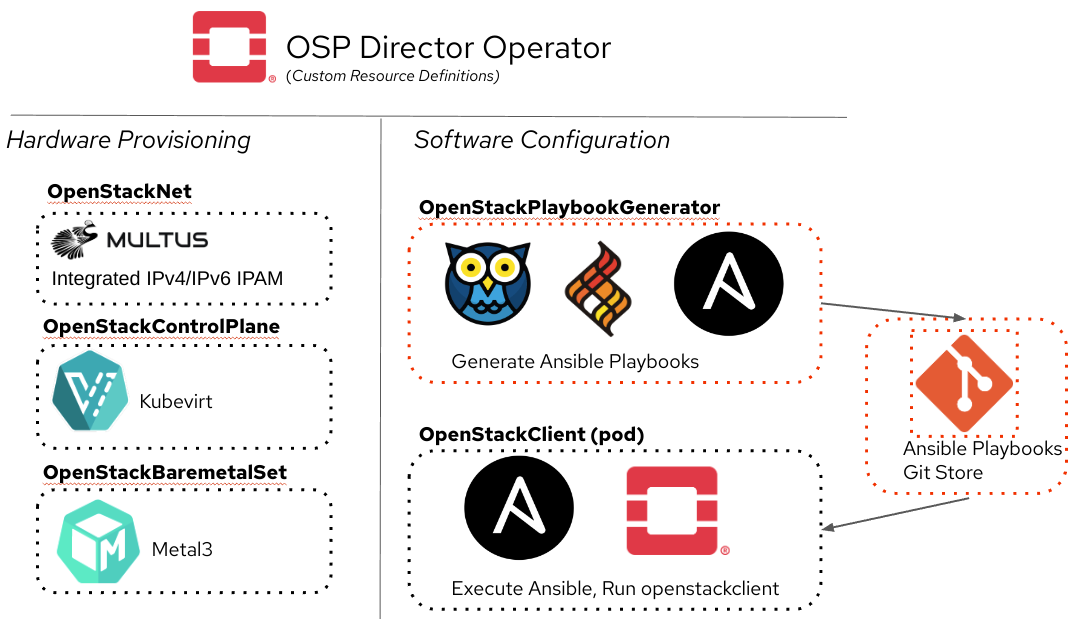
Since the Director Operator is not a net new installer but rather uses TripleO Heat, it maintains the traditional director templating structure, but with a twist! Now said templates are being consumed by a configmap called by a CRD to generate from the Ansible content that will be deployed on the target nodes.
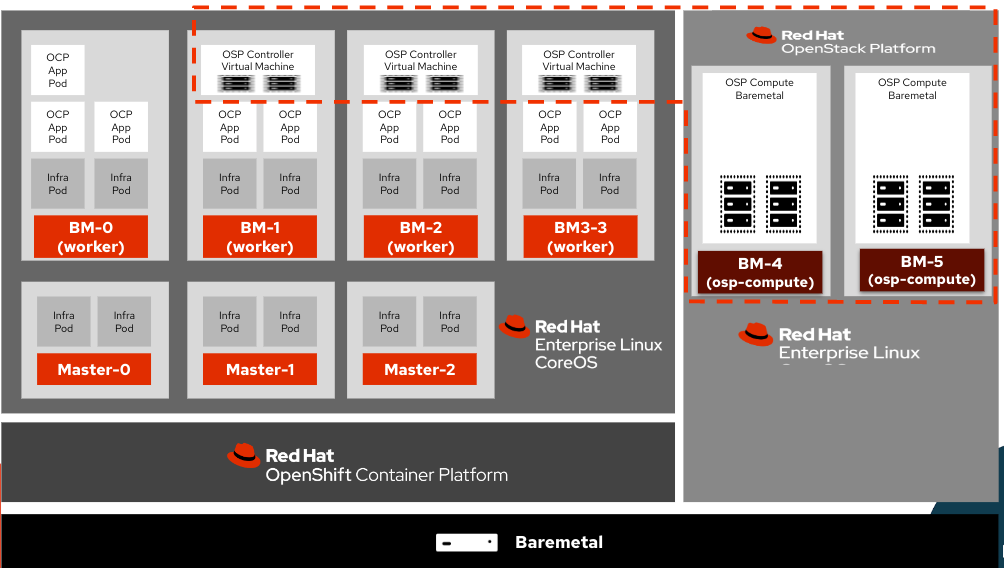
The controller nodes are based on OpenShift Virtualization VMs and are provisioned by calling the ctlplne CRD while the compute nodes andHCI Nodes are being called by the compute provision CRD from the OpenShift Cluster Metal3 inventory. Since, this inventory is shared with the OpenShift infrastructure and the bare metal nodes in it can be repurposed to expand either the OpenStack cluster or the OpenShift cluster if needed.
The Deployment Flow steps using OpenStack Director Operator

Once the deployment finishes the environment will look like this:
- Red Hat OpenStack Platform has a 5 year long life cycle for which our customers plan critical workloads and certifications that are tied to both an API and host operating system (RHEL).
- In most use cases, the Red Hat OpenStack Platform dataplane is being used to run critical applications which cannot tolerate multiple downtimes. Even if the host OpenShift infrastructure is being updated, the workloads will continue to run without interference.
Join us for the next blog in this series in which we will explore the set-by-step guide on how to deploy a Red Hat OpenStack Platform director operator OpenStack cloud.
Sull'autore
Altri risultati simili a questo
Modernizzazione della virtualizzazione nell'istruzione superiore: in che modo il ripristino automatico dei nodi protegge l'integrità dei dati
Perché le aziende rimandano le decisioni sulla virtualizzazione
Virtualization Is (Still) King | Compiler
Crack the Cloud_Open | Command Line Heroes
Ricerca per canale

Automazione
Novità sull'automazione IT di tecnologie, team e ambienti

Intelligenza artificiale
Aggiornamenti sulle piattaforme che consentono alle aziende di eseguire carichi di lavoro IA ovunque

Hybrid cloud open source
Scopri come affrontare il futuro in modo più agile grazie al cloud ibrido

Sicurezza
Le ultime novità sulle nostre soluzioni per ridurre i rischi nelle tecnologie e negli ambienti

Edge computing
Aggiornamenti sulle piattaforme che semplificano l'operatività edge

Infrastruttura
Le ultime novità sulla piattaforma Linux aziendale leader a livello mondiale

Applicazioni
Approfondimenti sulle nostre soluzioni alle sfide applicative più difficili

Virtualizzazione
Il futuro della virtualizzazione negli ambienti aziendali per i carichi di lavoro on premise o nel cloud
