
Happy May Fourth, everyone! A few weeks after Star Wars first released, I was lucky enough to see it in a Dolby theatre in Denver, CO. I was hooked, completely, and totally hooked. Over the past decade or so, I’ve built a really nice large screen television with surround sound setup and rarely go to the movies anymore. I wait for them to be streamed or hit Blue-Ray. I make an exception for Star Wars movies. Those I go see at least once at a theatre. Then yes, I buy a copy to watch at home when available.
[ You might also like: Stupid Bash tricks: History, reusing arguments, files and directories, functions, and more ]
As I know being a Star Wars fan is a trait that I share with many in the tech industry, I thought I’d celebrate May the Fourth with a little mix of containers and Star Wars in one. Several years ago, Simon Jansen created Star Wars Asciimation, which shows the first Star Wars movie, now called “Star Wars: Episode IV - A New Hope,” entirely in ASCII and runs over Telnet. It has made the rounds over the years and is fun to watch, but lately, trying to get it to run over Telnet can sometimes be challenging.
So after a colleague said I should run it from a container, I thought I’d try doing so. I made a few attempts at getting it to run but ran into issues with Telnet both in the container and on my host. Google to the rescue. I discovered the ascii-telnet-server project.
So on my Fedora machine, I did:
mkdir StarWars
cd StarWars
git clone https://github.com/nitram509/ascii-telnet-server
cd ascii-telnet-server
Now, if you look in this directory, you’ll notice that it’s been set up with a Dockerfile. However, the Dockerfile will play a sample movie if you use it without changing it. To play the ASCII Star Wars movie, edit this line in the Dockerfille:
ENV input_file sample_movies/short_intro.txtRemoving short_intro and replacing it with sw1 like this:
ENV input_file sample_movies/sw1.txtNow using Podman, do:
podman build -t asciistarwars .And once complete, run the container and enjoy.
podman run -it --rm -e mode=stdout asciistarwars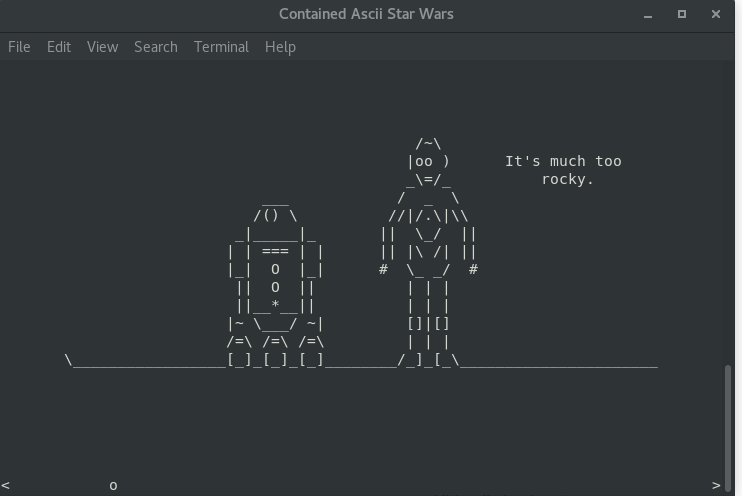
If by chance, you just want to run the movie without doing the configurations above, you can use the image that I put together on quay.io with:
podman run -it --rm -e mode=stdout quay.io/tomsweeneyredhat/asciistarwars[ Get this free ebook: Managing your Kubernetes clusters for dummies. ]
Wrap up
I thought it was a great way to get a little container fun in and celebrate May the Fourth. Now go enjoy your day, and I hope this helps you get a little Star Wars into it.
Sull'autore
Software engineer at Red Hat working on containers focusing on the Buildah and Podman projects. Manages the buildah.io and podman.io websites and can be found on freenode at #buildah and #podman. Joined the Open Source world in 2016 and wished he'd joined the community sooner. Husband and dad of 3 just trying to contain them, but has better luck containing bits and bytes with containers. When it's time to do some serious coding, it's time to crank the Bluegrass in the headphones and get the tea brewing!
Altri risultati simili a questo
Cinque motivi per cui la tua strategia di Lightwell richiede più che semplici patch
Gestisci le macchine virtuali su Red Hat OpenShift con Service Mesh
Scaling with Orchestrators | Compiler
Container Roundup | Compiler
Ricerca per canale

Automazione
Novità sull'automazione IT di tecnologie, team e ambienti

Intelligenza artificiale
Aggiornamenti sulle piattaforme che consentono alle aziende di eseguire carichi di lavoro IA ovunque

Hybrid cloud open source
Scopri come affrontare il futuro in modo più agile grazie al cloud ibrido

Sicurezza
Le ultime novità sulle nostre soluzioni per ridurre i rischi nelle tecnologie e negli ambienti

Edge computing
Aggiornamenti sulle piattaforme che semplificano l'operatività edge

Infrastruttura
Le ultime novità sulla piattaforma Linux aziendale leader a livello mondiale

Applicazioni
Approfondimenti sulle nostre soluzioni alle sfide applicative più difficili

Virtualizzazione
Il futuro della virtualizzazione negli ambienti aziendali per i carichi di lavoro on premise o nel cloud
