The telecommunications (telco) industry stands at the precipice of a new era. With 5G networks rapidly expanding, service providers face both immense opportunities and significant challenges. The promise of 5G for ultra-fast speeds, low latency, and massive connectivity hinges on the ability to operationalize these complex networks with unprecedented efficiency and rigorous security measures. Automation is not just a buzzword in this landscape; it’s how to unlock the full value of 5G.
Traditional manual processes simply cannot keep pace with the dynamic demands of modern networks. As network functions become increasingly containerized and cloud-native, the need for agile, consistent, and secure operations across hybrid and multicloud environments increases exponentially. Service providers want to invest in innovation to efficiently grow revenue, and automation is key to lowering costs and accelerating time to value on the journey to autonomous networks. Data and AI also deliver value across business and network aspects of telcos to mitigate risk, lower operational costs, and optimize resources.
One New Zealand's journey to automated 5G
One New Zealand and Red Hat recently hosted a webinar featuring Sam Sun, Account Solution Architect at Red Hat, and Art Sripukdee, Principal Architect from One New Zealand. They shared a compelling story of how One New Zealand transformed its 5G vision into reality, achieving economies of scale, efficiency, and building a network designed for growth.
One New Zealand, a leading telco provider, has consistently been at the forefront of mobile technology, from 2G to 5G, and recently launched text messaging over satellite. Their 5G rollout is not merely about new radio sites; it’s completely transforming network architecture. However, this transformation would be impossible without automation, which serves as the backbone of their network evolution.
Addressing the challenges of 5G transformation
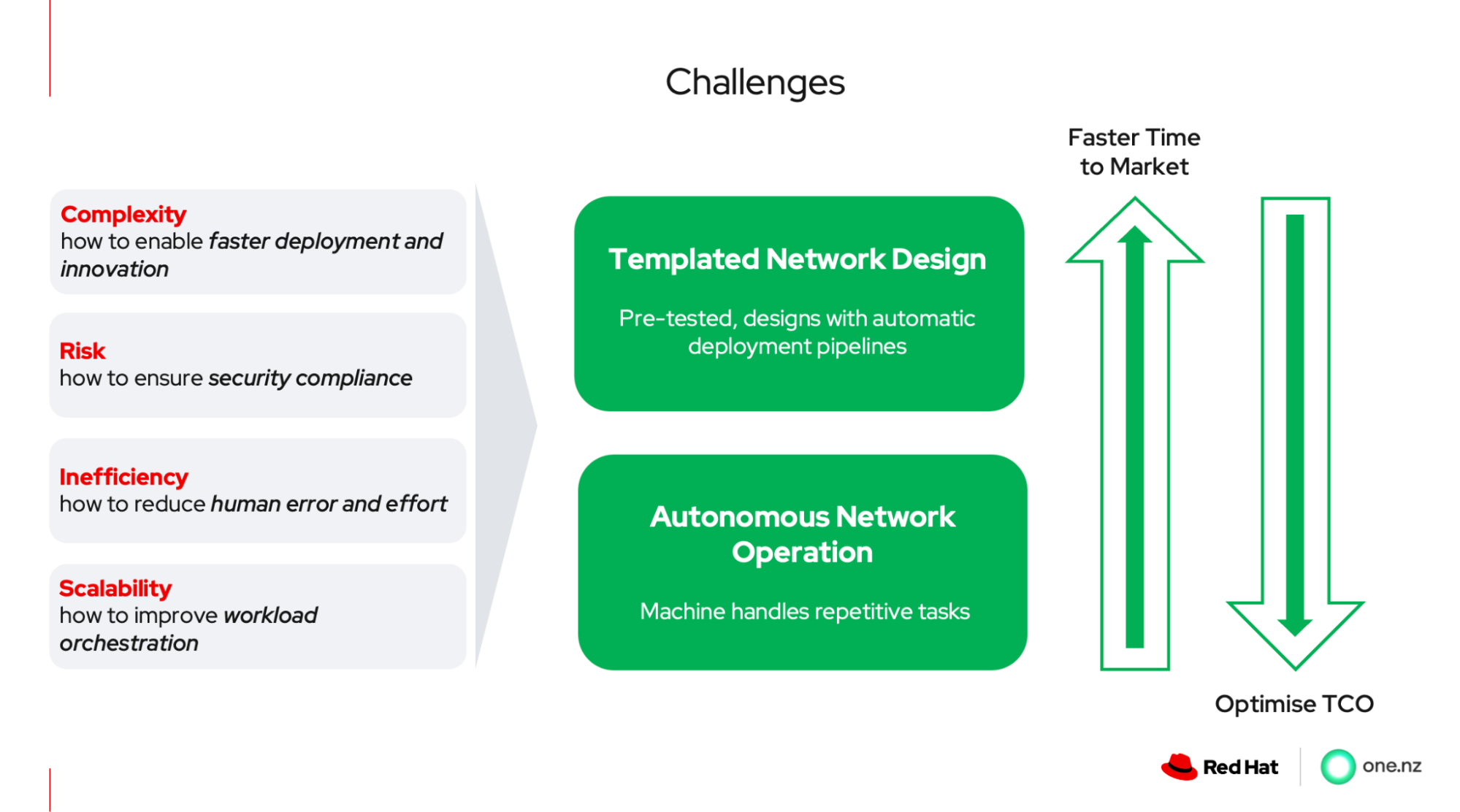
Art Sripukdee highlighted key challenges in 5G network transformation that automation helps overcome:
- Complexity: Each new 5G capability adds layers of complexity, making deployments slow and resource-heavy without the right approach.
- Risk: Ensuring strong security and compliance becomes more challenging with distributed functions. Networks must be secure and compliant by design.
- Efficiency: Human-driven processes do not scale well, introducing errors, delays, and additional costs.
- Scalability: Orchestrating workloads efficiently, reliably, and with the future in mind is crucial.
To tackle these, One New Zealand focused on 2 key areas: templated network design with automated deployment pipelines for faster, more predictable rollouts and autonomous network operations, where machines handle repetitive tasks, freeing up experts to focus on innovation and their AI strategy. These efforts lead to faster time to market for new services and optimized total cost of ownership (TCO).
The power of AI-enabled 5G automation
One New Zealand has developed an AI-enabled 5G automation framework, forming the foundation of their AI-powered operations. This framework aims to deliver 4 key outcomes: enhanced reliability through artificial intelligence/machine learning (AI/ML)-driven operations, increased efficiency with self-healing and auto-scaling, improved security with automated threat detection, and unlocked monetization through network slice as a service.
The framework is built on 3 core pillars:
- Unified containerized platform: A flexible and scalable foundation running across centralized datacenters, edge sites, on-premise private networks, and public cloud environments.
- Cloud-native 5G core application: Natively supporting auto-scaling, self-healing, in-service software upgrade rollback, energy-efficient operations, and programmability via open APIs.
- GitOps-based network automation: Managing everything as code—from bare-metal provisioning to infrastructure, policy security, and IP transport—orchestrated through a unified automation layer integrated with an AI-driven automation platform.

Automating the 5G core lifecycle
A containerized 5G core enables AI-driven operations, with full lifecycle automation across Day 0, Day 1, and Day 2 operations.
- Day 0: Defining architecture blueprints, onboarding new workloads, and establishing policy security controls and automation frameworks.
- Day 1: Automating the deployment of Red Hat OpenShift clusters and onboarding network functions onto Kubernetes-based infrastructure using Ansible and Terraform. This accelerates rollout and minimizes human error.
- Day 2: Automation delivers its greatest value, enabling continuous upgrades, dynamic scaling, self-healing, and proactive monitoring, significantly reducing downtime and operational effort.
The collaboration between Red Hat and One New Zealand produced a joint blueprint for a horizontal telco cloud platform, covering compute, storage, networking, and management. This blueprint is not theoretical; it’s built on a telco network cloud reference architecture with One New Zealand's specific security and networking requirements, ensuring alignment with industry best practices and security policies.
Zero-touch provisioning and GitOps in action
The webinar highlighted the dramatic impact of zero-touch provisioning (ZTP). What once took approximately 10 days for manual lab environment builds—including iLo configuration, server installation, server configuration, OpenShift cluster build, and IP service commissioning—can now be completed in a single day with automation. OpenShift cluster builds, for example, are reduced from 2 days to 4 hours, and IP switch commissioning to just 20 minutes. This represents a 10x faster execution time, proving the value of automated workflows.
For Day 2 operations, GitOps automation is crucial. As 5G networks grow in complexity with multiplying network functions and constant software upgrades, manual management becomes unmanageable. GitOps makes Git the single source of truth, capturing every update, patch, or configuration change. This provides version control, full auditability, and instant rollback capabilities. Changes are declared in Git, ensuring the live network always matches the desired state, and are reviewed, tested, and applied with strong security measures through pull requests before going live.
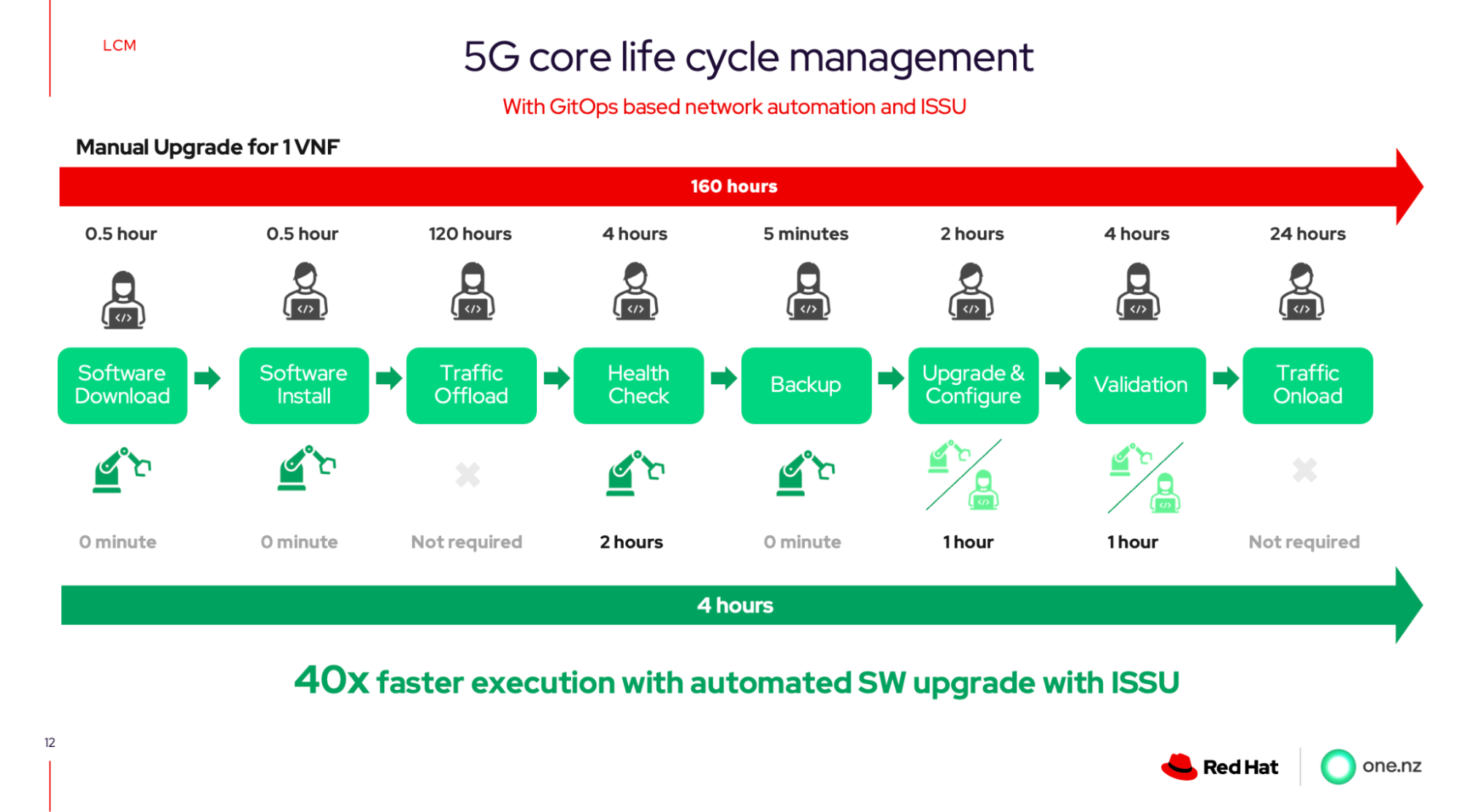
Furthermore, in-service software upgrades (ISSU), combined with GitOps-driven CI/CD pipelines, have reduced upgrade times for a single virtual network function (VNF) from over 160 hours to about 4 hours—a 40x improvement. The true value lies in zero downtime, allowing the network to remain online and resilient during continuous software deployments.
The future: AI intent-based automation
The next step for One New Zealand is to optimize Day 2 operations with AI intent-based automation. The goal is to make service operations smarter and network management more adaptive. By combining open observability with event-driven automation, using tools like open telemetry and Kafka, One New Zealand gains deep visibility into network performance, detecting and resolving issues before they affect services. Integrating AI engineering and machine learning (ML) automates routine tasks and handles network events instantly, reducing operational workload and freeing engineering resources for innovation.
Key takeaways
The webinar underscored 3 critical takeaways for telco service providers:
- Automation is crucial for managing the complexity of 5G network transformation.
- Blueprints are fundamental to successful automation, ensuring consistency, repeatability, and scalability.
- Without automated CI/CD, 5G lifecycle management becomes unmanageable.
Watch the demonstration
To see how One New Zealand implemented zero-touch provisioning to build their 5G containerized infrastructure, we invite you to watch the full webinar demonstration.
Watch the webinar and demonstration here.
Produkttest
Red Hat Ansible Automation Platform | Testversion
Über die Autoren

Volker Tegtmeyer develops content strategies that show how Red Hat solutions can help telecommunications service providers meet their business and technology challenges. Solutions that help service providers in their digital transformation and as they evolve from telco to techco. New technologies cover broad areas from 5G, AI/ML, telco cloud, automation to new solutions that help tackling sustainability goals. Volker has more than 20 years of experience in the telecommunications industry having previously worked in various roles at Siemens, Cisco and Akamai.

Sam is a certified Principal Solutions Architect Lead with over 20 years of experience in cloud computing, NFV, Telco Cloud, and advanced network architectures. Specializing in Red Hat, AWS and Azure, Sam has a proven track record in delivering cutting-edge cloud-native network solutions that enable digital transformation for clients in the telecommunications and IT industries.
A recognized expert in Agile, DevSecOps, and open-source, Sam leads cross-functional teams to design scalable, secure, and future-proof solutions. A strong communicator and strategic thinker, he excels at translating complex technical concepts into clear, actionable insights for all stakeholders. Sam ensures seamless alignment between business goals and technical execution.
Sam is passionate about mentoring teams, fostering innovation, and public speaking, including presentations at Red Hat Summit and local NZ community Meetup events. He has a proven track record of success with Tier-1 operators across APAC.

With over two decades of experience in the telecommunications industry,
Poohmipat has held key roles in leading digital transformation initiatives across
the SEA and Oceania region
Current Position: Principal Architect at One New Zealand
Leading Core Network and Cloud Infrastructure strategy, and roadmap for One
New Zealand. Previously an Account Technology Strategist at Microsoft for
Telecommunication and Retails, Industrial X Senior Technology Consultant at
Accenture Cloud Software and Services Domain Sales Manager at Ericsson, and
Customer Solution Architect at Nokia, he played a pivotal role in advancing 5G
technology, including cloud-native core and containerized infrastructure, to drive
industry-wide digital transformation.
Ähnliche Einträge
Planen Sie Ihr Upgrade auf Ansible Automation Platform 2.6
Optimieren Sie Ihren Netzwerkbetrieb mit Red Hat Ansible Automation Platform und Cisco Meraki
Technically Speaking | Taming AI agents with observability
Transforming Your Database | Code Comments
Nach Thema durchsuchen

Automatisierung
Das Neueste zum Thema IT-Automatisierung für Technologien, Teams und Umgebungen

Künstliche Intelligenz
Erfahren Sie das Neueste von den Plattformen, die es Kunden ermöglichen, KI-Workloads beliebig auszuführen

Open Hybrid Cloud
Erfahren Sie, wie wir eine flexiblere Zukunft mit Hybrid Clouds schaffen.

Sicherheit
Erfahren Sie, wie wir Risiken in verschiedenen Umgebungen und Technologien reduzieren

Edge Computing
Erfahren Sie das Neueste von den Plattformen, die die Operations am Edge vereinfachen

Infrastruktur
Erfahren Sie das Neueste von der weltweit führenden Linux-Plattform für Unternehmen

Anwendungen
Entdecken Sie unsere Lösungen für komplexe Herausforderungen bei Anwendungen

Virtualisierung
Erfahren Sie das Neueste über die Virtualisierung von Workloads in Cloud- oder On-Premise-Umgebungen
