In today's modern technological world, IT infrastructure must deliver uncompromising speed and reliability to meet the critical demands of the business. Centralized automated platforms, such as Red Hat Ansible Automation Platform, are essential for managing critical IT infrastructure. These platforms streamline operations and increase efficiency by standardizing and scaling automation across the entire organization, transforming complex, repetitive tasks into a governed, security-focused, and repeatable enterprise strategy.
The platform’s fundamental value lies in its resilience. For mission-critical automation, a resilient foundation is not merely a best practice—it’s essential. High Availability (HA) at the database layer serves as a critical safety net, protecting automation processes from interruption. This resilient environment moves beyond basic uptime to deliver the continuous availability required for the database, supporting your entire automation strategy.
With this in mind, Red Hat is collaborating with EDB to deliver a more resilient enterprise automation solution. Customers can now officially deploy production-ready EDB PostgreSQL clusters with enterprise-grade HA and failover capabilities for Ansible Automation Platform.
Unlocking true resilience
This collaboration provides continuous Postgres availability to your automation platform, focusing on the database layer.
The solution integrates core EDB Postgres AI capabilities with Ansible Automation Platform, delivering a fully tested, validated, and reliable foundation for your mission-critical automation. This approach gives you a production-ready PostgreSQL backend, making your database ready to support continuous operations.
This resilient foundation is built upon 3 integrated capabilities:
- Automated deployment: Powered by familiar Ansible tools, this functionality deploys and configures the entire production-ready HA cluster, including the operating system (OS), PostgreSQL, and failover management. This deployment follows EDB’s proven best practices and validated reference architectures, helping Ansible Automation Platform users scale automation with resilience built in from the start.
- HA and failover management: This core component functions as a critical safety net. It monitors the health of the database cluster, manages the Virtual IP, and automatically handles failure detection and switchover. This active management is crucial for maintaining continuous database availability and platform accessibility.
- Disaster Recovery (DR): Beyond basic uptime, DR capabilities are included to protect your data. This functionality enables full and incremental database backups, supporting Point-in-time recovery (PITR) to minimize data loss and assist recovery from critical failure scenarios.
How does it work?
By configuring Ansible Automation Platform o run against an external EDB Postgres AI database, enterprises immediately acquire HA and DR capabilities for the database layer in addition to the HA and resilient features of Ansible Automation Platform. These features are essential for supporting continuous operations and are critical for systems running workloads on Postgres. This dedicated, clustered database infrastructure supports continuous operations with:
- Resilience: If an Ansible Automation Platform component fails, data remains safe on the external database.
- Active-passive database replication: This solution meets stringent enterprise HA standards using a Primary Node (Active) for read/write operations, a Standby Node (Passive) for replication, and automated failover. If the Primary fails, automated failover promotes the Standby to the new Primary, maintaining platform accessibility and business continuity.
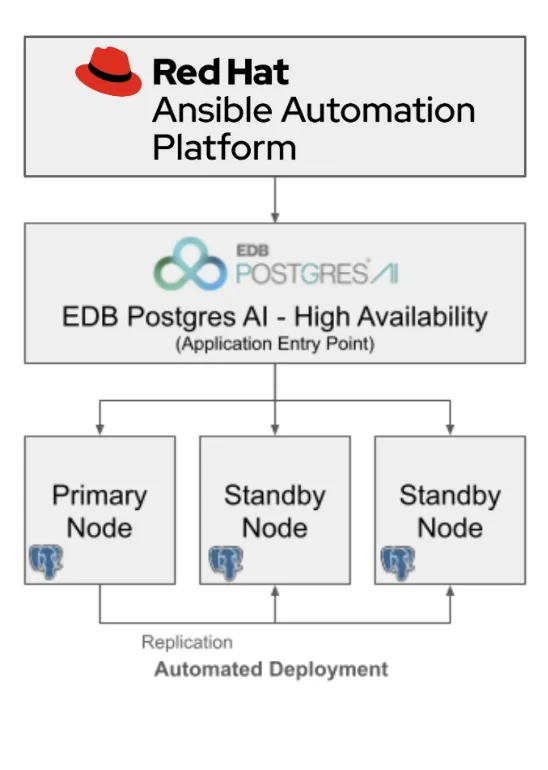
Figure 1. Integrated HA architecture combining Active/Passive EDB clusters, automated failover, Ansible Automation Platform for policy-driven automation triggers, and optional observability tools.
The benefits
EDB and Red Hat experts have validated this configuration to implement HA replication, reliable DR backups, and protection against replication pitfalls. Automating this deployment keeps your Postgres backend production-ready and resilient. Your enterprise can benefit from:
- Automated HA: EDB Postgres AI monitors cluster health, manages Virtual IP, and handles automatic failover and failback to maintain continuous database availability.
- Simplified deployment: Familiar Ansible tools provision the entire database cluster—including the OS, PostgreSQL, and failover management—based on predefined, validated reference architectures.
- Flexibility and choice: Either open source PostgreSQL and EDB Postgres AI database servers can be deployed, allowing you to choose the database that fits your preferred workload.
- Unified support: EDB supports the entire Ansible Automation Platform infrastructure in collaboration with Red Hat. This provides a direct path to resolution for issues spanning both the automation platform and the database backend.
This is the beginning of the evolution
EDB Postgres AI with Ansible Automation Platform is designed to strengthen resilient automation by delivering continuous Postgres availability and eliminating the complexity of setting up a production-ready PostgreSQL backend for Ansible Automation Platform.
We’ll be looking to enhance this solution further, using EDB's 2 decades of Postgres expertise and Red Hat’s market leading position with Ansible Automation Platform tested reference architectures. The Ansible team would love to hear your feedback. Your input helps us refine these capabilities and ensure the solution continues to provide the most resilient, continuously available, and flexible automation platform solutions in the marketplace.
Want to know more?
To learn more about EDB Postgres AI HA and automated failover, visit EDB’s documentation or contact us. To learn more about Red Hat Ansible Automation Platform, check out this webpage, or contact your Red Hat account team.
Produkttest
Red Hat Ansible Automation Platform | Testversion
Über den Autor

Phil Griffiths is a Product Manager for Ansible Automation Platform with nearly seven years of experience at Red Hat. Phil has held roles as a solution architect and technical consultant both at Red Hat and for other organizations.
Ähnliche Einträge
Manage clusters and applications at scale with Argo CD Agent on Red Hat OpenShift GitOps
Data-driven automation with Red Hat Ansible Automation Platform
Technically Speaking | Taming AI agents with observability
Transforming Your Secrets Management | Code Comments
Mehr erfahren
- E-Book: Das automatisierte Unternehmen
- Red Hat Ansible Automation Platform in selbstbestimmten, praxisorientierten Labs testen
- Red Hat Ansible Automation Platform: Ein Guide für den Einstieg
Nach Thema durchsuchen

Automatisierung
Das Neueste zum Thema IT-Automatisierung für Technologien, Teams und Umgebungen

Künstliche Intelligenz
Erfahren Sie das Neueste von den Plattformen, die es Kunden ermöglichen, KI-Workloads beliebig auszuführen

Open Hybrid Cloud
Erfahren Sie, wie wir eine flexiblere Zukunft mit Hybrid Clouds schaffen.

Sicherheit
Erfahren Sie, wie wir Risiken in verschiedenen Umgebungen und Technologien reduzieren

Edge Computing
Erfahren Sie das Neueste von den Plattformen, die die Operations am Edge vereinfachen

Infrastruktur
Erfahren Sie das Neueste von der weltweit führenden Linux-Plattform für Unternehmen

Anwendungen
Entdecken Sie unsere Lösungen für komplexe Herausforderungen bei Anwendungen

Virtualisierung
Erfahren Sie das Neueste über die Virtualisierung von Workloads in Cloud- oder On-Premise-Umgebungen
