
As companies adopt cloud-native computing for their enterprise workloads, many of them want to extend the same cloud datacenter processes to edge sites to leverage agile development methodologies, continuous integration (CI), continuous deployment (CD), and automation. With cloud computing, a company can rapidly deploy and manage resources across multiple locations, whether at a centralized, cloud, or edge site.
In particular, operations-intensive industries like manufacturing and transportation are transforming to become operationally agile. These companies are driven by the business imperative to manage distributed operations better across the supply chain, factory floor, or work sites.
The following architecture is based on a company operating across a vast geographical area that connects remote onsite operations with downstream processing centers and delivery. The company needs to monitor the condition of its physical pipeline and other infrastructure for operational safety and optimization.
This architecture takes advantage of Internet of Things (IoT) technologies for acquiring telemetry data and metrics.
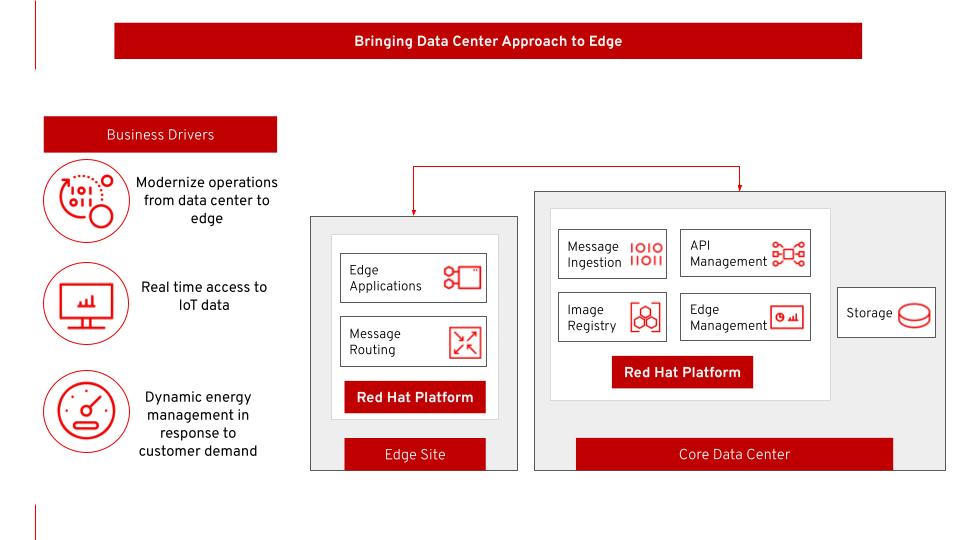
Conceptually, the datacenter-to-edge solution stack is deployed on an open cloud-native infrastructure (such as Red Hat OpenShift) based on either:
- IoT functions distributed across edge sites
- Core functions located at a centralized site
You can access these diagrams and other resources at the Red Hat Portfolio Architecture Center.
[ For more insight on modernizing your infrastructure, read an architect's guide to multicloud infrastructure. ]
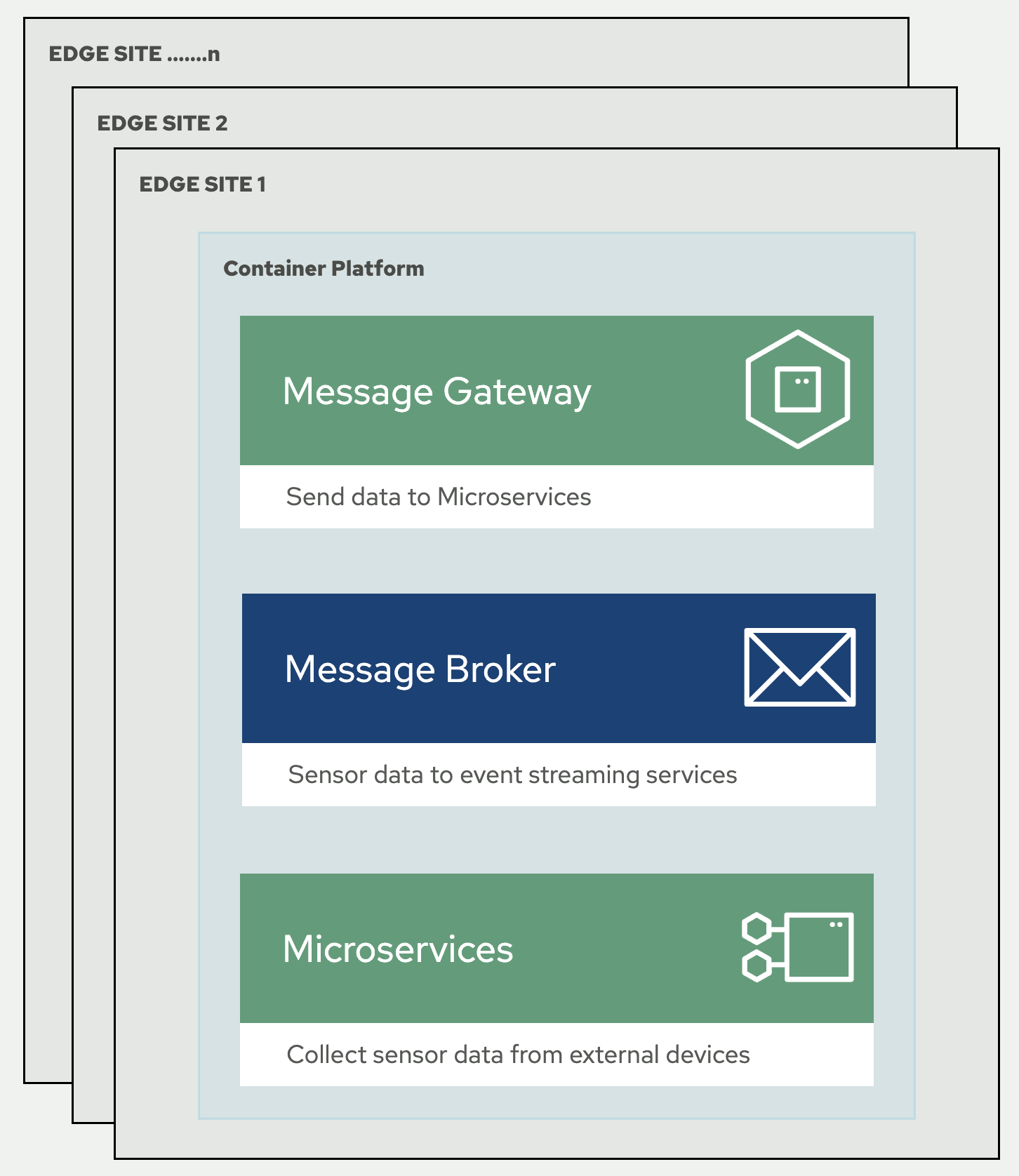
Edge sites
At edge sites distributed across wide geographic locations, telemetry data from sensors is acquired, normalized, and processed before it's transmitted to the core data center. New edge applications can be deployed in the future to add capabilities such as real-time analytics.
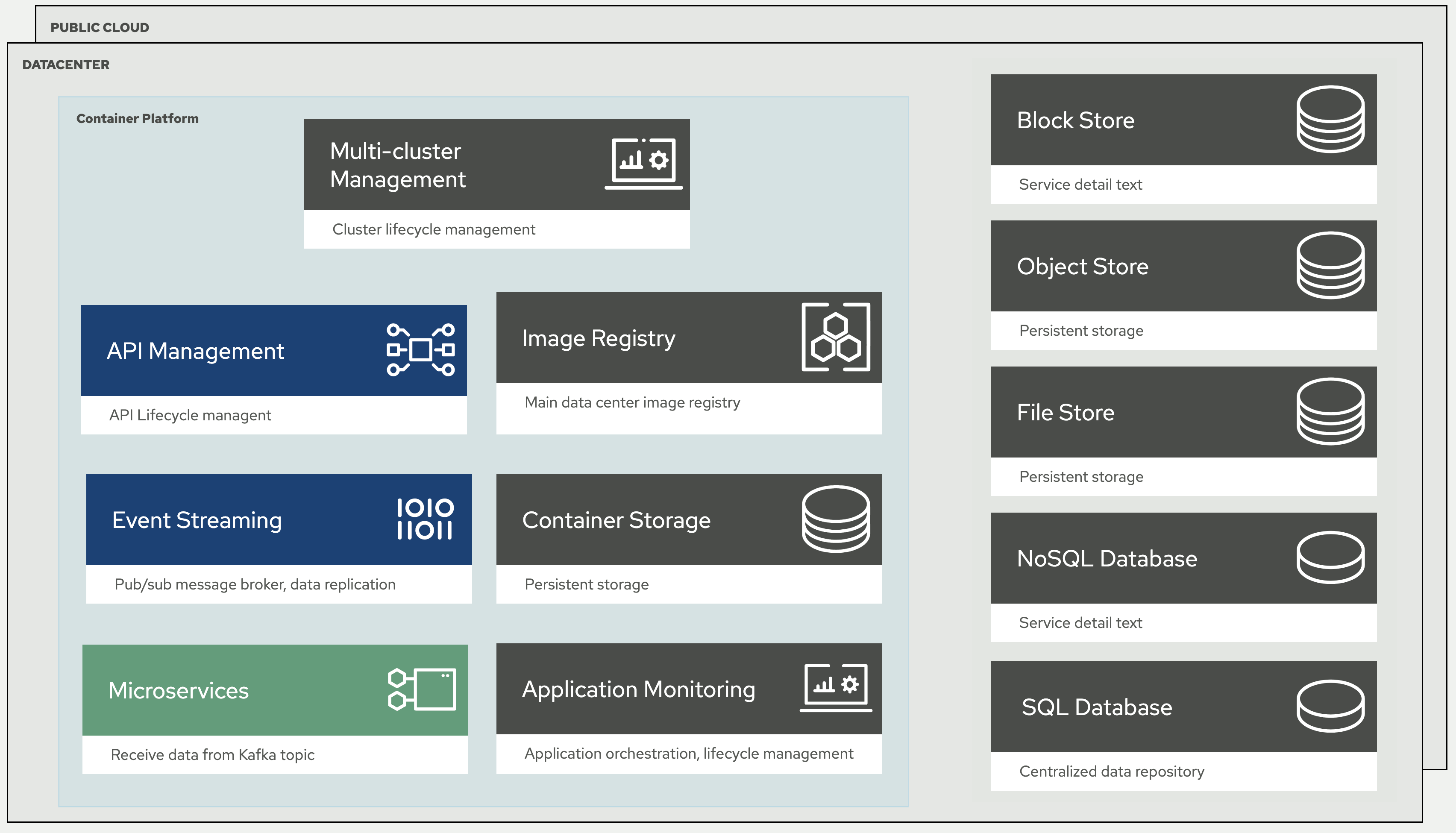
Centralized sites
In addition to core enterprise functions, the core data center and cloud are also responsible for processing and long-term storage of edge data. The cluster and application life cycle management functions, including the ones at edge sites, are also handled at the central location.
Infrastructure
An extensible, software-defined infrastructure provides a consistent framework that extends from central to edge sites. The virtualization element enables greater flexibility and automation of computing resources.

By taking a comprehensive approach, a company can integrate IoT data with other enterprise data to gain insights and automate provisioning and managing configurations of edge resources to become agile with application deployment.
[ You might also be interested in 5 reference architecture designs for edge computing. ]
Technology components
The following technology was chosen for this architecture:
- Red Hat OpenShift is an enterprise-ready Kubernetes container platform built for an open hybrid cloud strategy. It provides a consistent application platform to manage hybrid cloud, multicloud, and edge deployments.
- Red Hat Application Services helps an organization use the cloud delivery model and simplify continuous delivery of applications the cloud-native way. It's built on open source technologies and provides development teams multiple modernization options to enable a smooth transition to the cloud for existing applications.
- Red Hat AMQ Streams is a data-streaming platform with high throughput and low latency. It streams sensor data to corresponding microservices and automated diagnosis.
- Red Hat Advanced Cluster Management controls clusters and applications from a single console with built-in security policies. It extends the value of OpenShift by deploying applications, managing multiple clusters, and enforcing policies across multiple clusters at scale.
- Red Hat Quay is a private container registry that stores, builds, and deploys container images. It analyzes images for security vulnerabilities, identifying potential issues that can help mitigate risks.
- Red Hat OpenShift Data Foundations is software-defined storage for containers. As the data and storage services platform for OpenShift, OpenShift Data Foundation helps teams develop and deploy applications quickly and efficiently across clouds.
- Red Hat Enterprise Linux (RHEL) is an open source Linux operating system providing a foundation to scale existing apps—and roll out emerging technologies—across bare-metal, virtual, container, and all types of cloud environments.
Using edge technology
Edge recognizes that modern industries are global ventures in a physical sense. You can utilize edge in conjunction with your cloud and datacenter strategies to become more agile and discover new ways to improve existing processes. Edge computing and the IoT are built on trusted and emerging open source technology, so it's as flexible as you need it to be, making it a good fit for any industry.
Über den Autor
Ishu Verma is an AI Solution Architect at Red Hat dabbling in emerging technologies like AI Ops, AI safety and security. He, along with fellow open source hackers, works on building enterprise focused solutions with open source technologies. Prior to Red Hat, Ishu worked in technical marketing at Intel on IoT Gateways and building end-to-end IoT solutions with partners.
Ähnliche Einträge
Lightwell-Strategie: Mehr als nur einfache Patch-Updates
Red Hat Enterprise Linux Long-Life Add-On: RHEL ohne Enddatum
Container Roundup | Compiler
Untangling Networks | Compiler
Nach Thema durchsuchen

Automatisierung
Das Neueste zum Thema IT-Automatisierung für Technologien, Teams und Umgebungen

Künstliche Intelligenz
Erfahren Sie das Neueste von den Plattformen, die es Kunden ermöglichen, KI-Workloads beliebig auszuführen

Open Hybrid Cloud
Erfahren Sie, wie wir eine flexiblere Zukunft mit Hybrid Clouds schaffen.

Sicherheit
Erfahren Sie, wie wir Risiken in verschiedenen Umgebungen und Technologien reduzieren

Edge Computing
Erfahren Sie das Neueste von den Plattformen, die die Operations am Edge vereinfachen

Infrastruktur
Erfahren Sie das Neueste von der weltweit führenden Linux-Plattform für Unternehmen

Anwendungen
Entdecken Sie unsere Lösungen für komplexe Herausforderungen bei Anwendungen

Virtualisierung
Erfahren Sie das Neueste über die Virtualisierung von Workloads in Cloud- oder On-Premise-Umgebungen
