
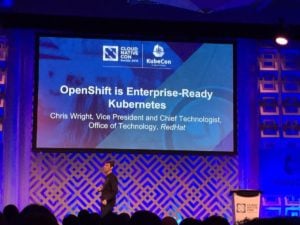
 This past week at KubeCon 2016, Red Hat CTO Chris Wright (@kernelcdub) gave a keynote entitled OpenShift is Enterprise-Ready Kubernetes. There it was for the 1200 people in attendance: OpenShift is 100% Kubernetes, plus all the things that you'll need to run it in production environments.
His talk came on the heels of a packed day of OpenShift, Kubernetes and Container discussions at OpenShift Commons Gathering, a community of over 200+ vendors, customers, technology partners, ISVs, SIs and contributors.
The Innovator's Dilemma
 Over two years ago, the OpenShift team made a critical decision to support both Docker containers and the emerging Kubernetes project. At the time, that decision was a classic innovator's dilemma. The OpenShift team was using a bunch of homegrown technology, had a number of existing customers, and were watching the market quickly evolve to demand a newer set of technologies. Their challenge at the time was not unlike the conversations that we have with customers on a daily basis. How can their company make a transition towards becoming a more digital-native company? How can their company get there without abandoning all of their existing investments, or giving up some existing advantages they have in their marketplace? How can they avoid building a DIY platform?
Their requirements list for this new platform is not uncommon from company to company:
- Help them deliver quantified value back to the business.
- Make sure it uses 100% open source technology.
- Deliver a great, self-service developer experience.
- Help them build, test and deploy software faster to their customers, partners and markets.
- Help them figure out how to evolve towards a DevOps culture.
- Help them figure out how to affectively use new container technologies.
- Deliver a highly automated environment that allows developers to quickly use resources in a scalable manner.
- Allow developers to support a broad range of languages and frameworks.
- Allow developers to push code into production in whatever ways will make them productive.
- Enable new, microservices-based applications to run on the platform.
- Also, enable existing, stateful applications (monoliths) to run on the platform, preferably with lower costs and faster velocity of updates.
- Enable a cost-effective, multi-tenant environment so that any groups within their company can use this new platform.
- Ensure that the platform has security controls for both developers and operators, which can align with our industry requirements.
- Build modular, operational capabilities (networking, storage, logging, monitoring, etc.) into the platform so that the operations team isn't a bottleneck to the developers.
- Make sure that it can run anywhere (VMware, OpenStack, AWS, Azure, GCP), as we try and architect a Hybrid Cloud. Give us multiple commercially-supported consumption options (software-only, managed/dedicated, public cloud) as well community-supported options.
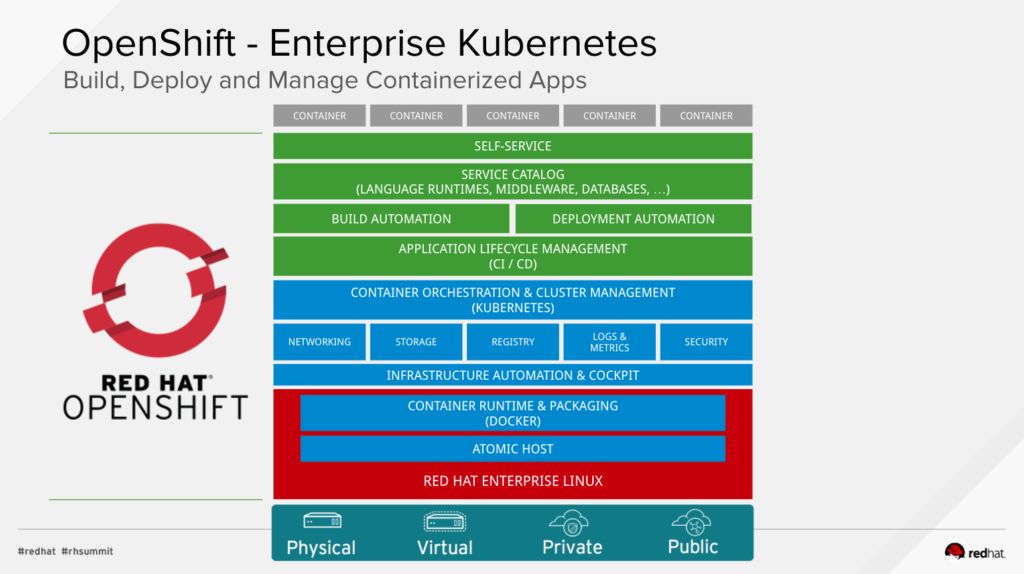
As we step back and look at where the OpenShift architecture has evolved over the past two years, it is clear that the investments we've made with this great technology and great community are well-aligned to helping customers as they attempt to answer those questions and drive towards implementations that improve their businesses.
Moving from DIY Projects to Production Applications
One of the most common discussions we heard at KubeCon were from companies that were in a transition from a series of DIY Kubernetes projects to a new reality around managing them as a platform that would support production applications. The challenges tended to fall into a few consistent buckets:
- How do we continue to drive costs out of our IT systems?
- How do we keep up with the frequency of updates from the Kubernetes community? The innovation vs. stability debate.
- How do we integrate CI/CD pipelines, new or existing, into the platform?
- How do we manage multi-tenancy and security for all of our production applications, in a way that will remain consistent as more users and groups are added to the platform?
- How do we manage the day-to-day operational elements like networking, logging, monitoring, etc?
- Do we really want to maintain the various pieces of software that we had to build to make the platform work the way we need for our business?
 The opportunities for Enterprise-Ready Kubernetes are coming from these new DIY platforms created by developers and DevOps teams. They are also coming from operations teams that didn't get it quite right with a Private or Hybrid cloud over the last couple of years, but now have pending business drivers that are refocusing their efforts. And the opportunities aren't just confined to Silicon Valley technology companies, but nearly every industry across the globe.
Is Enterprise-Ready Kubernetes for Real?
Let's start by saying that the Kubernetes community is for real. Given all the choices that developers have today, you don't get to 4-5x the number of contributors (vs. Cloud Foundry, Docker Swarm or Mesos) if the project doesn't have velocity and longevity. Red Hat made a very early and large investment in this community, and even as the community grows, Red Hat continues to be the #1 Enterprise contributor to the Kubernetes community.
 Source: The New Stack at KubeCon2016 (via presentation by Chen Goldberg, Google)
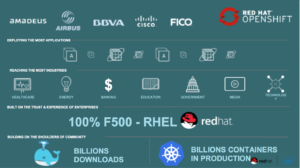
While community size and GitHub stars are great, what about actual customers of the technology? The companies that are putting the future of their business on an Enterprise-Ready Kubernetes platform - who are they? Some of them are profiled here. They are in banking, financial services, retailers, universities, government agencies, manufacturers, software, media and many more. And they are actively hiring to build out their platforms, expand their platforms and bring in engineer talent all around the world (just a few from this week) - Fortune 10, Fortune Global 10, Fortune 20, Fortune 100, Fortune 250, Fortune 500, Fortune 1000, Top 25 US University, Global FinServ SaaS.
Great Technology, Great Community, Great Partners
 As Joe Fernandes said last week, "...we chose Kubernetes and more than two years later, we couldn’t be happier with our decision!". Red Hat customers know that they can count on us to help them make open source innovation a reality for their business. We're seeing more and more of them also choosing Kubernetes to drive their cloud initiatives and their digital transformations. We believe the investments we continue to make in the Kubernetes community, to deliver Enterprise functionality, will help them grow their business in the future.
Über den Autor
Brian Gracely (@bgracely) is Sr. Director, Portfolio Strategy at Red Hat. He has previously held leadership, product management, engineering, marketing and M&A roles at Cisco, EMC, NetApp, Virtustream, Solo. He is an industry-recognized leader in cloud computing, and hosts the industry's #1 cloud computing and AI podcast, The Cloudcast.
Ähnliche Einträge
Red Hat Summit 2026: 4 Erkenntnisse zur KI-Automatisierung
KI-Bedrohungen abwehren: Agile Security für Unternehmen
Untangling Networks | Compiler
Operating System Management | Compiler
Nach Thema durchsuchen

Automatisierung
Das Neueste zum Thema IT-Automatisierung für Technologien, Teams und Umgebungen

Künstliche Intelligenz
Erfahren Sie das Neueste von den Plattformen, die es Kunden ermöglichen, KI-Workloads beliebig auszuführen

Open Hybrid Cloud
Erfahren Sie, wie wir eine flexiblere Zukunft mit Hybrid Clouds schaffen.

Sicherheit
Erfahren Sie, wie wir Risiken in verschiedenen Umgebungen und Technologien reduzieren

Edge Computing
Erfahren Sie das Neueste von den Plattformen, die die Operations am Edge vereinfachen

Infrastruktur
Erfahren Sie das Neueste von der weltweit führenden Linux-Plattform für Unternehmen

Anwendungen
Entdecken Sie unsere Lösungen für komplexe Herausforderungen bei Anwendungen

Virtualisierung
Erfahren Sie das Neueste über die Virtualisierung von Workloads in Cloud- oder On-Premise-Umgebungen
