
In the hallowed halls of open source software development, there are a few pieces of software that stand out above all others as unwaivering standards of quality, collaboration and security. The Linux kernel qualifies for this category, but the real unbridled winner of the title would probably have to be the Apache Web Server. The ubiquity and power of this httpd server enabled the growth of RESTful traffic: When SOAP was trying to gain footing, everyone just decided to stop inventing new gateways and just throw all the traffic at Apache.
But it is the very success of the Apache httpd server that enabled NGINX to rise to become another contender for the title of "Most Useful and Widely Used Open Source Project." Because RESTful traffic is different from simple Web traffic in its nature, NGINX has grown to address all the next layer problems that have arisen for developers and network administrators who now need to read this REST traffic and schedule it for delivery to an ever shifting host of containers. And while it's been evolving, it's also expanded to support enormous scale for caching, balancing, and proxying.
10 years ago, just about every virtualized Web stack had Apache in it. Today, just about every containerized open hybrid cloud stack has NGINX in it. Whether it's load balancing, Web serving, caching, or reserve proxying, NGINX is like the Swiss Army Knife of handling RESTful traffic.
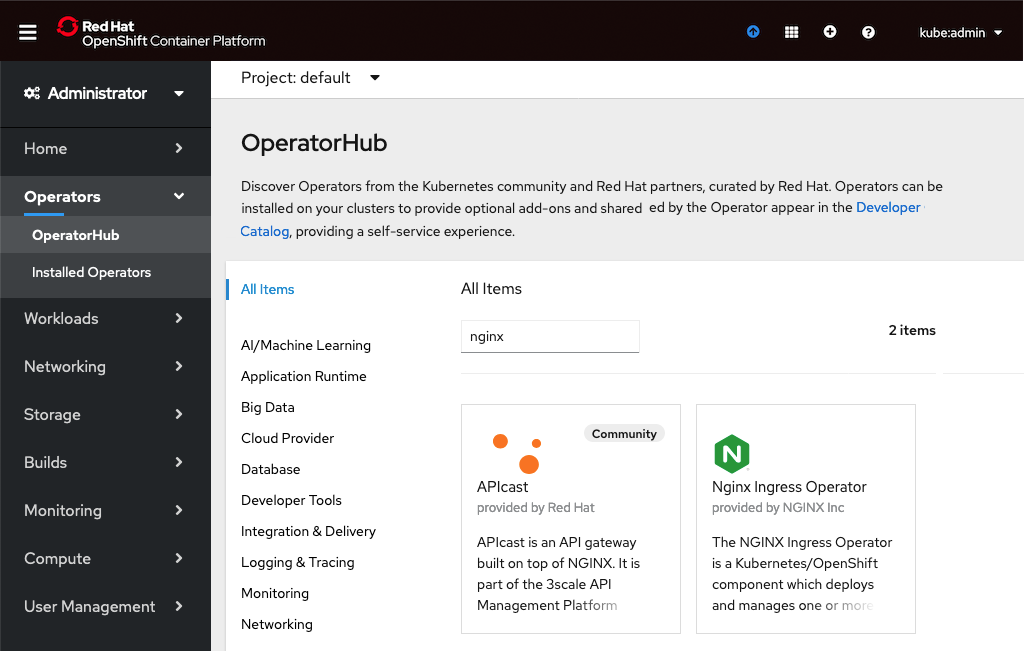
Therefore, it's important to have NGINX close at hand whenever you're working in the open hybrid cloud as an architect. We'd like to give a big thank you to NGINX for this excellent tutorial explaining how to get started with the NGINX Ingress Operator. Using NGINX to manage Kubernetes ingress is like building a highway off-ramp with a stop light right next to your brand new factory. Unleash the hordes while remaining in control. Go take a look!
Über den Autor
Red Hatter since 2018, technology historian and founder of The Museum of Art and Digital Entertainment. Two decades of journalism mixed with technology expertise, storytelling and oodles of computing experience from inception to ewaste recycling. I have taught or had my work used in classes at USF, SFSU, AAU, UC Law Hastings and Harvard Law.
I have worked with the EFF, Stanford, MIT, and Archive.org to brief the US Copyright Office and change US copyright law. We won multiple exemptions to the DMCA, accepted and implemented by the Librarian of Congress. My writings have appeared in Wired, Bloomberg, Make Magazine, SD Times, The Austin American Statesman, The Atlanta Journal Constitution and many other outlets.
I have been written about by the Wall Street Journal, The Washington Post, Wired and The Atlantic. I have been called "The Gertrude Stein of Video Games," an honor I accept, as I live less than a mile from her childhood home in Oakland, CA. I was project lead on the first successful institutional preservation and rebooting of the first massively multiplayer game, Habitat, for the C64, from 1986: https://neohabitat.org . I've consulted and collaborated with the NY MOMA, the Oakland Museum of California, Cisco, Semtech, Twilio, Game Developers Conference, NGNX, the Anti-Defamation League, the Library of Congress and the Oakland Public Library System on projects, contracts, and exhibitions.
Ähnliche Einträge
Virtuelle Maschinen in OpenShift Service Mesh verwalten
Zero Trust: Die letzte Verteidigungslinie bei CVEs
Scaling with Orchestrators | Compiler
Container Roundup | Compiler
Nach Thema durchsuchen

Automatisierung
Das Neueste zum Thema IT-Automatisierung für Technologien, Teams und Umgebungen

Künstliche Intelligenz
Erfahren Sie das Neueste von den Plattformen, die es Kunden ermöglichen, KI-Workloads beliebig auszuführen

Open Hybrid Cloud
Erfahren Sie, wie wir eine flexiblere Zukunft mit Hybrid Clouds schaffen.

Sicherheit
Erfahren Sie, wie wir Risiken in verschiedenen Umgebungen und Technologien reduzieren

Edge Computing
Erfahren Sie das Neueste von den Plattformen, die die Operations am Edge vereinfachen

Infrastruktur
Erfahren Sie das Neueste von der weltweit führenden Linux-Plattform für Unternehmen

Anwendungen
Entdecken Sie unsere Lösungen für komplexe Herausforderungen bei Anwendungen

Virtualisierung
Erfahren Sie das Neueste über die Virtualisierung von Workloads in Cloud- oder On-Premise-Umgebungen
