
This week we announced that Red Hat has been positioned as a Leader in the first ever 2024 Gartner® Magic Quadrant™ for Cloud Application Platforms. We are proud of this recognition, as we believe this is a great validation of Red Hat OpenShift cloud services’ ability to help organizations bring cloud-native applications to market faster with the infrastructure that best meets their unique needs. The Red Hat OpenShift cloud services portfolio consists of jointly engineered solutions with hyperscalers, including Red Hat OpenShift Service on AWS, Azure Red Hat OpenShift, Red Hat OpenShift on IBM Cloud and Red Hat OpenShift Dedicated on Google Cloud.
This report follows the Gartner recognition of Red Hat as a Leader in the recent 2024 Gartner Magic Quadrant for Container Management. Red Hat believes that these recognitions combined showcases how Red Hat OpenShift not only provides users with a comprehensive application platform to accelerate application development and deployment, but with availability in both fully managed or self-managed options, Red Hat OpenShift runs wherever and however customers need.
To help further explain the evaluation of the Gartner Magic Quadrant from our point of view, we’re answering some of the most frequently asked questions.
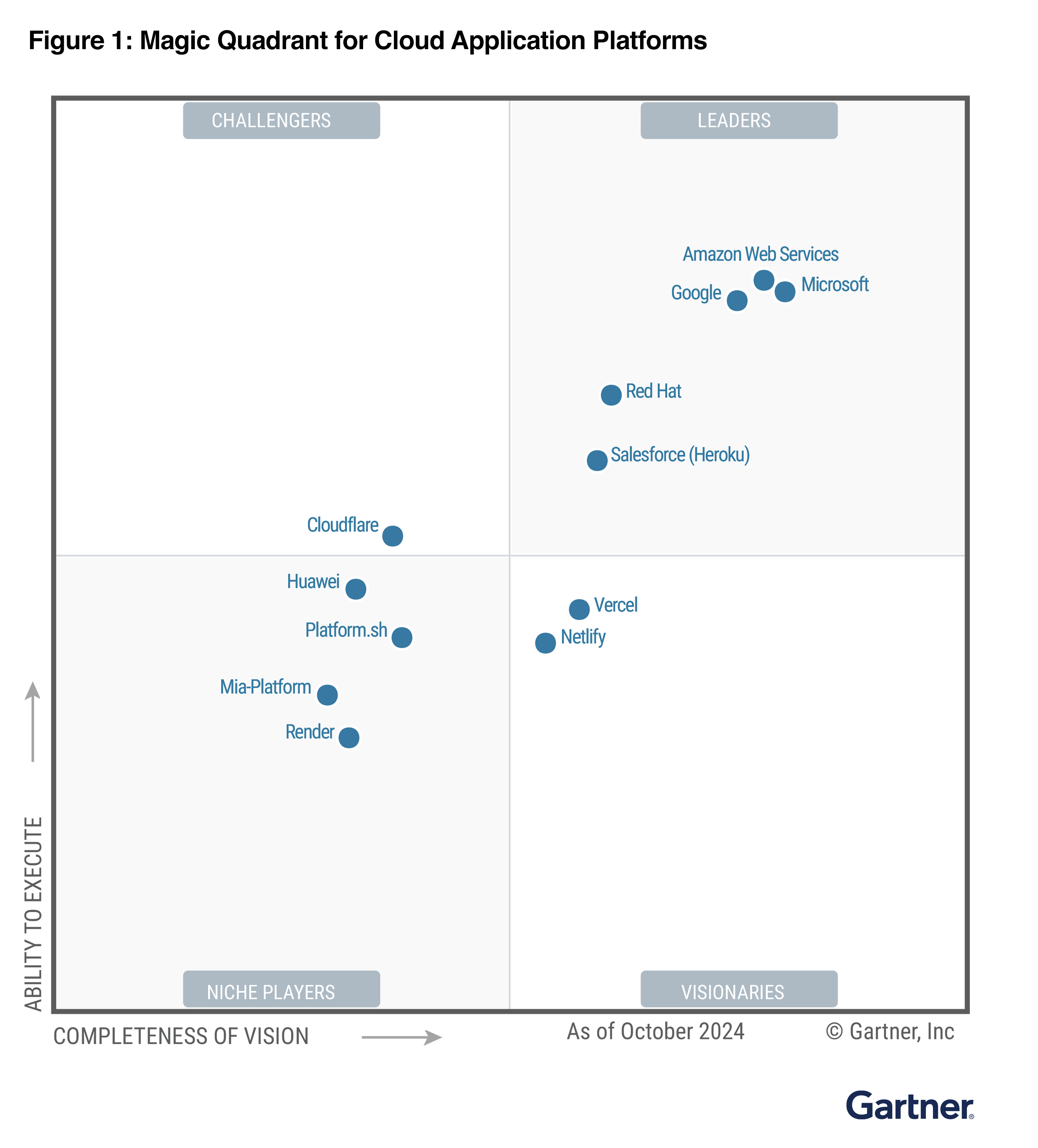
Source: Gartner, “Magic Quadrant for Cloud Application Platforms,” By Tigran Egiazarov, Mukul Saha, Anne Thomas, Steve Schwent, 4 November 2024
What is the Gartner Magic Quadrant?
“Magic Quadrant reports are a culmination of rigorous, fact-based research in specific markets, providing a wide-angle view of the relative positions of the providers in markets where growth is high and provider differentiation is distinct. Providers are positioned into four quadrants: Leaders, Challengers, Visionaries and Niche Players. The research enables you to get the most from market analysis in alignment with your unique business and technology needs.”
How was the evaluation done in this Magic Quadrant? What was the criteria for inclusion?
“Gartner defines cloud application platforms as those that provide managed application runtime environments for applications and integrated capabilities to manage the life cycle of an application or application component. They typically enable distributed application deployments and support cloud style operations — such as elasticity, multitenancy and self-service — without requiring infrastructure provisioning or container management.
Cloud application platforms are designed to facilitate the deployment, runtime execution, and management of modern cloud-native or cloud-optimized applications (e.g., web-based apps, back-end services with/without APIs, etc.) without the need to manage any underlying compute infrastructure. Also, they are designed to enhance developer productivity, accelerate development and deployment cycles, and increase operational effectiveness by making it easier to scale on demand.
Cloud application platforms offer a structured execution environment for applications, effectively hiding the complexities of the underlying infrastructure and computing resources. They also provide vendor supported versions of application runtimes and frameworks for the commonly used languages (for example, Java, Node.js, PHP, Python, Go and Ruby). By abstracting the complexities associated with infrastructure management, cloud application platforms enable product teams to deliver faster customer value.
The cloud application platforms market reflects the consolidation of technologies across deployment, scalability, security and observability of applications to streamline software delivery. They are intended to be more than just a platform for running applications; they are essential for businesses aiming to achieve excellence in software engineering, productivity and market responsiveness.”
“The mandatory features for this market include:
- Application runtime services (including language runtime support) for multiple application types including web applications, mobile backends, microservices, AI/ML models, and analytics applications without requiring infrastructure provisioning or container management.
- Automated deployment of cloud-native applications (e.g., integration with DevOps).
- Autoscaling (load balancing, scalability and running of multiple instances).
- Application monitoring and observability — support for monitoring and observability to improve service-level objectives, gathering production telemetry (logs, metrics, events, traces).
- Cloud-based managed service — vendor (service provider) handles the maintenance, monitoring, updates and troubleshooting of the cloud application platform. This includes support, security, backups and performance optimization. It allows users to only focus on the application that can be deployed on cloud application platforms.”
Why is this significant to us?
According to Gartner, Leaders execute well against their current vision and are well positioned for tomorrow. We believe Gartner is one of the most recognized technology analyst firms in the IT space and having been recognized as a Leader validates not only the current capabilities of Red Hat OpenShift, but also Red Hat’s vision for evolving the solution to best meet the needs of our customers in the future.
Learn more about Red Hat OpenShift as a Cloud Application Platform
A full copy of the Gartner Magic Quadrant on Cloud Application Platforms can be downloaded here.
Gartner disclaimer:
Gartner, Magic Quadrant for Container Management, By Dennis Smith, Tony Iams, Wataru Katsurashima, Michael Warrilow, Richard Watson, 10 September 2024
Gartner does not endorse any vendor, product or service depicted in its research publications, and does not advise technology users to select only those vendors with the highest ratings or other designation. Gartner research publications consist of the opinions of Gartner’s research organization and should not be construed as statements of fact. Gartner disclaims all warranties, expressed or implied, with respect to this research, including any warranties of merchantability or fitness for a particular purpose.
GARTNER is a registered trademark and service mark of Gartner and Magic Quadrant is a registered trademark of Gartner, Inc. and/or its affiliates in the U.S. and internationally and are used herein with permission. All rights reserved.
This graphic was published by Gartner, Inc. as part of a larger research document and should be evaluated in the context of the entire document. The Gartner document is available upon request from Red Hat.
Über den Autor
Anes Kim is a product marketing manager for Red Hat OpenShift cloud services and has been at Red Hat since 2020.
Ähnliche Einträge
Ansible Automation Platform 2.7: Execution Environment Builder
Stabilen Code behalten: Mit Lightwell schneller zum Ziel
Can agentic AI patch the internet?
Random Acts Of Automation | Compiler
Nach Thema durchsuchen

Automatisierung
Das Neueste zum Thema IT-Automatisierung für Technologien, Teams und Umgebungen

Künstliche Intelligenz
Erfahren Sie das Neueste von den Plattformen, die es Kunden ermöglichen, KI-Workloads beliebig auszuführen

Open Hybrid Cloud
Erfahren Sie, wie wir eine flexiblere Zukunft mit Hybrid Clouds schaffen.

Sicherheit
Erfahren Sie, wie wir Risiken in verschiedenen Umgebungen und Technologien reduzieren

Edge Computing
Erfahren Sie das Neueste von den Plattformen, die die Operations am Edge vereinfachen

Infrastruktur
Erfahren Sie das Neueste von der weltweit führenden Linux-Plattform für Unternehmen

Anwendungen
Entdecken Sie unsere Lösungen für komplexe Herausforderungen bei Anwendungen

Virtualisierung
Erfahren Sie das Neueste über die Virtualisierung von Workloads in Cloud- oder On-Premise-Umgebungen
