By Ross Turk, Red Hat Storage
The following chart might look familiar, especially if you’ve ever studied patterns of online behavior.
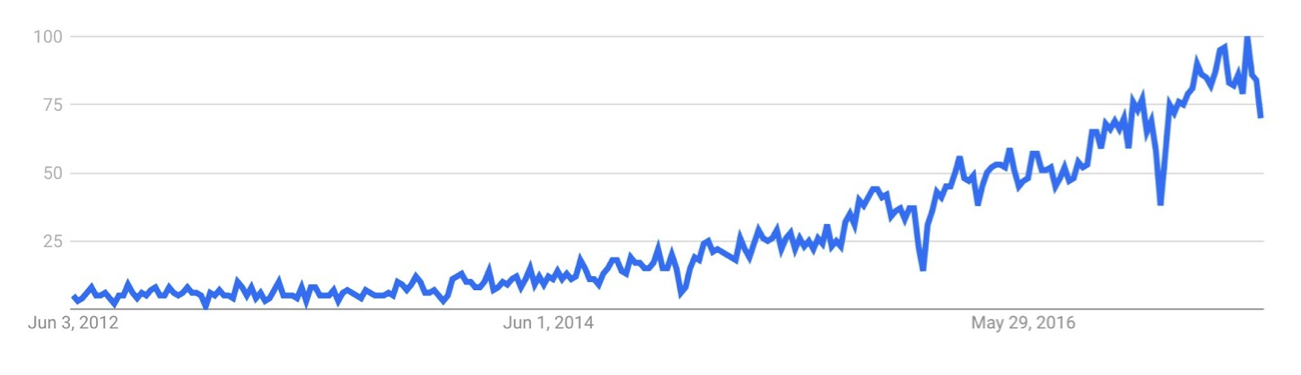
Like all the best charts, this one has a glorious up-and-to-the-right shape. But each year at the end of December, when much of the world goes offline for a few quiet days, there’s a characteristic drop. This chart—from Google Trends—represents a phrase that's growing in prominence: "digital transformation."
Digital transformation is everywhere
When I noticed—with distinct déjà vu—the industry using this phrase, I admit I was somewhat taken aback. Many of us live in a world dominated by technology. I can't remember the last time I paid for fast-food tacos with actual money, but I do know I stopped carrying cash completely when the taco shops began accepting credit cards. Every time I need to mail a letter now, it's a huge production! I'm just not prepared for that kind of task anymore.
Imagine a world without digital technology…. See?! You can't do it.
Not all digital transformation is equal
Another case in point. I renewed my driver’s license recently and found myself wondering: Now that the DMV is doing business using modern technology, who’s left to transform? If you live your life in an ivory tower made of wifi and capacitive touch screens—like me—a phrase like "digital transformation" can seem obsolete. It can throw you off the scent a bit. And, indeed, I was missing the point. Sure, even taxi companies embrace digital technologies these days...but are they any good at it? Do they enjoy the same efficiencies as a digitally native service like Uber?
Technology is now serious business
Digital transformation isn't about using technology—or even offering digital services. It's about redefining a business in technology terms, putting the modern technology experience first. It’s about businesses coming to terms with the truth: Technology can’t be a hobby for them anymore. They’re going to have a ton of applications and data, and they need to get really good at managing all of it. That means having solid priorities; agility and elasticity are a great place to start.
Modern storage can transform your business
Speaking of great places to start, there’s no better example of the challenges of digital transformation than storage. The amount of data that enterprises need to maintain is growing at a steady clip, and their customers expect all that data to be available instantly. Access patterns change as frequently as customer behaviors. Data is getting bigger, analytics are getting even more sophisticated. The traditional storage appliances that do a lot of the heavy lifting today are convenient, but at petabyte scale they show their inflexibility and limitation.
That's where Ceph and Gluster come in. They’re flexible, scale-out, software-defined storage technologies built for those who don't think storage is a hobby.
Learn how storage can make your digital transformation
If you want to learn more about modern approaches to storage—and Red Hat Storage, of course!—join me on June 22 for a 45-minute webinar. Register here.
About the author

More like this
Friday Five — May 1, 2026 | Red Hat
Building a hardened, image-based foundation for AI agents
Collaboration In Product Security | Compiler
Keeping Track Of Vulnerabilities With CVEs | Compiler
Browse by channel

Automation
The latest on IT automation that spans tech, teams, and environments

Artificial intelligence
Explore the platforms and partners building a faster path for AI

Cloud services
Get updates on our portfolio of managed cloud services

Security
Explore how we reduce risks across environments and technologies

Edge computing
Updates on the solutions that simplify infrastructure at the edge

Infrastructure
Stay up to date on the world’s leading enterprise Linux platform

Applications
The latest on our solutions to the toughest application challenges

Original shows
Entertaining stories from the makers and leaders in enterprise tech
