To build on investing in the right things, at the right time, the enterprise should prioritize top strategic initiatives within the enterprise portfolio. Using data to inform prioritization decisions is key. Executives and senior leaders want top initiatives to align to strategy, objectives, measurable business outcomes and financial factors (defined in the business case, which was covered in my previous post).
A Prioritization Scorecard calculates priority data that is needed to inform decisions, which are strategic drivers, or key values that align to strategic goals, and detractor information, key values that take away from the project. The data attributes for the key values should be taken directly from the business case. The key outcome is using this scorecard data to generate collective buy-in from senior leadership on top strategic priorities.
Table 1 below will help to model strategic drivers as examples of how the enterprise can build a Prioritization Scorecard:
Table 1
| Scorecard Measures | Driver 1 | Driver 2 | Range 3 |
| Definition - Use for the defining the meaning of the driver. | Definition | Definition | Definition |
| Measure - Use for defining the how the driver will be measured. | Measure | Measure | Measure |
| Range - Use for defining the normalized range for a quantifiable score (keep it simple, eg. 1-3) | Range | Range | Range |
| Initiative 1 | Score (1-3) | Score (1-3) | Score (1-3) |
| Initiative 2 | Score (1-3) | Score (1-3) | Score (1-3) |
Example Drivers include:
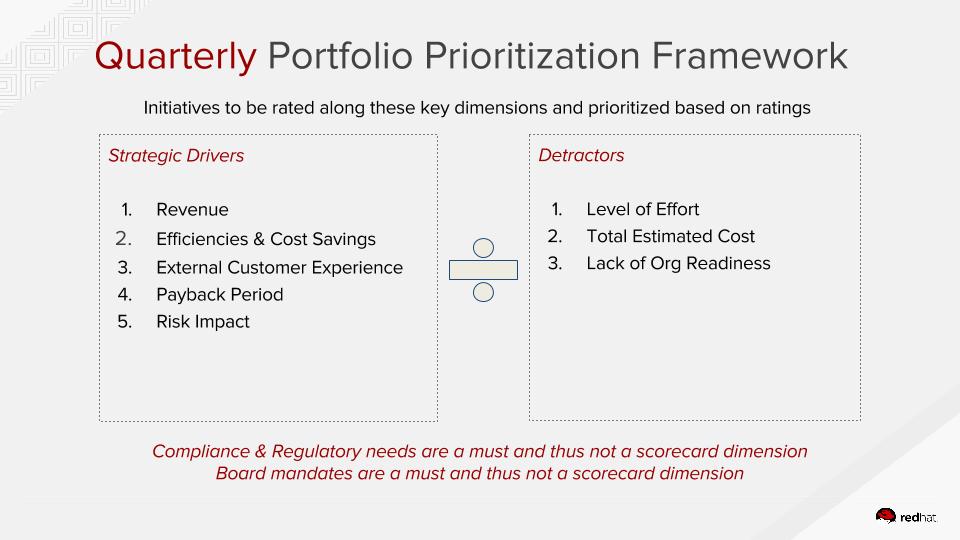
- Revenue - Does the program generate net new revenue?
- Cost Savings - Does Initiative automate processes to promote business efficiencies?
- Customer Experience - Does the Initiative affect external customer experience?
- Payback Period - How long will it take for benefits to exceed to the initial investment cost?
- Risk Impact - What is the key impact to the business if the project is not worked on? There can be any of a variety of reasons, such as risk avoidance, loss of revenue, increased costs, or company exposure.
Table 2 below helps to model the detractors as examples of how the enterprise can further build out the Prioritization Scorecard:
Table 2
| Scorecard Measures | Detractor 1 | Detractor 2 | Detractor 3 |
| Definition - Use for the defining the meaning of the detractor. | Definition | Definition | Definition |
| Measure - Use for defining the how the detractor will be measured. | Measure | Measure | Measure |
| Range - Use for defining the normalized range for a quantifiable score (keep it simple, eg. 1-3) | Range | Range | Range |
| Initiative 1 | Score (1-3) | Score (1-3) | Score (1-3) |
| Initiative 2 | Score (1-3) | Score (1-3) | Score (1-3) |
Example Detractors include:
- Level of Effort - Time taken to complete the initiative
- Estimate Costs - Total estimated cost of delivering the solution plus estimated ongoing operational expenses over a 3-5 year period
- Lack of Organizational Readiness - Initiative is able to complete successfully in terms of resourcing capacity (people, infrastructure, environment)
To score the prioritization, take the Driver's total score divided by the Detractor’s total score. That’s the priority score.
The higher the priority score, the higher the initiative priority with the portfolio of work. The prioritization scorecard data will ensure the right initiatives are prioritized, utilizing finite budgets, resources and timelines. Using this data-driven approach to prioritization will solicit leadership agreement for the enterprise portfolio.
Other Posts in the Series
- Enterprise investment management simplified: Business case
- Enterprise investment management simplified: Prioritization
- Enterprise investment management simplified: Budget efficiencies
저자 소개

유사한 검색 결과
내일로 가는 길: 현재의 기술과 미래의 AI를 연결
Introducing Quarkus on Red Hat OpenShift
Communicating the Value of Connecting Systems | Code Comments
채널별 검색

오토메이션
기술, 팀, 인프라를 위한 IT 자동화 최신 동향

인공지능
고객이 어디서나 AI 워크로드를 실행할 수 있도록 지원하는 플랫폼 업데이트

오픈 하이브리드 클라우드
하이브리드 클라우드로 더욱 유연한 미래를 구축하는 방법을 알아보세요

보안
환경과 기술 전반에 걸쳐 리스크를 감소하는 방법에 대한 최신 정보

엣지 컴퓨팅
엣지에서의 운영을 단순화하는 플랫폼 업데이트

인프라
세계적으로 인정받은 기업용 Linux 플랫폼에 대한 최신 정보

애플리케이션
복잡한 애플리케이션에 대한 솔루션 더 보기

가상화
온프레미스와 클라우드 환경에서 워크로드를 유연하게 운영하기 위한 엔터프라이즈 가상화의 미래
