
In today’s Storage Tutorial, Brian chats with Red Hat’s Paul Cuzner of the storage business unit. Paul has been focused on finding new ideas and strategies where Red Hat Storage can make a difference for customers and, most recently, has spent time working with Splunk. Watch the video below to find out just how Paul and Red Hat work with customers to make the most of Splunk and their storage, but we’ve broken down one salient bit for you right here…keep reading!
Understanding Splunk data flows
Data arriving within a Splunk indexer, as it’s being parsed, is placed into a structure named a bucket – a directory in a file structure. This bucket is considered “hot” because its index is being actively built, or files are constantly being added or removed from it. When it reaches a certain size, or age, it moves to “warm” storage, meaning the index is built and closed, so no further information is added and it becomes a point of record.
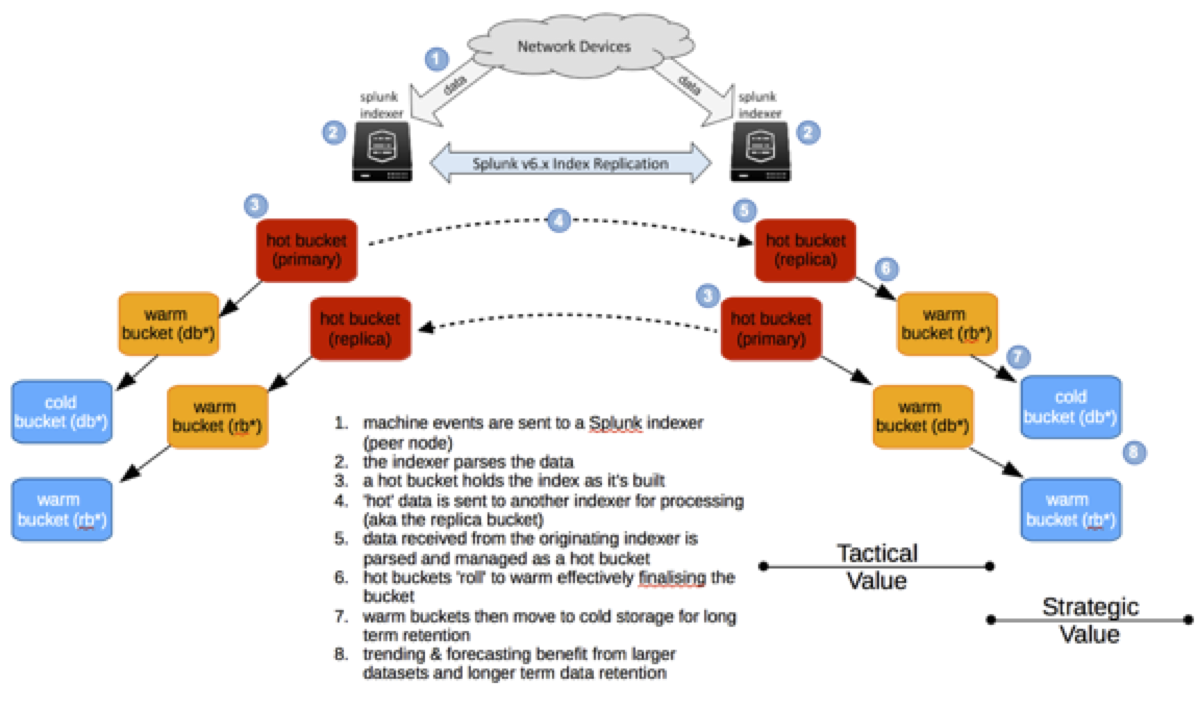 The Splunk data migration flow, illustrated!
Hot and warm buckets, because they are considered to be in use or readily available, are typically placed on very fast storage – 10,000 or 15,000 RPM hard disks or flash storage, for example.
Eventually warm buckets are rolled into “cold” buckets. These are also not written to and are available for search. This storage, because it isn’t accessed quite as often, is typically placed on slower storage with very high capacity…and this is where customers struggle to choose a platform.
Be sure to check out the video, next:
About the author
More like this
特徵儲存:所有 AI 資料管道的前端
Red Hat Hybrid Cloud Console:問題解答
Virtualization Is (Still) King | Compiler
Can Compliance Be A Piece Of Cake? | Compiler
Browse by channel

Automation
The latest on IT automation that spans tech, teams, and environments

Artificial intelligence
Explore the platforms and partners building a faster path for AI

Cloud services
Get updates on our portfolio of managed cloud services

Security
Explore how we reduce risks across environments and technologies

Edge computing
Updates on the solutions that simplify infrastructure at the edge

Infrastructure
Stay up to date on the world’s leading enterprise Linux platform

Applications
The latest on our solutions to the toughest application challenges

Original shows
Entertaining stories from the makers and leaders in enterprise tech
