The telecommunications industry is accelerating its digital transformation, driven by the increasing complexity of modern networks and the demand for faster, more reliable services rollout. To meet these demands, operators are turning to autonomous intelligent networks, designed to ingest massive amounts of data and autonomously execute actions at high speed. The journey to autonomous intelligent networks is not a technology project—it is a mandatory operational shift to protect margins and accelerate time-to-service. This has led to concepts such as a DarkNOC, a network operations center that can operate without direct human intervention, using technology to enhance network reliability, improve performance, and increase cost-efficiency.
There are two fundamental tenets for building autonomous networks: Better network AI insights and actionable automation.
Enabling better network AI insights
For any AIOps solution to be effective, it must be built on a foundation of highquality, AI-driven insights. These insights are derived from capabilities like:
- Data aggregation and analysis
- Anomaly detection and prediction
- Intelligent alerts and root cause analysis
- Leveraging AI for cross-domain event monitoring
Red Hat accelerates AIOps strategies by providing a robust, integrated set of technologies. Our portfolio, including hybrid cloud infrastructure, cloud-native development, AI, IT automation and management, and edge computing, is represented by technologies such as Red Hat OpenShift, Red Hat AI, Red Hat Enterprise Linux (RHEL), Red Hat Ansible Automation Platform, Red Hat Runtimes, and centralized messaging systems like Red Hat OpenShift Streams for Apache Kafka. Combined, these products offer the essential container-as-a-service (CaaS) and AI platforms that AIOps solutions require.
Delivering actionable automation
Gaining insights is only half the battle. You also need the ability to act on them quickly and reliably. You need actionable automation. Red Hat's involvement in concepts like the TM Forum DarkNOC Catalyst project highlighted the need for a unified approach to automation, such as one centered around Red Hat Ansible Automation Platform, that could overcome the fragmented landscape of proprietary tools and scripts.
The true power of this integrated approach is its ability to create a closed-loop system that moves from problem to resolution faster than any human-driven process. This agentic system autonomously detects an issue, determines the fix, generates the code, and remediates the problem—all in an auditable and policy-governed way. This means issues that once required a full team and hours of work are resolved automatically, maximizing network uptime.
The key primitives for an effective, multi-domain automation strategy include:
- A single automation language for simplicity, like Ansible YAML code.
- Accelerated code generation to improve code quality and address the lack of existing automation scripts.
- Reliable execution at scale, and event-driven execution at scale for speed and performance.
- Automated policyas code, serving as AI guardrails and while also confirming that automation meets relevant compliance and safety requirements.
From DarkNOC to agentic AI: The evolution of actionable automation
Today, we are evolving this vision beyond just generating code with generative AI services using Red Hat Ansible Lightspeed, a feature native to Red Hat Ansible Automation Platform. We are now adding agentic AI and model context protocol (MCP) to close the automation loop. Agentic AI represents a significant leap forward, because these are autonomous systems that can plan and execute complex tasks. By integrating agentic AI with Red Hat Ansible Automation Platform, we enable a system that can not only generate remediation code, but also intelligently orchestrate its execution, governed by AI guardrails through automated policy as code.
Bringing it all together
We’ve built a comprehensive demonstration that illustrates how Red Hat’s integrated and optimized portfolio combines better AI insights with actionable automation, using both generative and agentic AI to build the intelligent, autonomous networks of the future.
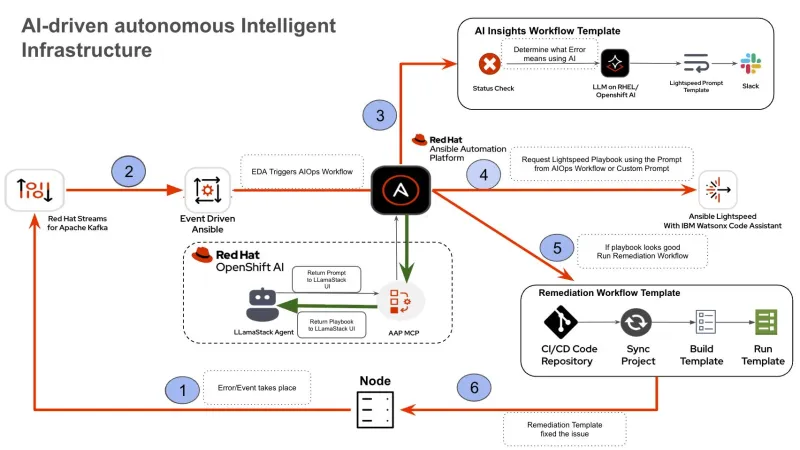
Here’s how the workflow of the demonstration unfolds:
- Event takes place: An intentional service failure is created.
- Alert and trigger: Red Hat Streams for Apache Kafka transports the event in a large and distributed environment, then it gets picked up by Red Hat Ansible Automation Platform. This automatically triggers a rule workflow in Event-Driven Ansible. .
- AI analysis and insight: The workflow sends error logs to a large language model (LLM) for root cause analysis (RCA). Based on this analysis, a prompt is generated for creating a remediation playbook. Simultaneously, the network operations team is notified by chat with the error logs and the AI-generated RCA.
- Ansible code generation: An AI agent picks up the prompt. Using the MCP server and Ansible Automation Platform, it feeds the prompt to Ansible Lightspeed to generate a new remediation playbook.
- System configuration: The AI agent uses Ansible Automation Platform and the MCP server to push the new Ansible Playbook to a Git repository, syncs the project in Ansible Automation Platform, and creates a job template to run it.
- Remediation: Finally, the AI agent calls Ansible Automation Platform to orchestrate the execution of the Ansible Playbook providing the fix of the original issue that caused the service outage. Within Ansible Automation Platform, automated policy as code provides the guardrails for the AI agent (for example, you may not want your AI agent to run changes during a maintenance window).
Conclusion
The journey toward fully autonomous intelligent networks is complex, but the path is clear and can be broken down into smaller, practical steps. By combining better network AI insights with actionable automation, a service provider can overcome the challenges of fragmentation and build unified, intelligent, and self-healing systems. Red Hat’s unified set of solutions provides the essential foundation to build these self healing systems
Learn more about Red Hat’s integrated set of technologies TM Forum Initiatives and relevant Catalyst projects.
- Red Hat Ansible Automation Platform
- Red Hat OpenShift AI
- Red Hat OpenShift Container Platform
- Model context protocol: Discover the missing link in AI integration
- Network Automation with Red Hat Ansible Automation Platform
- Red Hat Ansible Lightspeed
- TM Forum DarkNOC: GenAI propels insights driven NetOps
- TM Forum Is a global alliance of telecom and tech companies
Hatville: Die Miniaturstadt, in der das Edge Computing zum Leben erwacht
Über die Autoren

As an Associate Specialist Solutions Architect on the Red Hat Tiger Team, Saad helps guide customers through the exciting world of open source. He contribute(s) to shaping Red Hat's strategy and ensuring customers get the most out of our innovative solutions.
Since joining Red Hat in 2023, he has/have primarily focused on designing and implementing robust cloud-native platforms using Red Hat OpenShift. While OpenShift is his core focus for building scalable applications, he also explore(s) how these platforms can cleverly incorporate AI capabilities to unlock new possibilities for businesses. With a Master's degree in Computer Science, he bring(s) a strong technical foundation to every challenge, helping organizations transform their ideas into powerful, real-world solutions.

Expert Telecom Solution Architect with 19 years of hands-on experience in designing, implementing, and optimizing Multi-Platform Integration & Automation solutions.
Ähnliche Einträge
IT automation with agentic AI: Introducing the MCP server for Red Hat Ansible Automation Platform
Fast and simple AI deployment on Intel Xeon with Red Hat OpenShift
Technically Speaking | Build a production-ready AI toolbox
Technically Speaking | Platform engineering for AI agents
Nach Thema durchsuchen

Automatisierung
Das Neueste zum Thema IT-Automatisierung für Technologien, Teams und Umgebungen

Künstliche Intelligenz
Erfahren Sie das Neueste von den Plattformen, die es Kunden ermöglichen, KI-Workloads beliebig auszuführen

Open Hybrid Cloud
Erfahren Sie, wie wir eine flexiblere Zukunft mit Hybrid Clouds schaffen.

Sicherheit
Erfahren Sie, wie wir Risiken in verschiedenen Umgebungen und Technologien reduzieren

Edge Computing
Erfahren Sie das Neueste von den Plattformen, die die Operations am Edge vereinfachen

Infrastruktur
Erfahren Sie das Neueste von der weltweit führenden Linux-Plattform für Unternehmen

Anwendungen
Entdecken Sie unsere Lösungen für komplexe Herausforderungen bei Anwendungen

Virtualisierung
Erfahren Sie das Neueste über die Virtualisierung von Workloads in Cloud- oder On-Premise-Umgebungen
