
In my previous post I reviewed the trends related to the integration of Linux systems into environments managed by Active Directory (AD). In this post I will review two integration options, namely: direct integration and indirect integration.
The direct option is, not surprisingly, when your systems are integrated into AD directly (i.e. your Linux systems communicate directly with AD), while the indirect option leverages an intermediary server (see figure below).
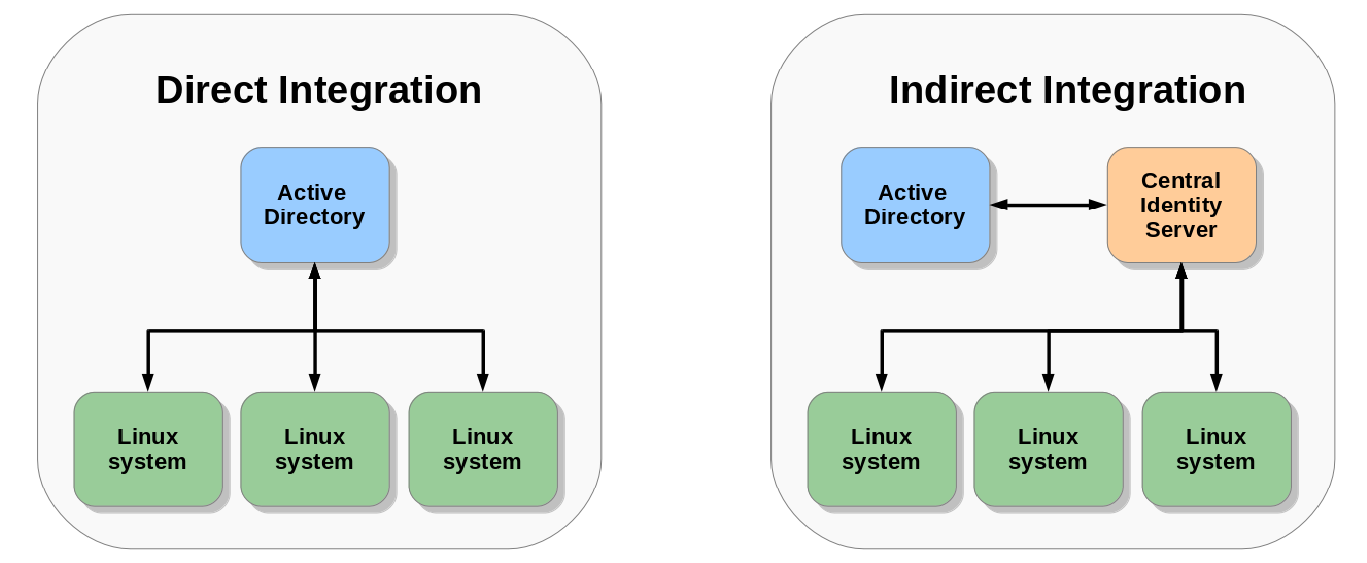 Before we dive into an overview and detailed comparison of these two integration options we need to define “the aspects of the integration”. The aspects of integration are:
- Authentication - A user logs into a Linux system, how is he or she authenticated?
- Identity Lookup - How does a given system know about the right accounts? How are Active Directory accounts are mapped to accounts used on Linux?
- Name Resolution and Service Discovery - How does a system know where to find its authentication and identity server?
- Policy Management - How are other identity related policies are managed on the system?
Having outlined this set of criteria, my next post will use it towards reviewing both the direct and indirect integration options in greater detail.
About the author
More like this
asago 簡介:開放原始碼人工智慧 (AI) 安全與治理調度
讓每一小時的 GPU 時間都發揮價值:Red Hat OpenShift AI 中的進度追蹤
Random Acts Of Automation | Compiler
How Red Hat cleared IT debt for scalable AI
Browse by channel

Automation
The latest on IT automation that spans tech, teams, and environments

Artificial intelligence
Explore the platforms and partners building a faster path for AI

Cloud services
Get updates on our portfolio of managed cloud services

Security
Explore how we reduce risks across environments and technologies

Edge computing
Updates on the solutions that simplify infrastructure at the edge

Infrastructure
Stay up to date on the world’s leading enterprise Linux platform

Applications
The latest on our solutions to the toughest application challenges

Original shows
Entertaining stories from the makers and leaders in enterprise tech
