
By Steve Bohac, Product Marketing, Red Hat Storage
Explosive data growth continues to overwhelm hardware-based storage and IT budgets. Web-scale architectures are becoming more and more prevalent within enterprise IT, as well as cloud providers. By "web scale," we mean large (often a PB and beyond!) architectures employed by the large social media and large cloud services providers we all use every day.
Very often, these web-scale storage architectures are built on object storage. Traditional, proprietary, file-system-based storage appliances generally are built with architectures that are too rigid at this PB (or greater) scale. Installations this large can expose the file system’s inherent weaknesses, performance limitations, and management complexities. Thus, object storage is becoming more attractive for its potential of handling scale while minimizing complexity and costs. Software-defined storage (like Red Hat Storage) can significantly cut costs, prevent vendor lock-in, and allow customers to add capacity and performance independently—critical at the PB+ scale!
You may have seen our recent announcement of Red Hat Ceph Storage 2 featuring enhancements to its object storage capabilities. We've seen that object storage implementations have increased over the past few years. Red Hat Ceph Storage has been object based since day one of the Ceph open source project. In fact, RADOS, the foundational component of Ceph, is an acronym for Reliable, Autonomous, Distributed Object Store.
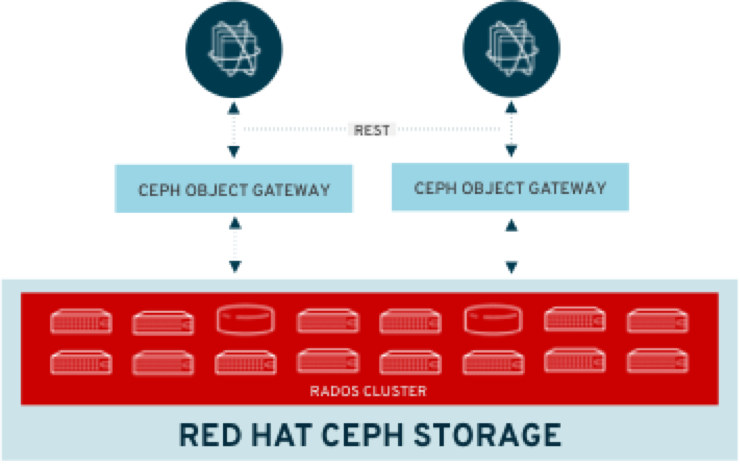
Red Hat Ceph Storage is well suited for object storage installations because it is:
- Proven at web scale for object storage – Red Hat Ceph Storage was designed from the ground up since the beginning of Ceph 10 years ago. During the past decade, it has been hardened by customer usage as well as extensive community development. Consequently, many large companies are running Red Hat Ceph Storage for their large production workloads with object storage.
- Flexible storage for your applications – Several access methods provide customers flexibility in how their applications interact with Ceph object storage: Amazon S3, OpenStack Swift, or Ceph’s native API protocols can all be employed. Ceph’s scale-out architecture provides additional flexibility, allowing customers to scale performance and capacity separately.
- Capable of offering the data protection, reliability, and availability enterprises demand – The distributed nature of the Ceph storage architecture allows you to store and protect your data across numerous hardware assets (thereby mitigating the risk of a hardware failure). The employment of erasure coding provides more storage-efficient data protection than traditional RAID-based solutions. Last, geo-replication capability provides disaster recovery in the unfortunate event that a location suffers some sort of outage.
- Open, community-based, software-defined storage for object – An open source object storage offering, Red Hat Ceph Storage draws on the innovations of a community of developers, partners, and customers.
- Cost-effective object storage to help you maximize your storage budget – The employment of a distributed, open, software-defined storage solution has the potential to significantly cut costs, prevent vendor lock-in, and allow customers to add capacity without degrading performance – critical at the PB+ scale!
Learn more at http://www.redhat.com/storage and https://www.redhat.com/en/technologies/storage/use-cases/object-storage.
About the author
More like this
特徵儲存:所有 AI 資料管道的前端
Red Hat Hybrid Cloud Console:問題解答
Virtualization Is (Still) King | Compiler
Can Compliance Be A Piece Of Cake? | Compiler
Browse by channel

Automation
The latest on IT automation that spans tech, teams, and environments

Artificial intelligence
Explore the platforms and partners building a faster path for AI

Cloud services
Get updates on our portfolio of managed cloud services

Security
Explore how we reduce risks across environments and technologies

Edge computing
Updates on the solutions that simplify infrastructure at the edge

Infrastructure
Stay up to date on the world’s leading enterprise Linux platform

Applications
The latest on our solutions to the toughest application challenges

Original shows
Entertaining stories from the makers and leaders in enterprise tech
