
Many SAP environments are deployed in a hybrid landscape where applications may run on-premise, or on Infrastructure-as-a-Service (IaaS), Platform-as-a-Service (PaaS), or Software-as-a-Service (SaaS). Red Hat has three product solutions to support SAP workloads including Red Hat Enterprise Linux (RHEL), Red Hat Ansible Automation Platform, and Red Hat OpenShift. In this blog we demonstrate how these solutions are used in a hybrid landscape to run, simplify, and expand SAP capabilities.
The following diagram depicts an example hybrid SAP landscape, with each number marker explained in following sections.
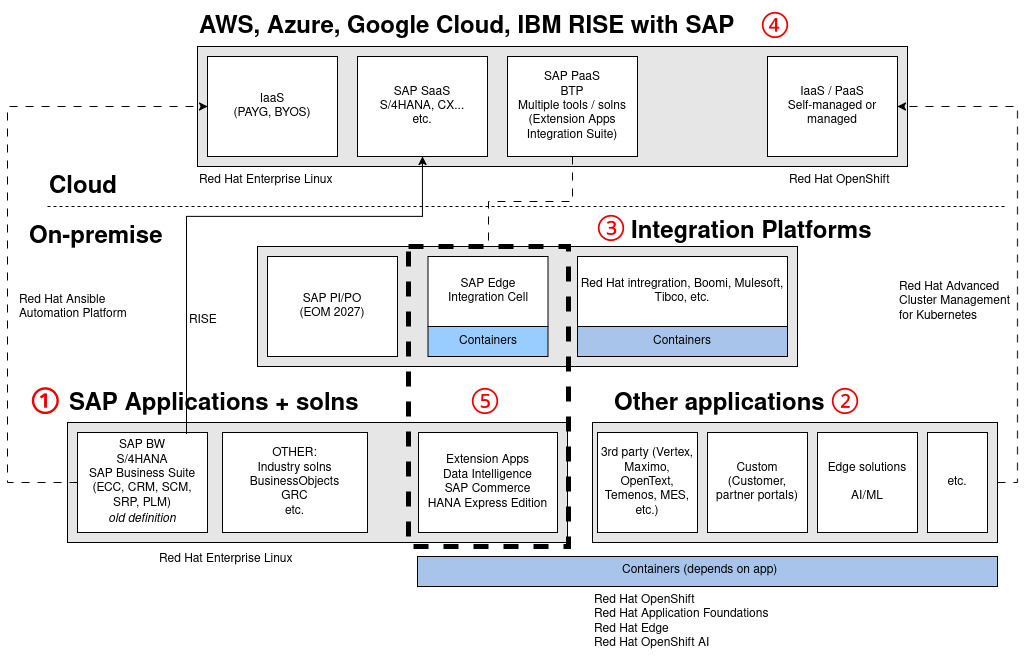
1. On-premise and IaaS deployments
An organization that's been running SAP before cloud adoption is likely to have on-premise deployments consisting of:
- All, or parts of, the older SAP Business Suite (SAP ERP, SAP CRM, SAP SRM, SAP SCM, SAP PLM). This has mainstream support through 2027, with optional extended maintenance until 2030. In 2025, SAP introduced a new generation of its SAP Business Suite based on their SaaS/PaaS offerings.
- SAP S/4HANA replaces SAP ERP and portions of the older SAP Business Suite.
- Other products, such as SAP Business Warehouse, SAP BusinessObjects; and so on.
Red Hat provides a subscription of Red Hat Enterprise Linux (RHEL) for SAP Solutions. The subscription provides the following features that optimizes performance and helps reduce downtime. This includes:
- Update Services provide support for certain minor releases for up to four years from general availability.
- RHEL High Availability Add-on and additional high availability solutions for SAP.
- Red Hat Lightspeed for automated risk assessments related to performance, availability, stability, and security according to SAP rules and policies.
- Red Hat Satellite automates the deployment, configuration, and maintenance of RHEL.
- RHEL system roles for SAP provide a prescriptive and automated way to easily install, configure required RHEL operating system settings documented in SAP KB articles.
Note: SAP S/4HANA is now supported on RHEL 10.
The system roles can be used with Red Hat Ansible Automation Platform for scalability across a large number of hosts. Ansible Automation Platform provides additional automation features specific to SAP, enabling Day 1 and Day 2 operations.
Organizations have now deployed SAP systems on cloud using the IaaS model. Ansible Automation Platform can be used to speed up migration of SAP from on-premise to the cloud. RHEL is certified in all major hyperscalers, so you can purchase RHEL for SAP in the cloud as:
- Bring your own subscription (BYOS): Purchase directly from Red Hat and Red Hat provides level 1 support.
- Pay as you go ( PAYG): Purchase from the hyperscaler, which then provides level 1 support.
2. Non-SAP applications integrated with SAP
SAP applications support business processes that typically require data integration between SAP and non-SAP applications. Non-SAP applications (custom and pre-packaged from other software vendors) can be candidates to run in containers. Red Hat offers the following solutions to manage applications running in containers:
- Red Hat OpenShift: The industry's leading enterprise grade application platform for accelerating the development and delivery of cloud-native applications in a consistent way across on-premises, cloud, and edge environments.
- Red Hat Application Foundations: Suite of tools providing API management, data streaming, enterprise integration, application security, migration, and additional capabilities needed to deliver cloud-native applications.
Red Hat Advanced Cluster Management for Kubernetes allows organizations to manage all Red Hat OpenShift deployments (on-premise and in the cloud) from a single console. This enables containers to be migrated between locations and the flexibility to consistently manage workloads between on-premise and different hyperscalers.
Here are some examples of applications used by SAP customers that integrate with and complement SAP's core functions (depending on the industry vertical) and can be deployed in containers:
- OpenText: Content management solution.
- IBM Maximo Application Suite: Asset monitoring, management, predictive maintenance.
- Temenos: Core banking application.
- Vertex: Provides tax compliance solutions. For example, Vertex O Series Edge is a deployment option using edge computing, and is based on container images.
- Critical Manufacturing: Manufacturing execution system.
Your organization's needs are likely unique, and you can identify other applications that closely integrate with SAP through a discovery session with Red Hat and Red Hat partners.
3. Integration platforms
Research by ASUG shows SAP customers are heavily involved in projects integrating data between different SAP applications, and SAP and non-SAP applications. These integration projects rely on application integration platforms that enable independently designed applications and services to work together. These platforms can run on-premise or in the cloud as integration platform as a service (iPaaS).
Many integration platforms can be deployed in containers. Some example platforms used by organizations are:
All of the above have been validated on Red Hat OpenShift.
4. SAP cloud-based services
SAP has a portfolio of cloud-based SaaS applications providing various business functions. There are SAP cloud services, deployed by SAP in a hyperscaler of your choice, that use Red Hat solutions:
RISE with SAP
RISE with SAP is designed to help organizations transition existing SAP ERP systems (ECC or S/4HANA on-premise) to S/4HANA in the cloud, where the system is managed by SAP. SaaS-based S/4HANA is deployed on RHEL and uses the Red Hat Enterprise Linux for SAP Solutions subscription (as announced in the article SAP and Red Hat Deepen Partnership to Power SAP® Software Workloads with Red Hat Enterprise Linux).
SAP Business Technology Platform (BTP)
SAP BTP is a SAP PaaS offering and includes multiple solutions and services enabling development of new cloud solutions or extension of SAP systems. It includes the SAP Integration Suite, which is the successor to SAP's older integration platform SAP Process Integration/Process Orchestration (PI/PO) which reaches end of maintenance in 2027.
SAP Integration Suite, Edge Integration Cell (EIC), is a hybrid integration solution. EIC allows you to design integration content in the SAP-cloud, and deploy it on-premise or on your private cloud to run integration flows in your organization's private landscape. Edge Integration Cell runs on Red Hat OpenShift, both in cloud environments and on-premise.
Red Hat Ansible Automation Platform in RISE and BTP
SAP cloud operations can leverage Red Hat Ansible Automation Platform to automate Day 1 and Day 2 operations in RISE and BTP. Pre-built and re-usable units of Ansible automation, called roles, are available for:
- Services in various different hyperscalers
- SAP HANA operations
- BTP operations
5. SAP products and solutions supported on Red Hat OpenShift
The older SAP Business Suite and SAP S/4HANA are not yet supported by SAP to run in containers, although they can run in containers for non-production deployments and the ROI of SAP deployment costs can be increased. Some SAP solutions, however, can or must be deployed in containers on Red Hat OpenShift. These include:
- SAP Integration Suite, Edge Integration Cell (EIC)
- Side-by-side extension applications: Custom decoupled applications deployed on a cloud native platform outside of the SAP S/4HANA system that exchange data with SAP S/4HANA. The runtime platform can be SAP BTP, Red Hat OpenShift or Red Hat Application Foundations. For use cases that are very SAP-centric, SAP BTP may be preferred or required, but many organizations run Red Hat OpenShift for its flexibility:
- OpenShift runs identically on different hyperscalers and on-premise.
- OpenShift is built for any language, database, or toolchain.
- A combined SAP BTP and Red Hat OpenShift environment is possible, as in this example architecture.
- SAP Data Intelligence 3 is validated and supported to run on Red Hat OpenShift. For more information, read the SAP article 2976676 - Installing SAP Data Intelligence on Red Hat OpenShift (an SAP login is required).
- The on-premise version of SAP Commerce has been validated on Red Hat OpenShift.
For users that have less experience in managing containers, Red Hat offers an easily accessible managed-service for OpenShift called Azure Red Hat OpenShift (ARO) on Azure and Red Hat OpenShift Service on AWS (ROSA) which can be used for SAP deployments.
Conclusion
Hybrid SAP deployments are intrinsically diverse, because legacy systems distributed across on-premises and cloud environments require connectivity with modern cloud-native applications. Red Hat solutions deliver a consistent foundation for this diversity spanning the distributed IT environment and providing the freedom to move workloads so you can optimize cost, and scale the operations of SAP applications.
Transitioning your on-premise SAP environment to the cloud? Contact Red Hat today. Along with our partners, we help you navigate the diverse hybrid landscape to find the right solutions for your enterprise.
Produkttest
Red Hat Ansible Automation Platform | Testversion
Über die Autoren
After graduating in Electrical & Electronic Engineering, Vas started his career in the UK with a global system integrator . He then moved to the US where he worked in the IT organizations of chemical and pharmaceutical companies supporting large global SAP deployments. For the last 20 years Vas has worked on SAP technical solutions with focus on performance and sizing and high availability on technology platforms from Sun Microsystems, VMware and Red Hat. His roles have included SAP system test planner, ABAP programmer; SAP Basis administrator, SAP Solutions Engineer and RHEL & SAP Specialist (current role at Red Hat).
Matthias has been building and managing SAP business in Senior Management Positions at Fortinet, Hitachi Vantara, VMware, Sun Microsystems, Digital Equipment and since 2025 at Red Hat.
Matthias is a very passionate tennis player.
Ähnliche Einträge
Kostenbewertung in Cloud-Umgebungen: Rating in OpenStack mit CloudKitty
Red Hat OpenShift 4.21: Intelligentere Skalierung, schnellere Migration und KI-gestützte Effizienz
Do We Want A World Without Technical Debt? | Compiler
Avoiding Failure In Distributed Databases | Code Comments
Nach Thema durchsuchen

Automatisierung
Das Neueste zum Thema IT-Automatisierung für Technologien, Teams und Umgebungen

Künstliche Intelligenz
Erfahren Sie das Neueste von den Plattformen, die es Kunden ermöglichen, KI-Workloads beliebig auszuführen

Open Hybrid Cloud
Erfahren Sie, wie wir eine flexiblere Zukunft mit Hybrid Clouds schaffen.

Sicherheit
Erfahren Sie, wie wir Risiken in verschiedenen Umgebungen und Technologien reduzieren

Edge Computing
Erfahren Sie das Neueste von den Plattformen, die die Operations am Edge vereinfachen

Infrastruktur
Erfahren Sie das Neueste von der weltweit führenden Linux-Plattform für Unternehmen

Anwendungen
Entdecken Sie unsere Lösungen für komplexe Herausforderungen bei Anwendungen

Virtualisierung
Erfahren Sie das Neueste über die Virtualisierung von Workloads in Cloud- oder On-Premise-Umgebungen
