Skip to content AI
  • Overview

    • AI news
    • Technical blog
    • Live AI events
    • Inference explained
    • See our approach
  • Products

    • Red Hat AI Enterprise
    • Red Hat AI Inference
    • Red Hat Enterprise Linux AI
    • Red Hat OpenShift AI
    • Explore Red Hat AI
  • Engage & learn

    • Learning hub
    • AI topics
    • AI partners
    • Services for AI
Hybrid cloud
  • Platform solutions

    • Artificial intelligence

      Build, deploy, and monitor AI models and apps.

    • Linux standardization

      Get consistency across operating environments.

    • Application development

      Simplify the way you build, deploy, and manage apps.

    • Automation

      Scale automation and unite tech, teams, and environments.

  • Use cases

    • Virtualization

      Modernize operations for virtualized and containerized workloads.

    • Digital sovereignty

      Control and protect critical infrastructure.

    • Security

      Code, build, deploy, and monitor security-focused software.

    • Edge computing

      Deploy workloads closer to the source with edge technology.

  • Explore solutions
  • Solutions by industry

    • Automotive
    • Financial services
    • Healthcare
    • Industrial sector
    • Media and entertainment
    • Public sector (Global)
    • Public sector (U.S.)
    • Telecommunications

Discover cloud technologies

Learn how to use our cloud products and solutions at your own pace in the Red Hat® Hybrid Cloud Console.

Products
  • Platforms

    • Red Hat AI iconartificial intelligence, Red Hat Enterprise Linux AI, Red Hat OpenShift AI, RHEL AI, machine learning38382025-03-12T19:43:40.963Zimage/svg+xmlRed Hat AI iconartificial intelligence, Red Hat Enterprise Linux AI, Red Hat OpenShift AI, RHEL AI, machine learningIconno2025-03-12T19:39:59.817ZTechnology iconStandardRed Hat AI

      Develop and deploy AI solutions across the hybrid cloud.

    • Red Hat Enterprise Linux iconRHEL, Linux platforms, CentOS2024-03-01T15:26:42.958ZpendingTRA3b65dd25-844d-49bb-93c1-30f5b34684f1Icon2024-03-01T15:26:42.958Ztruepending2024-03-21T00:40:29.326Zrhcc-audience:internalnoTechnology iconDER3b65dd25-844d-49bb-93c1-30f5b34684f1Standardyesrhcc-product:red-hat-enterprise-linuxTechnology iconimage/svg+xml2024-05-10T14:11:29.114ZRed Hat Enterprise Linux iconRHEL, Linux platforms, CentOSActivateActivate2024-05-10T14:11:29.836Zworkflow-process-serviceActivateworkflow-process-servicefalse2024-05-10T14:11:29.836Zworkflow-process-service2024-05-10T14:11:29.836ZUse technology icons to represent Red Hat products and components. Do not remove the icon from the bounding shape.Red Hat Enterprise Linux

      Support hybrid cloud innovation on a flexible operating system.

    • Red Hat OpenShift iconCloud, Containers, Kubernetes2024-03-01T15:26:53.684ZpendingTRA9ec76aa9-ef09-4c49-8816-01dd13970ca7Icon2024-03-01T15:26:53.684Ztruepending2024-03-21T00:39:44.126Zrhcc-audience:internalnoTechnology iconDER9ec76aa9-ef09-4c49-8816-01dd13970ca7Standardyesrhcc-product:red-hat-openshiftrhcc-product:red-hat-openshift-on-ibm-cloudrhcc-product:microsoft-azure-red-hat-openshiftrhcc-product:red-hat-openshift-service-on-awsrhcc-product:red-hat-openshift-container-platformrhcc-product:red-hat-openshift-platform-plusTechnology iconimage/svg+xml2024-05-10T14:18:23.703ZRed Hat OpenShift iconCloud, Containers, KubernetesActivateActivate2024-05-10T14:18:25.221Zworkflow-process-serviceActivateworkflow-process-servicefalse2024-05-10T14:18:25.221Zworkflow-process-service2024-05-10T14:18:25.221ZUse technology icons to represent Red Hat products and components. Do not remove the icon from the bounding shape.Red Hat OpenShift

      Build, modernize, and deploy apps at scale.

    • Red Hat Ansible Automation Platform iconManagement, edge2024-03-01T15:26:35.068ZpendingTRA759b57c4-760b-45a0-a939-821f47181964Icon2024-03-01T15:26:35.068Ztruepending2024-03-21T00:39:55.923Zrhcc-audience:internalnoTechnology iconDER759b57c4-760b-45a0-a939-821f47181964Standardyesrhcc-product:red-hat-ansible-automation-platformTechnology iconimage/svg+xml2024-05-10T14:04:00.014ZRed Hat Ansible Automation Platform iconManagement, edgeActivateActivate2024-05-10T14:04:01.784Zworkflow-process-serviceActivateworkflow-process-servicefalse2024-05-10T14:04:01.784Zworkflow-process-service2024-05-10T14:04:01.784ZUse technology icons to represent Red Hat products and components. Do not remove the icon from the bounding shape.Red Hat Ansible Automation Platform

      Implement enterprise-wide automation.

      New version
  • Featured

    • Lightwell
    • Red Hat AI Enterprise
    • Red Hat OpenShift Virtualization Engine
    • Red Hat Desktop
    • See all products
  • Try & buy

    • Start a trial
    • Buy online
    • Integrate with major cloud providers
  • Services & support

    • Consulting
    • Product support
    • Services for AI
    • Technical Account Management
    • Explore services
Training
  • Training & certification

    • Courses and exams
    • Certifications
    • Skills assessments
    • Red Hat Academy
    • Learning subscription
    • Explore training
  • Featured

    • Red Hat Certified System Administrator exam
    • Red Hat System Administration I
    • Red Hat Learning Subscription trial (No cost)
    • Red Hat Certified Engineer exam
    • Red Hat Certified OpenShift Administrator exam
  • Services

    • Consulting
    • Partner training
    • Product support
    • Services for AI
    • Technical Account Management
Learn
  • Build your skills

    • Documentation
    • Hands-on labs
    • Hybrid cloud learning hub
    • Interactive demos
    • Training and certification
  • More ways to learn

    • Blog
    • Events and webinars
    • Podcasts and video series
    • Red Hat TV
    • Resource library

For developers

Discover resources and tools to help you build, deliver, and manage cloud-native applications and services.

Partners
  • For customers

    • Our partners
    • Red Hat Ecosystem Catalog
    • Find a partner
  • For partners

    • Partner Connect
    • Become a partner
    • Training
    • Support
    • Access the partner portal

Build solutions powered by trusted partners

Find solutions from our collaborative community of experts and technologies in the Red Hat® Ecosystem Catalog.

ConsoleDocsSupport Search

I'd like to:

  • Start a trial
  • Buy a learning subscription
  • Manage subscriptions
  • Contact sales
  • Contact customer service
  • See Red Hat jobs

Help me find:

  • Documentation
  • Developer resources
  • Tech topics
  • Architecture center
  • Security updates
  • Customer support

I want to learn more about:

  • AI
  • Application modernization
  • Automation
  • Cloud-native applications
  • Linux
  • Virtualization
New For you

Recommended

We'll recommend resources you may like as you browse. Try these suggestions for now.

  • Product trial center
  • Courses and exams
  • All products
  • Tech topics
  • Resource library
Log in

Get more with a Red Hat account

  • Console access
  • Event registration
  • Training & trials
  • World-class support

A subscription may be required for some services.

Log in or register
Contact us
Red Hat logo
  • Home
  • Resources
  • Network automation for everyone

Network automation for everyone

July 2, 2026•
Resource type: E-book
Download PDF

Chapter 1: Now is the time for network evolution

Networking is a critical component of both IT and operational technology (OT), supporting hybrid cloud applications, remote workforces, and edge deployments. However, while infrastructure has evolved rapidly, network management often lags behind. Many organizations still rely on a fragmented mix of custom automation scripts, single-function tools, and manual processes. This approach presents several challenges: 

  • Fragmented expertise: Network operations (NetOps) teams often specialize in isolated domains, limiting cross-team productivity.
  • Isolated team structures: Disparate departments struggle to coordinate workflows.
  • Legacy constraints: Traditional operational practices are difficult to modernize without a platform that supports the entire lifecycle of the network.
  • Complicated security landscape: An increasing volume of threats can overwhelm teams that lack automated, policy-driven responses, making security and compliance across multivendor environments more difficult.
  • Vendor-centric management: Many vendors focus on individual product features rather than holistic operational improvements and interoperability. 

NetOps teams are able to overcome these challenges with strategic automation. As organizations adopt artificial intelligence for IT operations (AIOps), the programmable foundation provided by network automation serves as an essential governance layer. It provides the deterministic execution required to turn insights into trusted, reliable action. Additionally, NetOps teams can collaborate more effectively through increased transparency of cross-functional initiatives that support business transformation and modernization.

Strategic automation helps you accelerate network operations 

IT organizations must adapt to rapidly shifting application and developer requirements. Traditional, manual approaches to network configuration are too slow to support these needs, making it difficult to:

  • Provide a high level of service to users.
  • Deliver resources to application development and IT operations teams on demand.
  • Implement consistent change control and configuration processes.
  • Manage inventory and maintain configuration standards across disparate platforms.
  • Build proactive, self-sufficient NetOps teams and NetSecOps practices.

While programmable, software-based technologies support digital initiatives, NetOps teams often struggle to reach the same automation maturity as IT teams. Many only automate specific tasks in a limited capacity, creating hybrid processes that require manual intervention. This often happens because:

  • Device-specific tools are often difficult to incorporate into end-to-end automation processes.
  • Integrating automation across multivendor environments can be difficult.
  • Teams can perceive automation as a loss of control or an increased operational risk.
  • NetOps professionals can feel they lack the specific skills to use new automation technologies.

Embracing end-to-end automation can help you overcome these challenges to adopt agile NetSecOps approaches and deliver high-value network services on demand. The possibilities offered by network automation are expansive. You can automate Day 0, Day 1, and Day 2 operations, and even respond to changing conditions in your network and IT environment without human intervention.

For example, when a security incident is detected, the platform can automatically shut down affected ports, quarantine components, and generate a service ticket for IT. You can also use automation to gather facts for troubleshooting, identifying and remediating issues before they affect users–preventing outages and making sure teams no longer suffer from work that is led by interruptions.

Network automation helps make teams more productive and operations more consistent, so your organization can focus on its highest priorities.

Chapter 2: Streamline processes with programmable logic

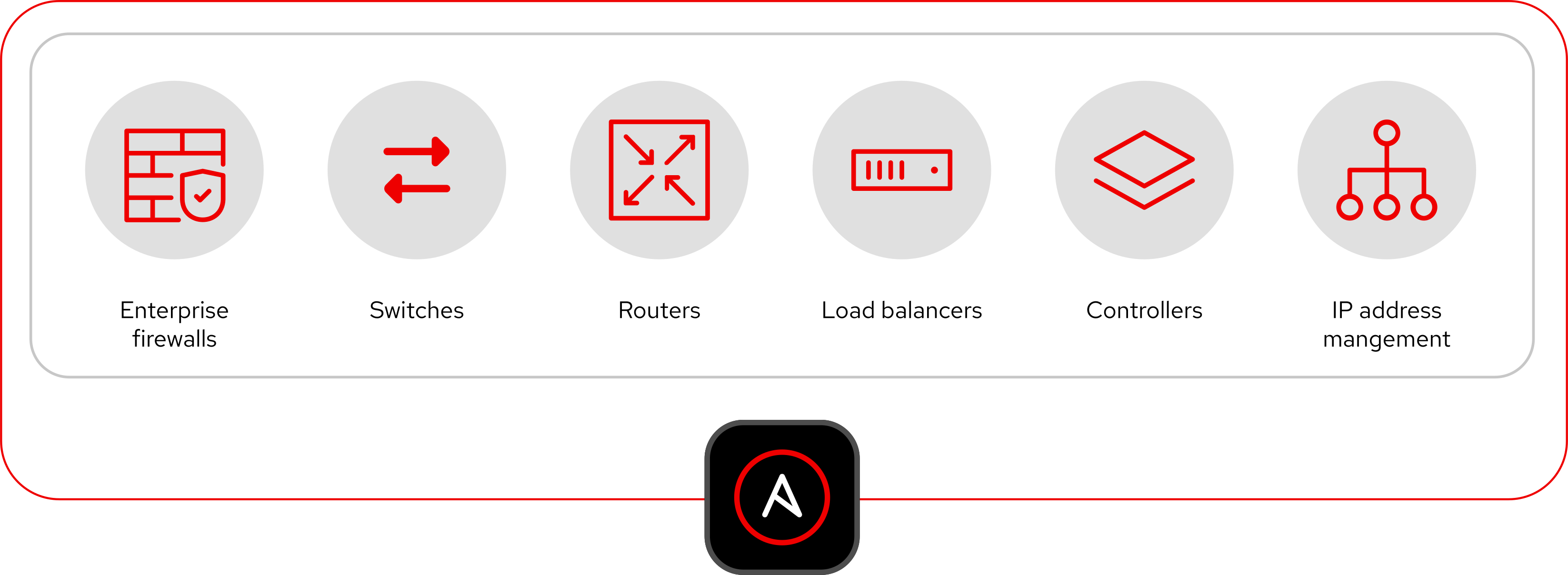
Network automation uses programmable logic to manage resources and services, allowing NetOps teams to rapidly configure, scale, harden, and integrate network infrastructure (layers 1-3) and application services (layers 4-7). While telecommunications and cloud providers were early adopters, many organizations now use network automation to accelerate growth across their already fast-growing environments.

Red Hat Ansible Automation Platform icon with gears orchestrates Network infrastructure layers

Figure 1. Network infrastructure layers

With network automation, NetOps teams can respond quickly to changing workload requirements for flexible capacity, application security, load balancing, and hybrid cloud integrations. Network automation helps enable:

  • Productivity: Teams use self-service, on-demand network activities that satisfy corporate security policies without manual bottlenecks.
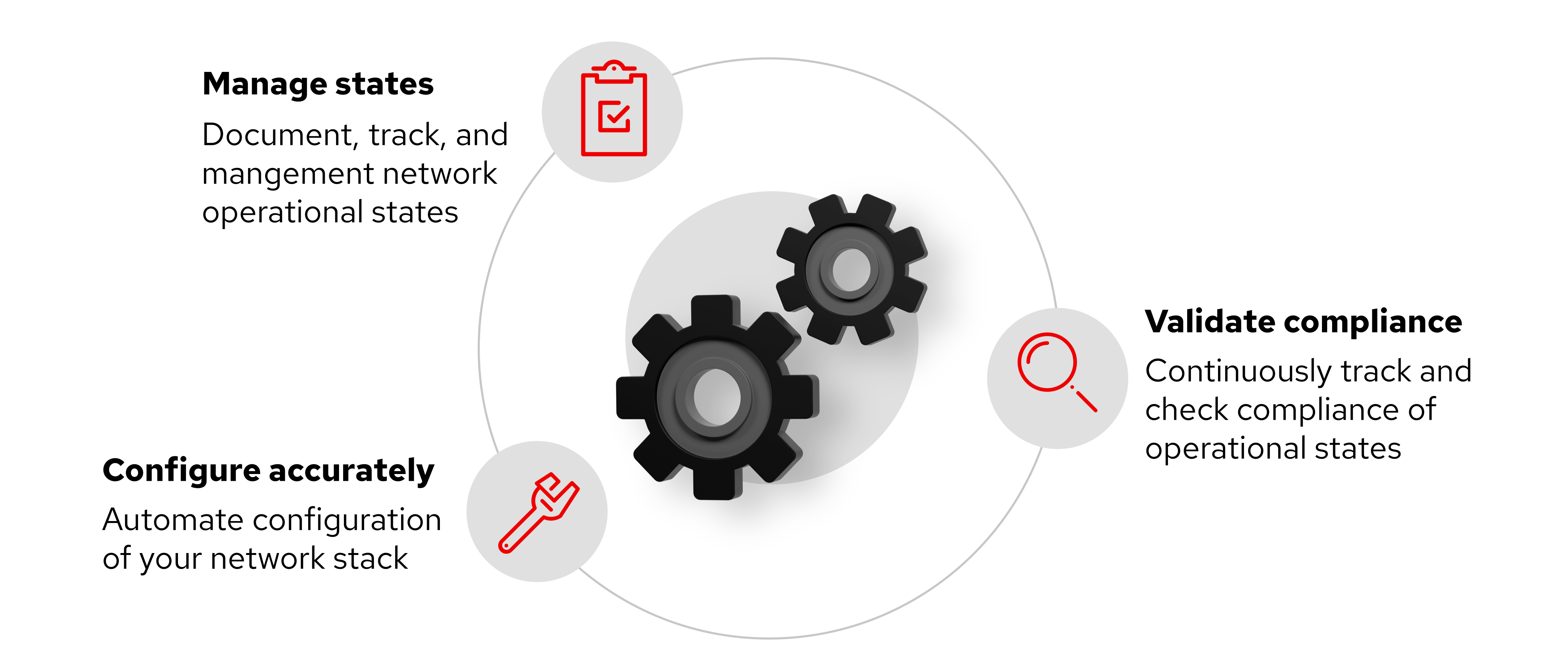
  • Operational transparency: Improvements to change management, documentation, and logging increase visibility across the datacenter and edge networks.
  • Resilient operations: Event-driven approaches automatically respond to changes in your network or IT environment. 

Together, these improvements provide NetOps teams with a programmable foundation, built on network automation, that serves as an essential governance layer across the organization. 

Why automate your network?

Network automation benefits organizations of varying sizes, across industries.

Reusable, scalable, and software-defined automation gives you greater control and visibility across your infrastructure. The result is improved uptime, staff productivity, and hardened security.

Productivity

Improve your team’s response time to increased demand for changes. 

  • Streamline essential routine activities and allow all team members to perform basic operations.
  • Test and deploy network changes automatically. 
  • Automate repetitive and unpopular tactical tasks across network domains.
  • Integrate automated network operations into IT change management systems and workflows.

Security

Rapidly identify vulnerabilities and implement fixes across your entire network.

  • Collect information about network devices. 
  • Build and maintain an inventory of devices on demand. 
  • Automatically mitigate simpler issues so staff can focus on more complex and sophisticated attack vectors.
  • Adopt an event-driven approach using telemetry and integrations with network management systems to automatically mitigate security issues.

Compliance

Ensure continuous compliance with changing policies and regulations. 

  • Implement a consistent, centralized source of truth for GitOps processes. 
  • Automatically test changes before committing.
  • Validate that changes were made appropriately.
  • Automate auditing tasks and change logging.
  • Automate drift notifications and remediation tasks.

Availability

Increase network uptime with more effective testing and management. 

  • Gain visibility into the impact of changes. 
  • Ensure consistency across your entire network.
  • Reduce errors with automated change management.
  • Scale network capacity to meet changing needs.

Resilience

Respond automatically in a predefined manner to observed events in your network and IT environment. 

  • Automatically identify and remediate potential issues before they affect operations and users.
  • Simplify and speed up troubleshooting activities by automating initial response actions.
  • Respond automatically to user administration requests like recovering passwords or managing network access.
  • Watch for configuration drift and automatically apply updates to maintain the expected state of network infrastructure.
  • Optimize your network performance automatically to meet user and application demand.
graphic showing servers, a cloud icon, and a cursor over a code window

Chapter 3: Run your network more efficiently

As a foundation for building and operating automation at scale, Red Hat® Ansible® Automation Platform allows you to create and orchestrate complete IT workflows that support your business goals. Multiple domain teams can use the platform to build, scale, and deploy automation across the entire organization while maintaining strict governance controls.

Ansible Automation Platform orchestrates every aspect of your IT environment—from servers and networks to applications, security, and DevOps. It supports both standalone and devices controlled through software-defined networking (SDN) across multivendor virtual, physical, and cloud environments so you can automate your entire infrastructure using a single, unified platform.

Using a common language, Ansible Automation Platform makes everyday tasks repeatable and scalable so you can run your network more efficiently. Choose to automate where you need it most. The platform’s flexible framework embraces incremental change, so you can start small and expand over time.

With Ansible Automation Platform, you can automate everything from individual network tasks (like device configuration updates), to complex processes that involve multiple network teams, to entire workflows that cross IT domains. For example, you can use Ansible Automation Platform to manage the lifecycles of cloud-native applications, including the underlying virtual machines (VMs), network connectivity, access management, and other dependencies.

Network management efficiencies by responsibility

Simple

Ansible Automation Platform uses human-readable automation through YAML-based playbooks, roles, and rulebooks. Tasks are executed in order and can be combined to orchestrate complex processes. Users can create effective automation sequences through a visual user interface (UI). Because no special programming skills are required, NetOps engineers can use the platform immediately.

Powerful

The platform acts as a sophisticated abstraction layer for your entire IT environment. By using modules and plugins, it transfers instructions over existing transport mechanisms and provides templating engines for large-scale automation. Use certified and validated automation content from our network partner ecosystem helps you create reliable enterprise workflows. Command line interfaces (CLIs) and application programming interfaces (APIs) can also be accessed directly within the platform, so you can implement network configurations as code while the platform translates commands for each endpoint.

Agentless

An agentless architecture means there is no need to install software on your networking devices. This approach ensures a low attack surface and improves network security. Connection plugins for network devices make it easier to deploy existing automation onto new device APIs, supporting more reliable operations without the overhead of agent management.

Optimized 

Ansible Automation Platform helps organizations adopt and use AIOps to achieve true operational resilience with features like Event-Driven Ansible. The platform turns probabilistic alerts into deterministic execution through trusted Ansible Playbooks, bridging the gaps between team insights, AI, and network execution. This approach builds more resilient operations as Event-Driven Ansible automatically translates network telemetry into immediate remediation, handling routine diagnostics and configuration fixes to reduce operational noise. Every action is governed: the AI agent recommends network optimization while Ansible Automation Platform ensures what runs is approved, documented, and compliant from the datacenter to the edge.

Automate complete networking lifecycles

With Ansible Automation Platform, you can manage your network infrastructure throughout the entire production lifecycle.

graphic displaying the network automation lifecycle

Figure 2. Network automation lifecycle

Deploy production-grade automation at scale

Ansible Automation Platform delivers the features required to create, manage, and scale automation across teams and technologies. It provides the governance layer necessary for critical environments, including:

  • A CLI-based automation engine.
  • A visual management interface with API access.
  • Advanced operational analytics.
  • Certified and validated automation content and content management.
  • Enterprise support.

The platform provides control over how automation is deployed and used, as well as auditable knowledge about sources and outcomes.

Flexible architecture: Security-focused and scalable

Ansible Automation Platform provides a scalable, security-focused fabric for building and managing automation across diverse environments. Whether you use a monolithic or decoupled architecture, an encrypted automation mesh connects execution nodes to manage path redundancy, workload scaling, and bandwidth optimization.

Automation analytics: Measuring success

Ansible Automation Platform provides operational analytics that help you understand current usage, measure investment and time savings, and encourage collaboration so teams can be more productive.

Trusted content: Foundation for AIOps

To ensure deterministic execution in an AIOps-driven world, you need content you can trust. Ansible Automation Platform offers certified, supported content to integrate with third-party technologies and expand across domains. Access validated, opinionated references that serve as a stable starting point for your automation initiatives.

Key features and benefits

  • Single interface for multivendor networks: Orchestrate your network across core, datacenter, campus, and edge devices with support for hundreds of third-party components.
  • Certified and validated content collections: Use automation content that is tested and supported by Red Hat and our certified partners.
  • Role-based access control (RBAC): Maintain governance by specifying access for people, processes, and devices.
  • Dynamic inventory: Connect to any data source in your network to build and maintain an accurate inventory on demand.
  • Workflows and scheduling: Organize complex tasks and schedule playbooks to ensure consistent operations without manual intervention.
  • Event-driven automation: Integrate with enterprise systems like Domain Name System (DNS), Dynamic Host Configuration Protocol (DHCP) and IP address management (IPAM), IT service management (ITSM), and others to trigger event-based automation workflows. 
  • RESTful API: Exchange instructions with other tools, such as ITSM and IPAM solutions.

Common myths about using Ansible Automation Platform

  • You must know how to code to use it.

    There is no need to learn a programming language to get started with Ansible Automation Platform. You can automate your network using simple, human-readable commands that will work for automating your existing network.
     
  • You will automate your job away.

    Automating tedious tasks allows you to focus on high-value and innovative projects that matter for your company and your professional growth.
     
  • It is only for servers.

    Ansible Automation Platform can be used to automate your entire IT environment.

Watch this on-demand video playlist to learn more. 

What is a playbook?

Playbooks provide instructions for configuring, deploying, and orchestrating IT assets through Red Hat Ansible Automation Platform. They consist of sets of commands called plays that define automation across an inventory of hosts. Each play includes one or more tasks that target specific systems in your environment. Playbooks provide the deterministic execution required to turn AI-driven insights into trusted, reliable action by ensuring that the resulting changes are governed, predictable, and repeatable. By sharing and reusing playbooks across your organization, you foster more productive teams and build a stable automation supply chain.

Chapter 4: Adopt an open, strategic approach to network automation

Modern IT environments are complex, often spanning multiple vendors and technologies. Networking is critical to this mix and must be integrated across multivendor stacks to ensure reliable, security-focused connections. Red Hat believes that vendor collaboration through open ecosystems is essential for building the resilient operations customers need to meet their unique business goals.

Certified and validated content

Ansible Content Collections offer more than 180 prebuilt modules and roles from industry-leading partners, including a broad selection of network vendors and technologies. Red Hat Ansible Certified Content jumpstarts integration with partner platforms, while Ansible validated content provides a tested, opinionated path for performing complex operational tasks. 

From community innovations to a commercial-grade product

Ansible Automation Platform is a fully supported product that incorporates the innovation of open source projects while mitigating enterprise risk. Our open development model frees your staff from managing, updating, and testing community releases—saving time and increasing productivity. The platform also delivers essential enterprise security capabilities like role-based access control (RBAC), auditing, logging, and integration with authentication systems.

Comprehensive support 

Red Hat offers holistic, end-to-end support—from operating system (OS) to automation software to dozens of certified vendor integrations. Every Red Hat subscription provides access to technical experts to help you build and manage your solutions. Our collaborative approach gives you access to the latest product knowledge and best practices. Security patches and updates are regularly provided by the Red Hat Global Support Services team.

Expertise to empower your staff

Red Hat provides expert services and training to help you on your path to network automation:

  • Red Hat Consulting: Works with your team to analyze challenges and design cost-effective, comprehensive solutions.
  • Red Hat Training and Certification: Offers hands-on training and practical certifications to help your staff apply best practices and improve overall productivity.

Choice and flexibility for your network

Red Hat fosters a large ecosystem of certified partners, ensuring you can deploy your preferred tools, clouds, and hardware with confidence. Ansible Automation Platform includes network-specific Ansible Content Collections that allow you to automate devices from a vast range of vendors.

Because the platform works across networks and tools, you can orchestrate complete workflows that incorporate your current technologies—such as switches, routers, firewalls, access points, and load balancers—as well as those you plan to adopt in the future. This flexibility ensures you can manage the entire lifecycle of your infrastructure.

What is an Ansible Content Collection?

Ansible Content Collection is a standardized distribution format for Ansible content that includes playbook examples, roles, modules, plugins, and more. Available through a Red Hat Ansible Automation Platform subscription, they allow you to streamline automation across the hybrid cloud by providing prebuilt, reusable assets.

What is an Ansible Rulebook?

Ansible Rulebooks are the foundation of Event-Driven Ansible, providing the logic required to perform actions in a resilient, automated environment. Written in human-readable YAML, rulebooks use "if-then" structures to link specific events—such as those from monitoring, observability, or AIOps tools—to automated actions.

Network workflow orchestrated across the network

Figure 3. Network workflow orchestrated across the network

Chapter 5: Common use cases

Start small and build overtime to increase value

Red Hat Ansible Automation Platform helps you automate the lifecycle of your network. Most teams begin with one of these use cases and expand over time to increase business value.

Back up and restore configurations

Storing backups of configurations is a critical activity for NetOps. Ansible Automation Platform makes it easy to pull an entire configuration, or just parts of the configuration, from one or more network devices. You can then restore these configurations to network devices as needed.

Collect facts to gain visibility

Read-only tasks like fact collection can help you gain visibility into your network inventory and state. Ansible Automation Platform makes it easier to collect information from your network devices and create reports for compliance and standardized, agnostic network management.

Update sources of truth across your network

Knowing the configurations of your network devices is essential for efficient NetOps. Ansible Automation Platform can help you update an off-device source of truth that treats network configurations as structured variables for Infrastructure as Code management approaches. Modules let you transform the configurations of devices from a variety of network vendors into structured data to integrate with your sources of truth.

Manage network configurations

Configuration drift happens. Ansible Automation Platform simplifies policy enforcement, drift monitoring and correction, and configuration maintenance. Using a Network as Code approach with structured configuration data, you can manage your network in the same way you manage servers.

Integrate your existing tools and devices

NetOps teams need to make the most of their network investments. Ansible Automation Platform integrates with your existing network devices, controllers, and management tools, as well as other vendor-specific automation tools, to help you automate the network you have today.

Self-heal networks with Event-Driven Ansible

To reach operational resilience, teams use Event-Driven Ansible for self-healing automation. Event-Driven Ansible can process events containing discrete intelligence about conditions in the IT environment, determine the appropriate response to the event, then execute automated actions to address or remediate the event.

By starting with these foundational steps, your team can build a trusted automation supply chain that scales from simple tasks to complex, cross-domain workflows.

Experience real business outcomes via network automation

Many organizations are already gaining benefits by automating with Ansible Automation Platform.

Mission-critical automation takes flight at Southwest Airlines

Southwest Airlines, one of the most honored airlines in the world, needed to modernize its massive network infrastructure to eliminate manual configuration drift and support 4,000 daily flights. The company uses Ansible Automation Platform to implement a "golden configuration" model, allowing its NetOps team to manage more than 5,000 devices with speed and consistency.

  • Improved operational resilience by scaling firmware upgrades from 10 to over 100 devices per night.
  • Boosted staff productivity by reducing the time to stand up airport network cores from 30 minutes per device to 20 minutes for an entire site.
  • Accelerated time to value by shortening network access control (NAC) deployment timelines from 10 months to 6 weeks through reusable automation.

Read the success story2

Build your skills

Red Hat offers training courses and resources to help your team get started with automation. 

  • Ansible Basics (DO007) provides an introduction to using Ansible Automation Platform.
  • Ansible for network automation (DO457) teaches you how to automate network management. 
  • Free, self-paced labs offer a preconfigured environment for learning and experimenting.
  • Consult the Network automation guide1 as you think about your next steps in broader network automation.
  • Ansible Automates are no-cost, one-day, virtual events that show Red Hat’s IT automation solutions.
  • Network automation webinars cover a variety of network-related topics for different roles.
  • Complimentary, 60-day trial subscriptions let you try Ansible Automation Platform in your environment.

Automating network operations for TDBank 

TD Bank offers a full range of financial products and services to over 27.5 million customers worldwide. Through their network transformation roadmap, the bank sought to lead with an automation-first mindset at the center of its platform delivery capabilities, ranging from scalability of software upgrades, configuration management and deployment, and standing up new products. The internal evolution of their automation capabilities drove forward the reduction of repetitive tasks for engineering teams alongside bringing new standardization to their deployments.

  • Maintained access controls across firewall, load balancer, and switching teams for playbook execution, while fostering cross team-collaboration on workflows.
  • Automated the standardization of more than 10,000 network devices against new-state standards, improving software deployment and compliance, as well as configuration management.
  • Automated upgrade of more than 8,500 Cisco devices over the span of 8 months.

Read the success story3

Automation Unlocks 5G Potential at One New Zealand

One New Zealand (formerly Vodafone NZ), a leading telecommunications and digital services provider, needed to simplify its complex network operations to support the rollout of 5G and manage increasing traffic demands. The company uses Ansible Automation Platform to move from manual, per-node configurations to a unified automation framework that spans its core network and datacenter environments.

  • 40x improvement in upgrade times for a single virtual network function (VNF).
  • Reduced provisioning time from 10 days to a single day.
  • Automated version control and rollback functionality critical for 5G networks.

Read the blog post4

The State of Missouri Scales Automation, Unlocking Time for Innovation

The State of Missouri’s Office of Administration, Information Technology Services Division (ITSD), needed to overcome manual, siloed processes to better serve its 6 million citizens. The state uses Ansible Automation Platform to consolidate disparate tools into a unified automation strategy, streamlining the management of thousands of servers across its diverse agencies.

  • Automated 28,000 tasks to significantly reduce manual workloads.
  • Saved 22,000 labor hours annually for IT staff.
  • Improved consistency and speed of service delivery for Missouri citizens.

Read the blog post5

Ability to scale

Red Hat Ansible [Automation Platform] is really our saving grace of being able to scale the bank from an enterprise reach perspective, across our US and Canadian environments and across the world.

Drew Yates

Global Head, Network Service Delivery, TD Bank

Chapter 6: Get started with network automation

Red Hat can help you define your path to efficiency

Network automation is essential for supporting the evolving application and workload requirements of modern digital business. Ansible Automation Platform provides a clear path to modernizing your network operations while maintaining support for your current processes and existing infrastructure.

While transitioning to a fully automated network can seem intimidating, we recommend starting small and making incremental changes at your own pace. Focus on solving the contained, tactical problems your team faces daily, and build the foundation from there.

It’s easy to get started

  • Gain visibility: Create playbooks that perform low-risk read-only tasks to verify information and validate network state across the datacenter and edge networks.
  • Automate toil: Build simple jobs to replace tedious, unpopular, and manual tasks.
  • Bridge the skills gap: Use the platform’s human-readable YAML to apply your team’s current domain expertise to automation without requiring complex programming skills.

As you expand these efforts, you will organically create the governance and trust layer necessary for future AIOps initiatives and ensure your organization can better manage modernizing its infrastructure with confidence and scale. Remember, automation is more than a tool—it’s a journey, a culture, and a strategy.

Ready to start automating your networks?

Network automation provides the governance layer that streamlines operations, decreases response times, and supports modern business demands. 

Red Hat Ansible Automation Platform gives your organization everything it needs to automate its IT network and cloud environment at scale. With flexible, user-friendly automation, you can define a simple, powerful path to network efficiency without leaving your organization’s existing processes and infrastructure behind. 

Get started with your Ansible Automation Platform trial

Learn more at ansible.com/network-automation

  1. Red Hat e-book. “Network automation guide.” 4 April 2025.

  2. Red Hat case study. "Southwest Airlines is expanding its automation use cases." 2 May 2024.

  3. Red Hat success story. “Meet the 7 customers innovating with Red Hat technologies." 1 July 2025.

  4. Red Hat blog. “Automation unlocks 5G's full potential: One New Zealand's journey." 15 Oct. 2025.

  5. Red Hat blog. “The State of Missouri Scales Automation, Unlocks Time for Innovation." 29 Oct. 2025.

Tags:Automation and management

Red Hat logo

About Red Hat

Red Hat is the open hybrid cloud technology leader, delivering a trusted, consistent and comprehensive foundation for transformative IT innovation and AI applications. Its portfolio of cloud, developer, AI, Linux, automation and application platform technologies enables any application, anywhere—from the datacenter to the edge. As the world's leading provider of enterprise open source software solutions, Red Hat invests in open ecosystems and communities to solve tomorrow's IT challenges. Collaborating with partners and customers, Red Hat helps them build, connect, automate, secure, and manage their IT environments, supported by consulting services and award-winning training and certification offerings.

  • North America
  • Asia Pacific
  • Latin America
  • Europe, Middle East, and Africa
  • 888-REDHAT1
  • +6564904200
  • +5443297300
  • +0080073342835
  • www.redhat.com
  • apace@redhat.com
  • info-latam@redhat.com
  • europe@redhat.com
  • @red-hat
  • @redhat
  • @redhat
  • @red_hat

Copyright © 2026 Red Hat. Red Hat, the Red Hat logo, Ansible, and OpenShift are trademarks or registered trademarks of Red Hat, LLC or its subsidiaries in the United States and other countries. Linux® is the registered trademark of Linus Torvalds in the U.S. and other countries. The OPENSTACK logo and word mark are trademarks or registered trademarks of OpenInfra Foundation, used under license. All other trademarks are the property of their respective owners.

Red Hat logoLinkedInYouTubeFacebookXInstagram

Platforms

  • Red Hat AI
  • Red Hat Enterprise Linux
  • Red Hat OpenShift
  • Red Hat Ansible Automation Platform
  • See all products

Tools

  • Training and certification
  • My account
  • Customer support
  • Developer resources
  • Find a partner
  • Red Hat Ecosystem Catalog
  • Documentation

Try, buy, & sell

  • Product trial center
  • Red Hat Store
  • Buy online (Japan)
  • Console

Communicate

  • Contact sales
  • Contact customer service
  • Contact training
  • Social

About Red Hat

Red Hat is an open hybrid cloud technology leader, delivering a consistent, comprehensive foundation for transformative IT and artificial intelligence (AI) applications in the enterprise. As a trusted adviser to the Fortune 500, Red Hat offers cloud, developer, Linux, automation, and application platform technologies, as well as award-winning services.

  • Our company
  • How we work
  • Customer success stories
  • Analyst relations
  • Newsroom
  • Open source commitments
  • Our social impact
  • Jobs

Change page language

Red Hat legal and privacy links

  • About Red Hat
  • Jobs
  • Events
  • Locations
  • Contact Red Hat
  • Red Hat Blog
  • Inclusion at Red Hat
  • Cool Stuff Store
  • Red Hat Summit
© 2026 Red Hat

Red Hat legal and privacy links

  • Privacy statement
  • Terms of use
  • All policies and guidelines
  • Digital accessibility