
Red Hat Consulting : Operationalize AI
Address complex challenges of modern technology
The IT industry continues to see a rising interest in AI, and this introduces a new set of complex challenges. Risks like data leakage, uncontrolled fine-tuning, and biased outputs make it challenging to trust generative AI (gen AI) for business-critical tasks. A lack of standardized and governed processes leaves teams without a clear path to production that meets high standards for reliability, security, and performance.
While many organizations strive to define a path to production, they may not always consider the full lifecycle of generative and predictive models. An approach that works for one team's proof-of-concept may need to be adapted to support another team’s reliable, enterprise AI capability that incorporates multiple foundational models and diverse business needs.
To guide customers through these modern technologies and challenges, Red Hat introduced Red Hat® Consulting: Operationalize AI. This engagement is designed to help organizations evolve and mature their AI strategies by creating a security-focused, automated, and scalable platform. The engagement delivers production-ready inference services with reusable patterns that simplify the complexity of the AI lifecycle by using proven cloud-native tools and architectures.
Use Red Hat Consulting to bridge the AI gap
Red Hat Consulting: Operationalize AI
For organizations familiar with training machine language (ML) models, Red Hat Consulting can help with next steps. Operationalize AI is an engagement that helps IT teams move past the experimentation phase toward creating a production-ready AI system using traceable and repeatable pipelines.
The engagement delivers 3 key capabilities to help customers bring their ML models into production:
- Model to microservice: Transform AI model prototypes, whether predictive or generative, into an application programming interface (API) service ready for production. Model to microservice involves automating the deployment of the model as a security-tight endpoint, monitoring the required custom metrics, and responding to automated alerts when metric thresholds are exceeded.
- Continuous integration and continuous delivery automation: Introduce continuous integration and continuous delivery (CI/CD) automation and deploy trusted practices with cloud-native tooling to help train and release models in less time, more frequently, and with higher confidence. GitOps is used to ensure a consistent single source of truth for pipelines, configurations, and environments.
- Observable metrics: Build observability into model, application, and business metrics to facilitate actionable decisions and continuous improvement.
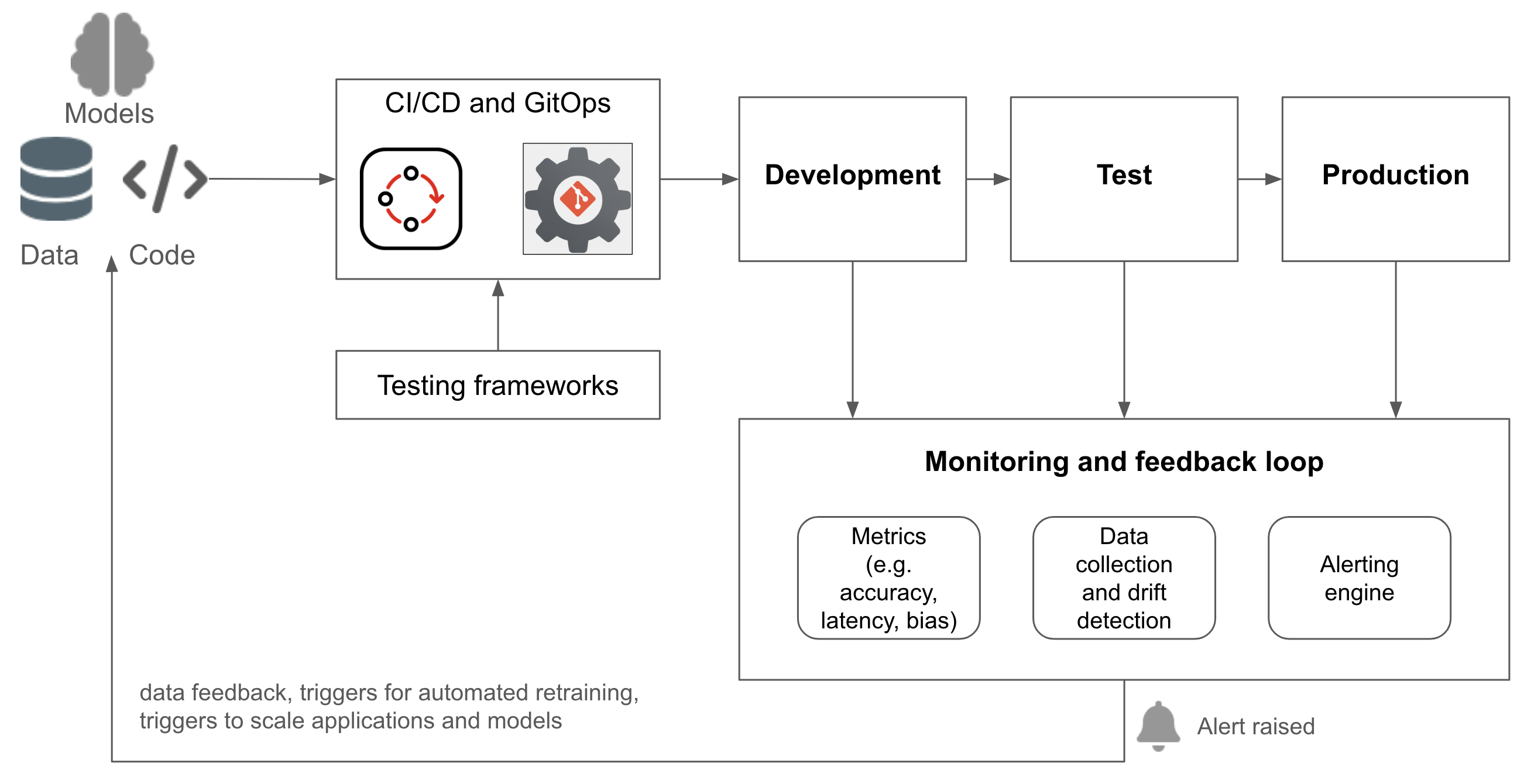
MLOps attempts to incorporate the philosophies of DevOps and GitOps to improve the lifecycle management of an ML application or service. There are unique challenges in the ML process that can inhibit an organization’s ability to deploy models into production, and Red Hat Consulting aims to guide teams through these key components. Figure 1 displays the approach Red Hat Consulting takes to support customer adoption of MLOps. The diagram of the MLOps lifecycle shows an iterative, not linear, process.
Establish patterns and best practices for managing production-ready solutions with Red Hat Consulting
We want Amberg to be a test bed for pioneering manufacturing innovation, to find ways to support and improve the end-to-end, integrated approach used at our three Digital Industries factories.
Adopting Red Hat OpenShift means we can use a modular development approach where components can be reused. The scale-out platform architecture also provides consistency across different environments, even as demands grow or change.1
Learn about how Siemens Amberg worked closely with Red Hat Consulting during deployment to gain insight on best practices and quickly troubleshoot issues.1
Our local teams had no experience with container technology or Red Hat OpenShift. Training was crucial to building our teams’ skills quickly, so we could optimize our application development and delivery from the start.1
Customer-focused approach
With a customer-focused solution, it is highly recommended that a sample model be identified prior to the start of the Operationalize AI engagement. The customer and Red Hat team will work together and continue to iterate on the sample model during the engagement. Throughout the process, Red Hat subject experts will help the customer:
- Deploy the model to a 3-tiered application environment (development, test, and production) with the ability to make changes using CI/CD and GitOps.
- Build a testing framework throughout the model training and promotion process.
- Consider how to generalize to multiple use cases and models.
- Use case specific custom metrics and monitoring capabilities.
- Integrate with existing enterprise toolings.
- Integrate with existing application and data science frameworks.
- Automate retraining capabilities.
Operationalize AI is available in different options and capabilities to help meet specific business needs and requirements. For guidance on building a sample model, Red Hat Consulting: AI Platform Foundation could be a good engagement option for an organization.
Get started with Red Hat Services
Red Hat is committed to helping its customers deliver not just their first AI model but the foundation for all their AI systems. By creating a reusable pattern to train, deploy, and monitor an AI model as a production-ready solution, Red Hat assists its customers in delivering successful future AI projects.
Red Hat helps organizations with deploying production-ready AI solutions, and also helps bridge application development and data science disciplines, navigate the complexities of building modern and innovative infrastructure and applications, and guide teams through migrating to an open, cloud-native, integrative foundation.
- Red Hat Consulting: With hands-on mentoring, Red Hat Consultants build IT skills and help foster operational independence, while streamlining tedious processes, aligning disheveled IT teams, and making certain systems and applications work together.
- Red Hat Training and Certification: Red Hat Training and Certifications help close skills gaps and hone teams’ Red Hat product expertise by developing role-based, hands-on knowledge in emerging and foundational open source technologies. Our curriculum helps Red Hat AI users improve their knowledge and develop skills to boost productivity and advance their careers.
- Red Hat Technical Account Management (TAM): Technical Account Managers partner with organizations to resolve potential problems before they occur, minimizing disruption and alleviating time to focus on key business challenges.
Ready to get started with AI services offered by Red Hat? Contact the Red Hat Account team for your organization or a Red Hat Consultant.
Red Hat case study. “Siemens improves uptime and security with Red Hat OpenShift,” 12 July 2022.