
How to build your 5G core and RAN architecture
A transformative performance shift for telecommunications
The 5th generation of mobile networks is not merely an incremental upgrade but a paradigm shift in terms of performance, propelled by advancements in network architecture, particularly within the 5G core and radio access network (RAN).
This overview presents a full summary of this evolution, beginning with the historical backdrop of mobile networks, the complex architecture of 5G core and RAN, the modern technologies, and the vital importance of industry standards. For telecommunication service providers (telco), understanding these evolutions is important for building more agile and flexible networks, reducing operational costs, and upgrading infrastructure to capitalize on the transformative potential of 5G to stimulate economic growth. Artificial intelligence (AI) is also transforming service provider networks, and plays a key role within the 5G network by providing a more refined customer and operational experience.
5G allows telco service providers to build more flexible networks, reduce operational costs, and prepare their infrastructures for the future.
From 1G to 4G: Laying the foundation
Mobile network generations are defined by 3 essential factors: the underlying technology, data transmission speed, and network latency, which is the amount of time between sending and receiving a signal. Each successive generation has introduced significant improvements in these areas, shaping how we communicate and interact in a new digital world:
- 1G: Emerging in the late 1970s, 1G networks introduced basic wireless voice calling with speeds just over 2 Kbps.
- 2G: In the early 1990s, 2G introduced short message service (SMS) and multimedia message service (MMS), with speeds rising to around 200 Kbps.
- 3G: By the mid-2000s, 3G significantly increased data transmission speeds to 40 Mbps.
- 4G: Coming out in 2010, 4G offered speeds up to 100 Mbps and remains a dominant mobile technology today.
Throughout the mobile network generations, the core network provides essential functions, including authenticating, authorizing, and managing subscribers, while granting devices access to services. In addition, the RAN is integral to wireless telecommunications and consists of base stations equipped with antennas, radio units, and controllers that establish a radio link between devices (like mobile phones or computers) and other parts of the network. The base station is responsible for transmitting device traffic (voice, data, video) to the core network.
While each generation has delivered significant improvements in connectivity and new consumer experiences, earlier network architectures had been unable to meet the demand for flexibility and high scalability. Modern applications demand these capabilities to deliver real-time data processing and business-critical communications.
Understanding 5G: A paradigm shift
5G, representing the fifth generation of mobile networks, is specifically designed to complement and augment existing 4G networks. This generation is characterized by data transmission speeds reaching up to 10 Gbps. These speeds translate into more customized user experiences—the emergence of new business services that can spur economic growth, and the innovation required to deploy bandwidth-intensive applications.
The increased bandwidth and improved speed of 5G facilitates the delivery of superior consumer and business services, including access to high-quality multimedia content and personalized experiences. Beyond speed, a key differentiator of 5G, particularly when compared to 4G, is its capacity to support up to 1 million connections per square kilometer. This density is critical for supporting the demands of smart cities, smart homes, self-driving cars, and the rapidly expanding internet of things (IoT). For business users, 5G is equipped to meet the stringent performance and availability requirements of industrial manufacturing and production processes.
Primary use case categories
5G capabilities are categorized into 3 primary use cases:
- Enhanced mobile broadband (eMBB): 5G significantly enhances multimedia experiences through higher bandwidth allocation and increased throughput.
- Ultra-reliable, low-latency communication (uRLLC): this capability supports the demanding requirements of vertical industries for business-critical and latency-intolerant applications, achieving sub-millisecond latency.
- Massive machine type communications (mMTC): 5G empowers cost-efficient and reliable connections for a vast number of devices without overwhelming the network.
Market opportunities for new services
The new business opportunities unlocked by 5G are extensive and span across numerous industries, applications, and services.
- Automotive: The automotive industry uses 5G to provide predictive maintenance, autonomous ride-sharing, and advanced driver-assistance technologies and systems.
- Energy: Including predictive infrastructure maintenance, the energy industry also uses 5G to optimize grid operations, storage, and smart metering.
- Healthcare: In healthcare, 5G allows advanced diagnostic capabilities, improved image analysis, and early pandemic detection. Physicians can also use virtual reality to treat patients remotely, extending healthcare to underserved areas.
- Manufacturing: This industry uses 5G for facilitating process correction and optimization, alongside on-demand production. 5G technologies, combined with open hybrid cloud architectures, are crucial for the emergence of Industry 4.0
5G improves what customers experience while boosting new business applications and services.
5G enhances the customer experience, and delivers new business applications and services.
- Smart agriculture: 5G allows farmers to guide autonomous farm equipment, track cattle with sensors, and operate drones to monitor plant health, soil quality, and moisture. Using 5G in smart agriculture helps farmers optimize resources.
- Fixed wireless access (FWA): Services that provide wireless broadband connectivity for stationary devices like smart TVs and gaming consoles, help extend reach and improve connectivity in areas where wired solutions are cost-prohibitive.
- Virtual and augmented reality (VR/AR) and gaming: This novel technology requires low-latency connectivity for consistent real-time data streaming, which 5G high-frequency radio waves deliver.
5G allows service providers to tap into a variety of lucrative vertical and adjacent market opportunities.
Standards and industry initiatives
The 3GPP organization is a collaborative project that unites telco associations to produce globally applicable technical specifications for mobile communications, including 5G. The project plays a critical role in defining the development of mobile networks, from the disaggregation of RAN components to outlining the various transition options for service providers moving to a 5G core. 3GPP is also actively involved in developing future standards, such as 5G-Advanced and 6G.
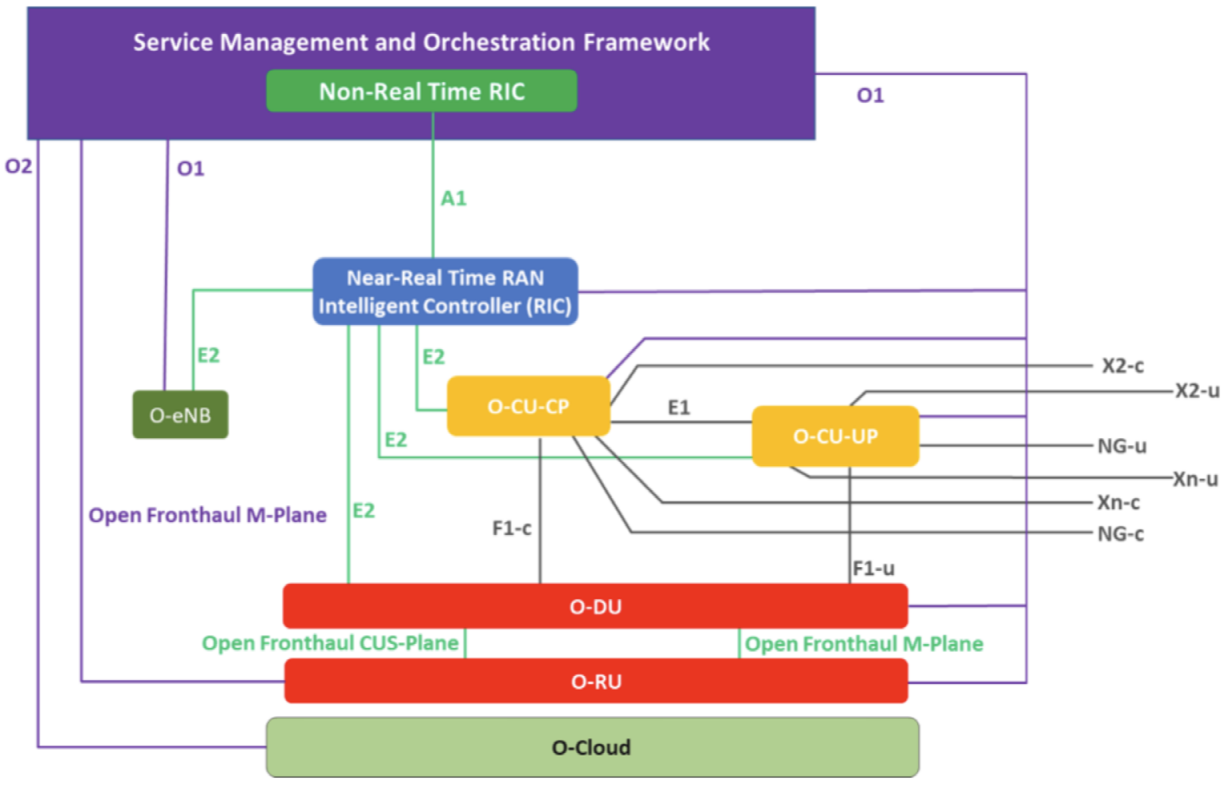
The O-RAN Alliance is a crucial industry organization dedicated to defining open interfaces for RAN architecture. Its goal is to define disaggregated components across various working groups. The standards defined by the O-RAN Alliance complement 3GPP specifications by providing the necessary open interfaces and profiles that allow multivendor interoperability within the RAN. Most open RAN solutions adhere to O-RAN standards. Red Hat engages actively with O-RAN Alliance working groups.
Telecom Infra Project (TIP) is another significant industry initiative that brings together service providers, infrastructure providers, system integrators, and other technology companies to accelerate the development and deployment of new technologies and network solutions. Its OpenRAN project specifically incorporates input from both 3GPP and O-RAN Alliance specifications, contributing to efforts to accelerate the adoption of open compute hardware.
5G core network architecture
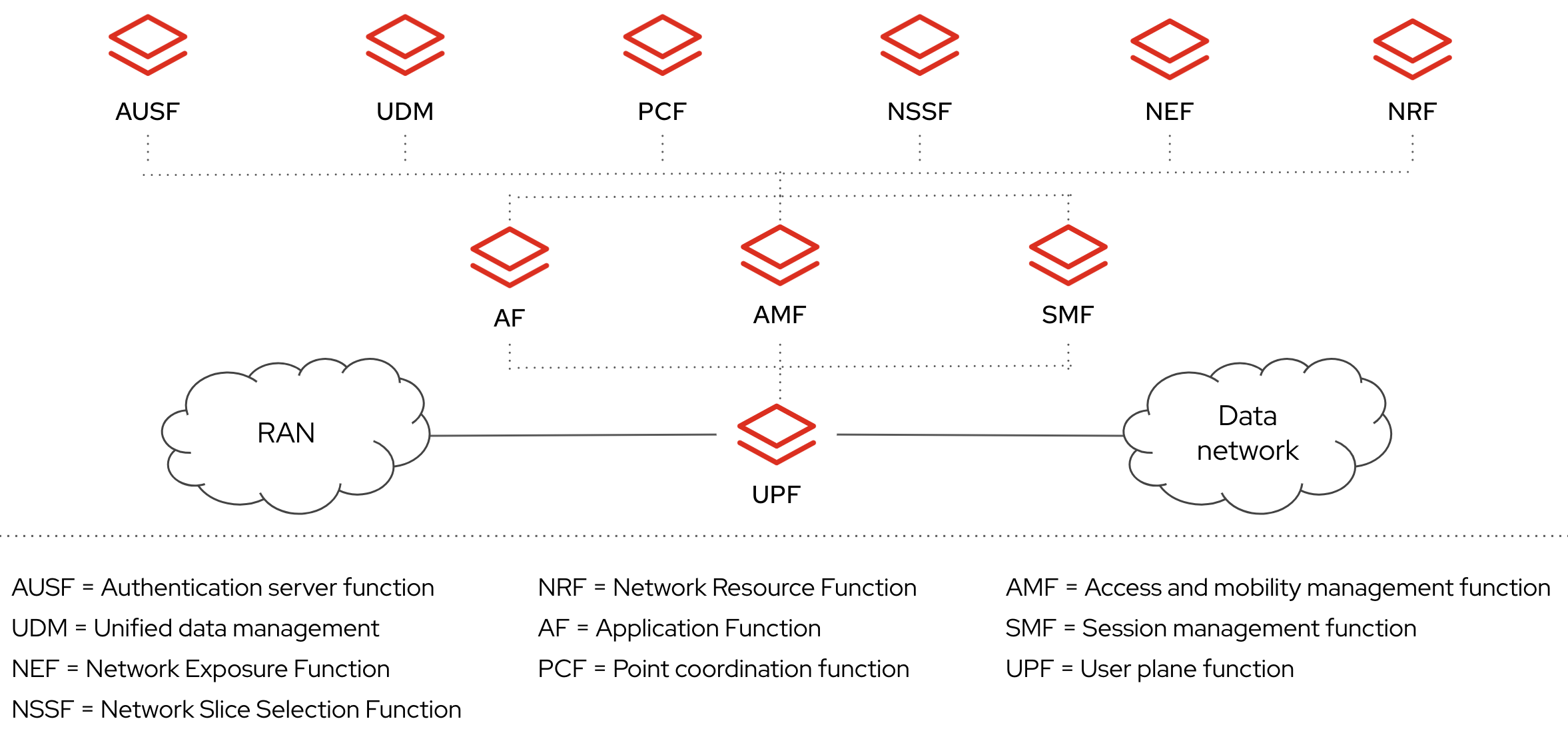
The 5G core network represents a fundamental shift from previous mobile network generations. Networks are no longer simply viewed as connectivity pipes for service delivery; instead, they are evolving into a service platform that offers various monetization opportunities.
The 5G core is software-defined, allowing it to be distributed to different parts of the network to support peak performance.
The 5G core architecture surpasses previous generations due to its software-defined nature and its construction with a service-based architecture (SBA). This design allows the 5G core to be disaggregated, cloud-native, and distributed. A significant advantage of the 5G core is the ability to place network functions, thereby allowing maximum efficiency, peak performance, and minimal latency, which collectively contribute to the best possible user experience. The following are the key architectural principles of a 5G core:
- SBA: Unlike the point-to-point architecture of previous evolved packet core (EPC) functions with overlapping responsibilities, the 5G core has an SBA with orthogonal functions that allow independent scaling.
- Message bus and application programming interfaces (APIs): The 5G core simplifies the integration of new functions by employing a message bus concept for control plane interactions, and implements representational state transfer (REST)-ful APIs that use HTTP/2 inquiries for a high degree of flexibility.
Ultimately, the 5G core is designed to be cloud-native, distributable, scalable, and agile. An EPC simply cannot deliver the same services as a 5G core.
5G deployment options
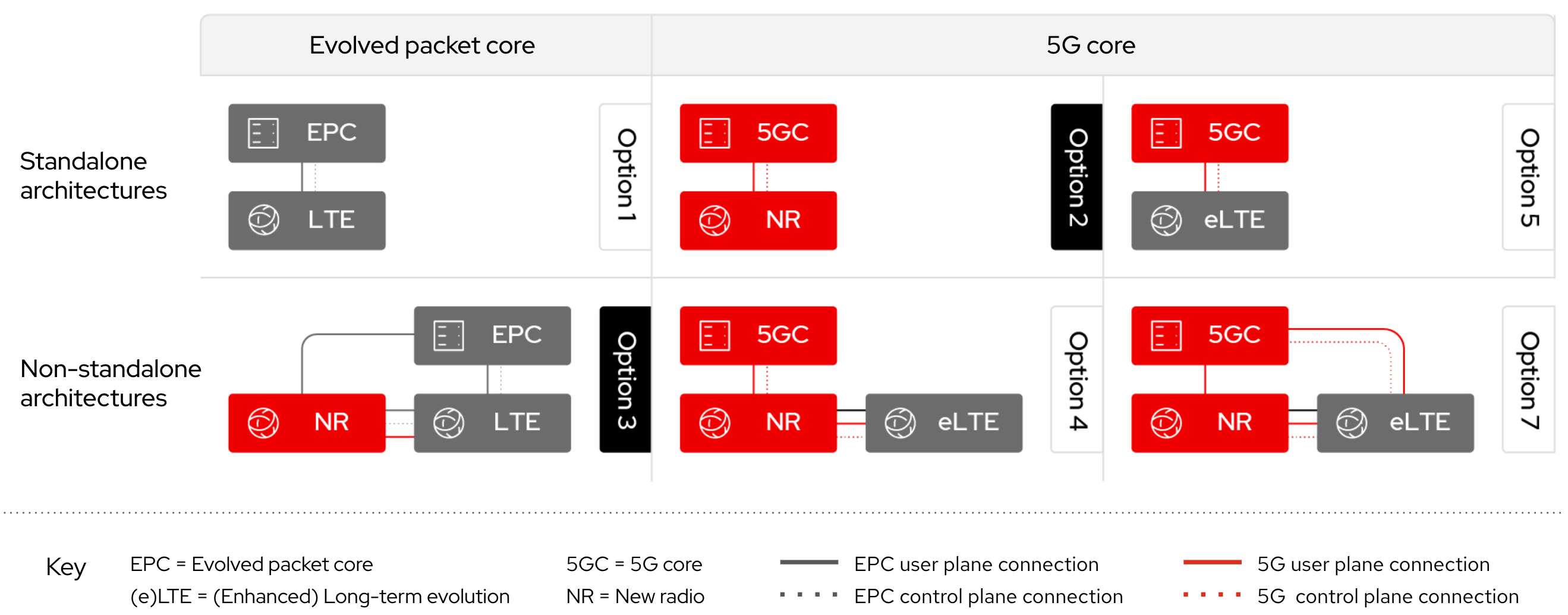
3GPP has outlined multiple options for service providers to transition toward a 5G core network, depending on where they are and where they want to go.
The following options address different starting points and desired end states.
- Option 1 represents the current state for many service providers, featuring a standalone (SA) EPC with a long-term evolution (LTE) radio access network. This is considered the starting point for the 4G to 5G transition.
- Option 2 involves a SA 5G core combined with a 5G new radio (NR) network. This is the ideal end-game for service providers, whether they are new network implementations (greenfield) or those with existing 4G networks (brownfield).
- Option 3 service providers retain their existing EPC and LTE network while adding 5G NR technology.
- Option 4 involves upgrading existing LTE networks to enhanced LTE (eLTE) and introducing both a 5G core and 5G NR technology. In this scenario, the eLTE network forms part of the user plane but not the control plane.
- Option 5 entails upgrading existing networks to eLTE and adding a new 5G core.
- Option 7 is similar to option 4. This involves upgrading existing LTE networks to eLTE and introducing a 5G core and 5G NR technology. In this case, the eLTE network is part of the control plane.
Options 1, 2, and 5 are considered standalone as they feature only one RAN, which is deemed ideal. However, many service providers initially choose non-standalone scenarios (NSA) to preserve existing investments and manage the rate of new infrastructure spending.
Similar to the 5G core, the 5G RAN has been strengthened to allow service providers to benefit from the latest innovations.
5G RAN evolution
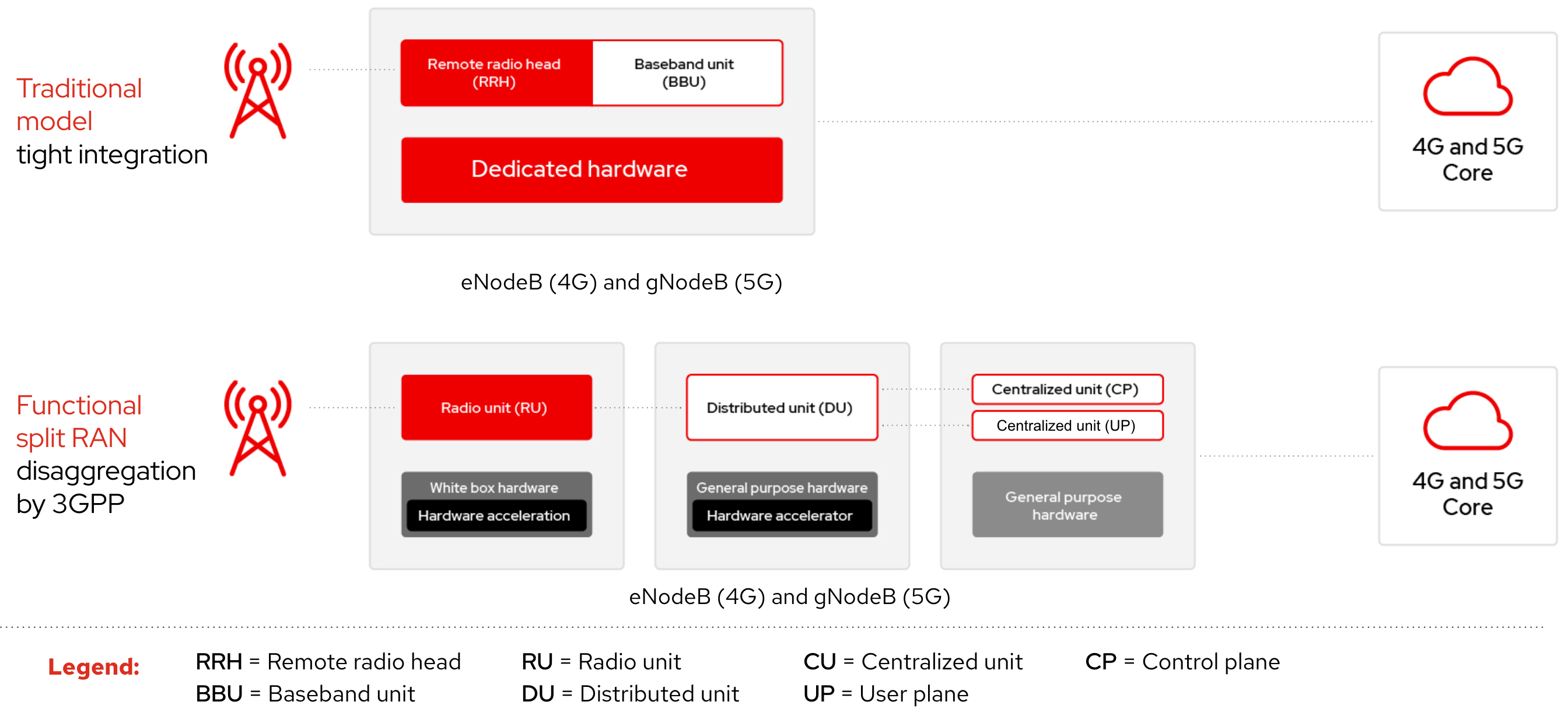
The RAN is a critical component of a 5G network, directly affecting network performance, coverage, and the ability to deliver new services to end-users. It comprises base stations equipped with antennas, radio units, and controllers. These elements collectively connect devices such as mobile phones, computers, or remotely controlled machines to other parts of the network via a radio link. The base station’s primary function is to transmit the device’s traffic, whether voice, data, or video, to the core network.
A RAN base station typically includes the following components:
- Antennas to convert electrical signals to radio waves.
- Radio units that transform digital information into wireless signals at correct frequency and power.
- Controllers that provide signal processing and connect the base station to the core network.
As part of the ongoing development of telco standards promoting stable environments, 3GPP has disaggregated the RAN into 3 main sections: the radio unit (RU), the distributed unit (DU), and the centralized unit (CU).
The RU can be integrated into or placed next to the antenna, while the DU and CU are computational parts that transmit digital signals through the network. This disaggregation allows the DU to be placed closer to the RU and the CU closer to the core network. However, even with this separation, the disaggregated RAN still primarily favors a single vendor approach.
Historically, RAN networks have been built using proprietary, single-vendor solutions. However, to meet the immense scalability, flexibility, and cost-efficiency demands of 5G, a more open and disaggregated approach is essential.
Open RAN
Open RAN is a generic term referring to an industry movement and the associated open RAN technology and architectures used within service provider networks. It encompasses the use of virtualization, microservices, container-based technologies, and crucially, open interfaces.
The open RAN model, championed by the O-RAN Alliance, specifically introduces an open fronthaul interface between the RU and DU. This interface paves the way for a potential multivendor RAN model.
Open RAN is predicated on the use of a cloud-native platform to promote using best-in-class solutions.
Historically, RAN solutions from different vendors have been difficult to integrate due to proprietary designs. RAN disaggregation, cloudification, and the advent of open RAN promote an open-source philosophy, helping service providers to select different elements (RU, DU, and CU) from various vendors that best suit their unique environments and needs. This flexibility is essential for the next generation of innovation in wireless telecommunication networks, particularly as 5G significantly increases the complexity and scale of RANs.
Key RAN terminology
Various terms to describe the RAN are often used interchangeably, but they refer to distinct concepts. These are most common:
- Virtualized RAN (vRAN): This term concerns the decoupling of RAN software from the underlying hardware, allowing elements of the RAN to run as software. However, vRAN virtualization does not necessarily imply compliance with O-RAN Alliance specifications or the ability to mix and match components from different vendors.
- Cloud RAN: This term refers to a vRAN built using cloud-native technology, potentially including microservices and container-based technology, and a cloud platform to host DU and CU workloads. Similar to vRAN, a cloud RAN does not inherently comply with O-RAN Alliance specifications or enable mixed vendor components.
- O-RAN: This term refers specifically to the O-RAN Alliance and the standards defined within it. These standards complement 3GPP specifications by defining new open interfaces and profiles. The O-RAN Alliance is the primary organization focused on defining open interfaces for RAN architecture, with the goal of defining disaggregated components into various working groups. When an organization claims its solution is open RAN compliant, it often means it is O-RAN compliant, as most open RAN solutions adhere to O-RAN standards.
- OpenRAN: This term refers to a project initiated by the TIP, which incorporates input from both 3GPP and O-RAN Alliance specifications.
- AI-RAN: This means the integration of AI within the RAN on a common cloud-native platform, and used for the realization of autonomous intelligent networks that have improved performance, higher resource efficiency, optimal energy consumption, and deliver a better user experience.
Understanding the distinction between these concepts is crucial. Investing in RAN technology that is not open might lead to a network that lacks sufficient flexibility for 5G evolution. The significant advantages of O-RAN-certified open RAN include fostering vendor diversity, providing tools to alleviate choke points, and providing the selection of best-in-class solutions for each aspect of the network. A single-vendor approach can create stumbling blocks, leading to proprietary, noninteroperable, or unsuitable RAN solutions.
Non-open RAN systems can be built with set pieces that, even if disaggregated, may contain choke points and inefficiencies in real-world scenarios. Conversely, an O-RAN-compliant open RAN network allows service providers to choose best-in-class solutions for each RAN component, avoiding the need to procure an entire package from a single vendor. This efficiency in disaggregated network components is vital because 5G networks are incredibly complex, built at scale, and require not only immense bandwidth, but also unflagging reliability. Every part of the network must function at peak performance for next-generation innovations requiring millisecond response times.
A cloud-native approach to building 5G networks promotes flexibility and scalability.
Principles of technology
The transition to 5G is heavily reliant on the principles of network function virtualization (NFV) and software defined networking (SDN). These technologies underpin the software-defined nature of 5G, allowing network functions that were once tied to proprietary hardware to be virtualized and run on generic servers. This abstraction of network functions from hardware provides immense flexibility and scalability, crucial for the dynamic demands of 5G networks.
Cloud-native 5G networks
Cloud-native, container-based networks are optimally suited to deliver 5G promises. A cloud-native approach to the 5G core involves refactoring existing applications and designing new core network applications as collections of microservices, using container-based technology. The use of container-based technology means that the microservices composing a 5G core application are packaged with all necessary operational components, including libraries and application-specific dependencies, within a dedicated and isolated space. This architecture ensures that the failure of an individual component or microservice will not cause the entire 5G core application to fail. Consequently, 5G core applications built in this manner exhibit more predictable behavior in terms of fault tolerance, scalability, and their efficient use of underlying cloud resources.
The distributed nature of 5G networks inherently supports the deployment of edge computing. By placing computational resources and network functions closer to the data source and end-users (at the edge of the network), 5G can significantly reduce latency and optimize data processing. This is particularly vital for uRLLC use cases and applications like autonomous vehicles, where real-time decision-making is critical.
5G will give service providers the ability to quickly launch compelling services and applications that will increase revenue.
5G opportunities and the future
Embracing 5G and its underlying architectural shifts offers compelling benefits for service providers:
- Increased revenue opportunities: The ability to offer new and enhanced services, from immersive multimedia to critical internet of things (IoT) applications, unlocks significant new revenue streams.
- Operational efficiencies and reduced total cost of ownership (TCO): Cloud-native architectures, automation, and disaggregation lead to more efficient resource utilization, simplified management, and ultimately, reduced operational costs.
- Flexibility and agility: The software-defined and open nature of 5G networks provides unprecedented flexibility to deploy, scale, and manage network functions dynamically, fostering accelerated service innovation and deployment.
- Enhanced innovation and service delivery: A highly flexible and programmable network fosters rapid innovation, allowing service providers to adapt to market demands and deliver new services with greater speed.
- Vendor diversity: Open RAN, particularly O-RAN Alliance compliance, promotes a multivendor ecosystem, allowing service providers to select the most efficient and performant solutions for each component of their network, rather than being locked into a single vendor's offerings.
Paving the way towards future technology and advancements
The evolution of telco networks is continuous. Unlocking 5G value is dependent on the modernization of the 5G core, and RAN and will deliver a richer set of services that can lead to increased revenue opportunities. In collaboration with a diverse set of ecosystem partners, service providers can enhance connectivity, unlock new advanced use cases, modernize their 5G networks, improve customer experiences, enhance business innovation, and achieve higher cost efficiency.
Successfully deploying and operationalizing 5G will pave the way for future technologies and advancements.
- 5G advanced: The next iteration of 5G, known as 5G advanced, is an upgraded standard established by 3GPP. Its primary aims are to maximize mobile coverage and enhance power efficiency.
- Introduction to 6G: 3GPP has already begun the process of developing the 6G standard. Early discussions suggest that 6G is expected to use new radio spectrum bands, including lower and upper centimeter wave bands and sub-THz/THz bands, to achieve even higher peak data rates. While discussions are still nascent, 6G promises further advancements in network capabilities.
- Continued evolution: The journey of telecommunications innovation is ongoing, with each generation building upon the last to meet ever-increasing demands for speed, capacity, and new services.
Mastering technical and business 5G capabilities is a critical stepping stone to defining and mastering 6G advancements, which promises further evolution of network architecture.
Red Hat is a catalyst and trusted advisor, meeting service providers where they are on their 5G transformation journey.
Red Hat can help service providers navigate 5G, RAN, and future strategies
Navigating the complexities of 5G, RAN evolution, and the path to AI and 6G requires a strategic approach grounded in open technologies and flexible infrastructure. Red Hat is uniquely positioned to collaborate with service providers on this journey, providing the open source expertise and cloud-native solutions necessary to build agile networks, reduce operational costs, and unlock new revenue opportunities.
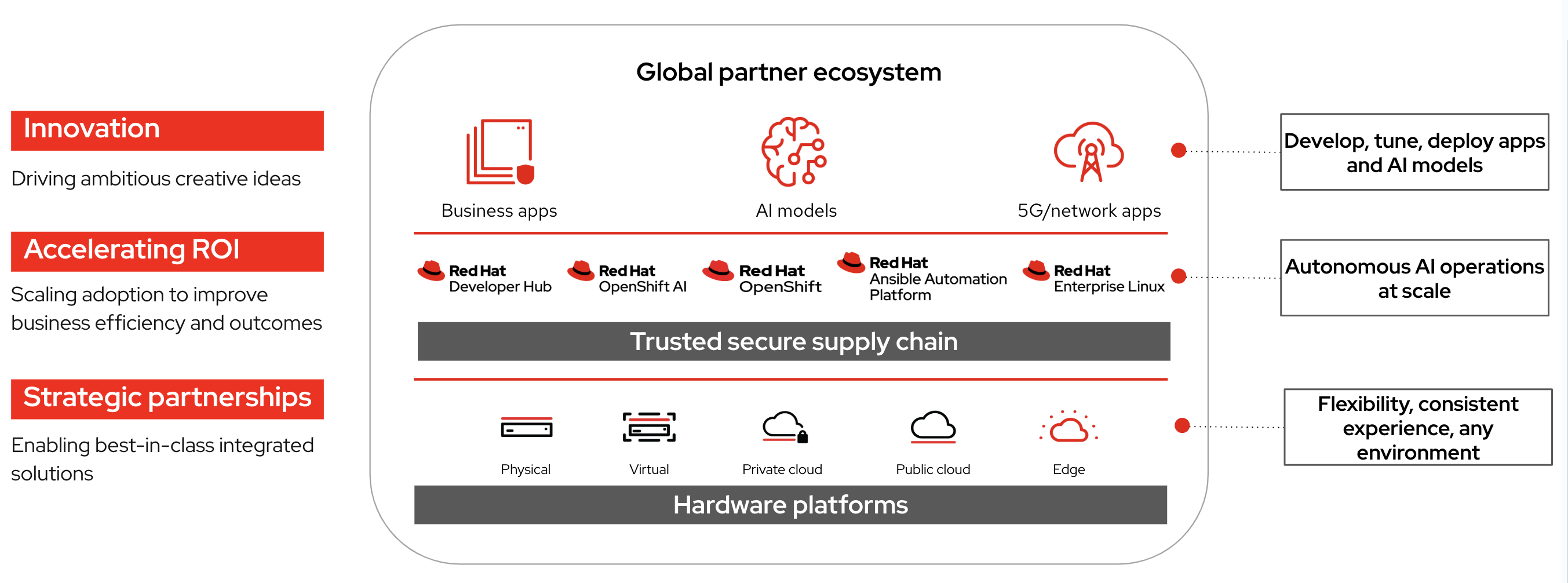
An effective 5G multivendor solution relies on a common cloud-native platform to bring tools, technologies, and workloads together. A common platform based on open source that can support any workload, on any size footprint, and at any location gives service providers the flexibility to build the right solution for their organization. A common platform also provides consistency for higher operational efficiencies and increased productivity. Red Hat’s common platform can be deployed in any environment and in any location, providing the flexibility, security, and performance needed to place multiple 5G functions across a network.
Red Hat OpenShift® is a security-focused and stable carrier-grade Kubernetes platform that provides common management and tools across infrastructure. This makes it possible to take advantage of a hybrid and multicloud strategy with confidence and compete more effectively in a market where customers have high expectations for faster innovation. Service providers can streamline the end-to-end management of their network with Red Hat Ansible® Automation Platform and scale with Red Hat Advanced Cluster Management for Kubernetes.
Red Hat's 5G offering combines a proven reference architecture that supports pre-integrated and certified 5G applications. Service providers are able to choose from a broad ecosystem of partners with enhanced service level agreements and consulting services from Red Hat that help them deploy in less time and maximize their success with 5G.
Learn more
Explore how that Red Hat can assist service providers and consider the potential of open technologies for your organization more closely. Then, contact a Red Hat representative.
Read this informative telco e-book about how cloud-native platforms, automation and AI are reshaping 5G and future networks.
“O-RAN architecture overview.” O-RAN Institute, accessed 20 Aug. 2025.