Developer offerings | |
Red Hat Enterprise Linux for Business Developers | Red Hat Enterprise Linux for Business Developers is a no-cost, self-serve offering available through the Red Hat Developer program. It delivers a complete set of Red Hat Enterprise Linux software for development and test use cases only (not production) in business environments. It provides access to 25 physical, virtual, or cloud-based instances per registered user and is self-supported with options for paid developer support. |
Red Hat Developer Subscription for Individuals | This subscription provides no-cost access to Red Hat Enterprise Linux for up to 16 physical or virtual nodes. This subscription is available self-service through the Red Hat Developer program for an individual’s personal use only, not for corporate use. It can be used for development, testing, or production and is self-supported. This subscription also provides access to the full Red Hat portfolio. |
Red Hat Developer Subscription for Teams | Red Hat Developer Subscription for Teams delivers a complete set of Red Hat Enterprise Linux software for development and test use cases only (not production) in business environments. This no-cost subscription allows unlimited access to physical, virtual, or cloud-based instances and is available via Red Hat or partner account representatives to organizations that are running other Red Hat offerings. It is self-supported with options for paid developer support. |
Platform offerings | |
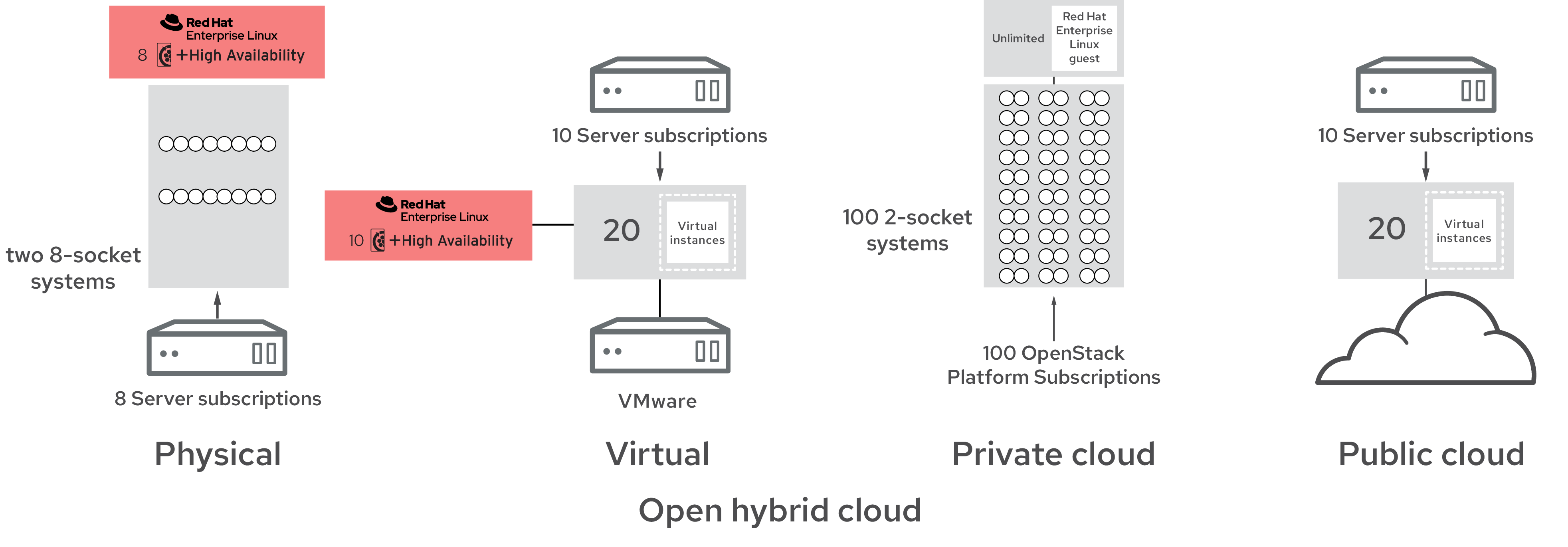
Red Hat Enterprise Linux Server | Red Hat Enterprise Linux Server is a versatile platform that can be deployed on physical systems, as a guest on the most widely available hypervisors, or in a cloud environment. This subscription can be purchased on a socket-pair for use in a physical machine or instance-pair basis for use in a VM. The subscriptions can be stacked. For example, 2 subscriptions may be stacked to satisfy the subscription requirements on a single 4-socket physical server. Also available as a cloud marketplace offering in Amazon Web Services (AWS) and Microsoft Azure. |
Red Hat Enterprise Linux for Third Party Linux Migration | Red Hat Enterprise Linux for Third Party Linux Migration offers a competitive price and a simplified conversion process for organizations migration from other rpm-based Linux distributions. It optionally includes up to 4 years of extended lifecycle support (ELS). Visit the Red Hat Enterprise Linux for Third Party Linux Migration webpage for more information. |
Red Hat Enterprise Linux for Server Entry Level, Self-support | Red Hat Enterprise Linux for Server Entry Level can be deployed only on physical systems. It is available only with self-support. This subscription cannot be stacked. The only Add-on that can be purchased for this subscription is Red Hat Satellite. This subscription is not intended for production environments and is not eligible for Red Hat Software Collections. |
| Red Hat Enterprise Linux for NVIDIA | Red Hat Enterprise Linux for NVIDIA provides a specialized, optimized OS edition designed to deliver Day 0 support for NVIDIA hardware. Red Hat and NVIDIA development teams collaborate to ensure that organizations are able to deploy and run AI workloads with the stability and security of Red Hat Enterprise Linux, while taking advantage of the full performance capabilities of the latest NVIDIA platform.
Note: There is no SKU for this optimized edition but the capabilities are delivered directly under the standard Red Hat Enterprise Linux for Arm SKU. Red Hat Enterprise Linux for ARM subscription holders have an option to enable a specific Red Hat Enterprise Linux for NVIDIA repository which provides access to the specialized packages (such as the updated kernel, QEMU, and libvirt) required to turn on the new NVIDIA hardware. |
Red Hat Enterprise Linux for ARM | Red Hat Enterprise Linux Server for ARM, and Red Hat Enterprise Linux Server for High-Performance Computing for Arm, are a part of a Red Hat strategy to support multiple architectures including x86, IBM POWER, and Z. Red Hat Enterprise Linux for ARM delivers a high-performance, reliable and more security-focused platform, including a consistent application environment across physical, virtual and cloud deployments. |
Red Hat Enterprise Linux for ARM (64K page size, new kernel) | The 64k page-size kernel provides the best possible performance to customers purchasing datacenter-class Arm servers with large physical memory for large data set workloads. These applications may include traditional HPC workloads, large database implementations, and AI/ML. Both kernels (4k and 64k) will run successfully on a range of Arm-based servers; however, the 64k kernel is intended for use with machines with large physical memory. |
Red Hat Enterprise Linux for IBM Power Little Endian Note: Red Hat Enterprise Linux for IBM Power Little Endian is available exclusively for renewals by existing Red Hat customers. Note that this offering will be removed from pricebooks beginning in 2Q 2027. New customers interested in these solutions should contact IBM directly for further assistance. | This subscription is for deploying Red Hat Enterprise Linux on IBM Power systems to scale-out large amounts of data and cloud deployments, or adding lower-capacity servers to manage the cost of handling growing workloads as demand increases. Due to the nature of this class of servers, interested customers should consult with their Red Hat account team for specific guidance. This offering is subscribed on a core and/or Logical Partition (LPAR) basis. The LPAR is an equivalent of a VM. |
Red Hat Enterprise Linux for IBM Z and LinuxONE with Comprehensive Add-Ons Note: Red Hat Enterprise Linux for IBM Z and LinuxONE with Comprehensive Add-Ons is available exclusively for renewals by existing Red Hat customers. Note that this offering will be removed from pricebooks beginning in 2Q 2027. New customers interested in these solutions should contact IBM directly for further assistance. | Red Hat Enterprise Linux for IBM Z and LinuxONE with Comprehensive Add-Ons is an offering that includes Red Hat Enterprise Linux High Availability Add-On for increased uptime, Red Hat Enterprise Linux Extended Update Support (EUS) Add-On, Red Hat Satellite to provide optimization and management of Red Hat Enterprise Linux, unlimited virtual guests, and premium support to help organizations manage Red Hat Enterprise Linux from physical machines to hybrid multiclouds. Due to the nature of this class of servers, interested customers should consult with their Red Hat account team for specific guidance. Note: For IBM Z and LinuxONE customers, Red Hat Enterprise Linux does not require the entire physical node to be entitled, only the cores used by Red Hat Enterprise Linux. IBM Z and LinuxONE customers know this as “subcapacity” entitlement. Customers using only a subset of the available cores on their IBM Z and LinuxONE environment for Red Hat Enterprise Linux only require subscriptions for the subset that is used for running those Red Hat Enterprise Linux instances. This applies regardless of how CPU partitioning is achieved, whether by CPU pooling, capping, separate logical partitions (LPARs), or other means. |
Red Hat Enterprise Linux for SAP Solutions | Red Hat Enterprise Linux for SAP Solutions is a highly available foundation to promote uptime and availability of critical systems like SAP. Features like Red Hat Enterprise Linux High Availability solutions for SAP HANAⓇ and SAP S/4HANAⓇ, Red Hat Enterprise Linux system roles for SAP, and workload awareness as part of Red Hat Lightspeed are the foundation to achieving near-zero downtime for SAP production deployments. It is for customers who are required to operate SAP HANA underneath S/4HANA deployments. The value of the rich feature set includes: Red Hat Enterprise Linux High Availability Add-On solutions for SAP, Red Hat Lightspeed, Red Hat Satellite, Red Hat Enterprise Linux Update Services for SAP Solutions, Red Hat Enterprise Linux system roles for SAP, and other software packages, e.g., compat-sap-c++ for running SAP HANA. The use cases for this SKU are for those that need to adopt or move to SAP S/4HANA, have a desire to include new, modern, innovative solutions into daily operations or increase competitiveness with agility. Also available as a cloud marketplace offering in AWS, Azure, Google and IBM Cloud. |
Red Hat Enterprise Linux for Virtual Datacenters (VDC) | This subscription allows the deployment of unlimited Red Hat Enterprise Linux guests in virtualized environments on supported hypervisors such as Red Hat Virtualization, VMware, and Microsoft HyperV. This subscription does not include a physical entitlement for Red Hat Virtualization. When pooling Red Hat Enterprise Linux for Virtual Datacenters, you must purchase uniform SLAs for all hosts in a cluster, and all hosts in a cluster must be accounted for with a subscription. You may subscribe to a subset of a virtualization cluster if your hypervisor allows the ability to restrict and enforce Red Hat Enterprise Linux workloads running only on that subset of the hypervisors in the cluster. |
Red Hat Enterprise Linux Disaster Recovery | Red Hat defines 3 types of disaster recovery (DR) environments: Hot, warm, and cold. Paid Red Hat Enterprise Linux subscriptions are needed for hot DR only. - Hot DR systems are defined as fully functional and running concurrently with the production systems. They are ready to immediately receive traffic and take over in the event of a disaster within the primary environment. When data volumes are actively being replicated either synchronously or asynchronously between systems they are considered to be “hot” DR systems.
- Warm DR systems are defined as already prepared to deploy and host workloads representing a reasonable facsimile of that found in the source system, but contain no customer workload from the source system(s). Warm DR systems should not be participating in active data volume replication either synchronously or asynchronously between systems. Warm DR recovery requires the customer’s data be restored onto the existing system hardware from outside of the source system.
- Cold DR systems are defined as having the infrastructure in place, but not the full technology (hardware, software, data) needed to restore service.
For both warm DR and cold DR, Red Hat Enterprise subscriptions can be transferred from the primary environment to the DR environment when the disaster occurs to restore service and maintain compliance with Red Hat's subscription terms. |
| Red Hat Enterprise Linux Extended Life Cycle, Premium | Red Hat Enterprise Linux Extended Life Cycle, Premium extends support 4 years beyond the standard 10-year lifecycle, providing up to 14 years of major version maintenance. It also offers 6 years of minor release support, delivering critical security fixes for stable environments. Including 24x7 premium support, it is essential for organizations with hardware or application dependencies preventing frequent, mandatory upgrades. Review the lifecycle webpage for more information. |
Add-Ons Note: All Red Hat Enterprise Linux Add-Ons, with the exception of Red Hat Satellite, are available only with Standard or Premium subscriptions. |
| Red Hat Enterprise Linux Long-Life Add-On | The Red Hat Enterprise Linux Long-Life Add-On is an exclusive, yearly maintenance offering for Red Hat Enterprise Linux Extended Life Cycle, Premium subscribers. It allows organizations to extend support for specific Red Hat Enterprise Linux versions, delaying upgrades due to stability, compliance, or resource constraints. By providing vital security patches and urgent bug fixes, it ensures continued operational security and continuity when standard upgrade cycles are not feasible. Review the lifecycle webpage for more information. |
Red Hat Enterprise Linux High Availability Add-On | The High Availability Add-On provides failover services between nodes within a cluster, making applications highly available. It supports up to 64 nodes and may be configured for most applications that use customizable agents and virtual guests. This subscription follows the same model as Red Hat Enterprise Linux. |
Red Hat Enterprise Linux Resilient Storage Add-On (Not supported with Red Hat Enterprise Linux 10) | The Resilient Storage Add-On allows a clustered file system to access the same block storage device over a network. Providing consistent storage across a cluster of servers creates a pool of data available to each server in the group that is protected if any 1 server fails. It supports up to 16 nodes. The Resilient Storage Add-On includes the High Availability Add-On. This subscription follows the same model as Red Hat Enterprise Linux. |
Red Hat Enterprise Linux Extended Update Support Add-On (2 years) and Red Hat Enterprise Linux Enhanced Extended Update Support Add-On (additional 2 years) | Extended Update Support Add-On and Enhanced Extended Update Support Add-On give you the flexibility to decide when to take advantage of new features in Red Hat Enterprise Linux and new server hardware by extending the support period of a specific Red Hat Enterprise Linux minor release for up to 24 or 48 months after its general availability. It allows you to efficiently plan resource and deployment cycles based on internal requirements while maintaining system security. This subscription follows the same model as Red Hat Enterprise Linux. Note: Extended Update Support Add-On (2-year) is included at no additional cost in the Premium subscription for x86 architectures. For Red Hat Enterprise Linux 8: Extended Update Support Add-On may be purchased as an add-on to Red Hat Enterprise Linux Server (Intel/AMD64) Standard subscriptions, and Red Hat Enterprise Linux for IBM Power LE subscriptions. For Red Hat Enterprise Linux 9: Extended Update Support Add-On may be purchased as an add-on to Red Hat Enterprise Linux Server (Intel/AMD64) Standard subscriptions, Red Hat Enterprise Linux for Workstations, and Red Hat Enterprise Linux for IBM Power LE subscriptions. Red Hat Enterprise Linux Server (x86) Self-Support is not eligible for the Extended Update Support Add-On. Enhanced Extended Update Support Add-On (only available for Red Hat Enterprise Linux 9 and after) may be purchased as an add-on to Red Hat Enterprise Linux Server (Intel/AMD64) Premium or Standard subscription, Red Hat Enterprise Linux for IBM Power LE subscriptions, and Enterprise Linux for IBM Z subscriptions. Red Hat Enterprise Linux Server (x86) Self-Support and Red Hat Enterprise Linux Workstation subscriptions are not eligible for the Enhanced Extended Update Support Add-On. Visit the extended and enhanced update support page for more information. |
Red Hat Enterprise Linux Extended Life Cycle Support Add-On | Extended Life Cycle Support Add-On is an optional add-on subscription for certain Red Hat Enterprise Linux subscriptions. Available during the extended life phase, Extended Life Cycle Support Add-On delivers certain critical-impact security fixes, selected urgent priority bug fixes, and troubleshooting for the last minor release of a given version of Red Hat Enterprise Linux. The Extended Life Cycle Support Add-On period runs for a minimum of 36 months beyond the Red Hat Enterprise Linux 10-year lifecycle. You should plan to migrate off of a Red Hat Enterprise Linux major release by the end of the 10 years. Extended Life Cycle Support Add-On provides a brief, additional migration period. Extended Life Cycle Support Add-On is available with Red Hat Enterprise Linux Premium and standard for IBM Z and the x86 architecture. It is not available for purchase with Red Hat Enterprise Linux Self-support subscriptions. Extended Life Cycle Support Add-On for Red Hat Enterprise Linux 7 is also available as a cloud marketplace offering in AWS, Azure and Google. |
Red Hat Enterprise Linux Security Select Add-On | For organizations using Red Hat Enterprise Linux with Extended Life Cycle Support Add-On or Extended Update Support Add-On and Enhanced Extended Update Support subscriptions, this add-on enhances security patch availability. The Security Select Add-On lets customers request fixes for a broader range of CVEs. Consult this datasheet for more information. |
Management offerings | |
Red Hat Satellite Server | Included with Red Hat Satellite subscriptions, Satellite Server is a systems management platform for efficiently managing Red Hat Enterprise Linux systems. Satellite Server synchronizes the content from the Red Hat Content Delivery Network and provides lifecycle management, role based access control, GUI/CLI/API access, and integrated subscription management. Satellite Server also provides superior patch management, multisystem provisioning, configuration management, and fine-grained reporting capabilities, making sure that systems have hardened security and comply with various standards. |
Red Hat Satellite Capsule Server | Included with Red Hat Satellite subscriptions, Red Hat Satellite Capsule Server mirrors content from the Satellite Server to facilitate scaling and content federation across geographical locations. Host systems can pull content from the geo-located Capsule Server instead of the Satellite Server. Capsule Servers help to scale the Satellite environment as the number of managed systems increase. |
Red Hat Satellite | Red Hat Satellite is an infrastructure management solution designed to provision and maintain any Red Hat Enterprise Linux infrastructure—physical, virtual, cloud, and edge environments. It simplifies end-to-end lifecycle management by streamlining repetitive tasks from defining and deploying Standard Operating Environments to patching, maintaining, and upgrading systems. Integrating Red Hat Lightspeed, included in every Red Hat Enterprise Linux subscription, with Satellite extends Red Hat Lightspeed visibility and analysis capabilities to identify risk, vulnerability, and compliance issues in an environment. Satellite then accesses remediation playbooks created by Red Hat Lightspeed, and executes them using existing Satellite servers and capsules. These playbooks include application of recommended patches, vulnerability updates, and compliance requirements. Identifying issues with Red Hat Lightspeed and remediating with Satellite reduces time to resolution, while minimizing manual errors. Together, Red Hat Lightspeed and Satellite increase operational efficiency while keeping systems security-focused, available, and compliant. |