
Red Hat build of Apache Camel for enterprise integration
Make applications, data, and devices work together as a cohesive system
Modern businesses rely on uninterrupted data sharing across applications, systems, and devices, often spanning on-premise, hybrid cloud, and multicloud environments. As organizations grow, integrating big data becomes a complex challenge, requiring efficient connectivity throughout the IT infrastructure. Enterprise integration involves connecting data, applications, and devices using advanced technologies and architectures. Finding a solution that simplifies this process with a flexible integration toolkit allows businesses to meet evolving needs with reusable endpoints and distributed architecture.
Enterprise integration requires more than a centralized enterprise service bus (ESB) to connect distributed components and maintain fast-paced systems. Organizations need a combination of messaging, application connectors, data streams, enterprise integration patterns (EIPs), and application programming interfaces (APIs). These tools allow for more efficient, iterative development and streamlined communication between applications, regardless of languages or platforms.
An overview of Red Hat build of Apache Camel
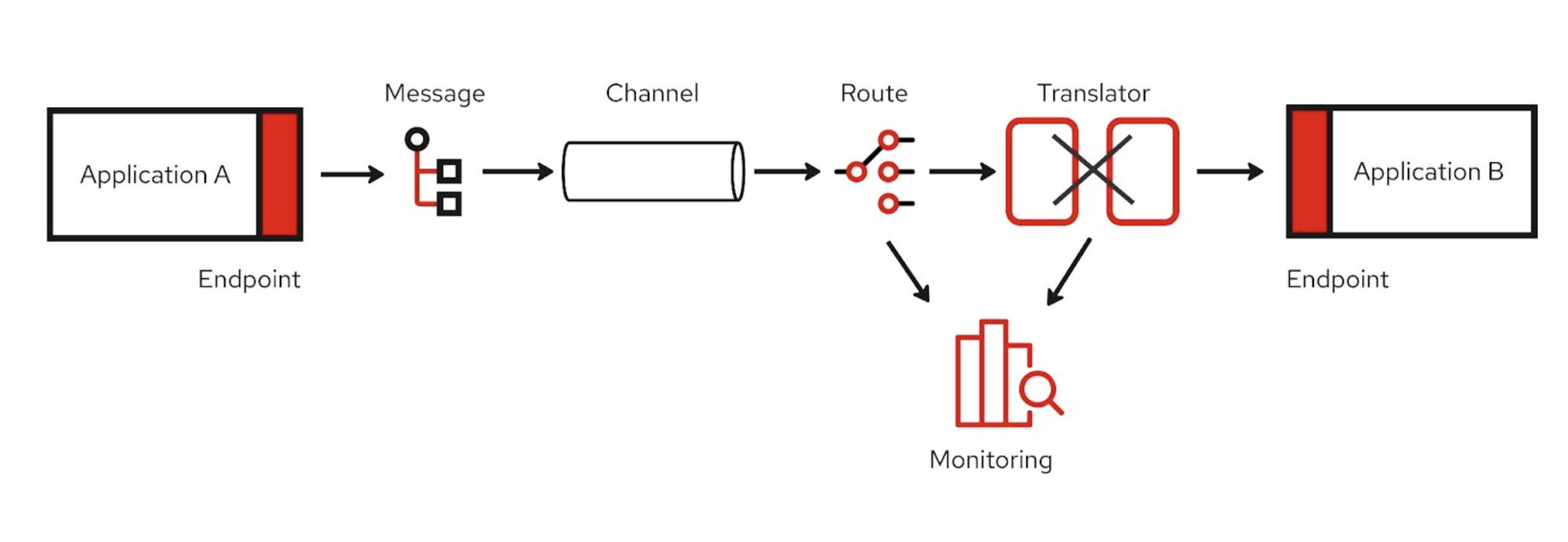
This solution is an industry-proven, highly adaptable, lightweight toolkit designed for enterprise integration, offering flexibility and performance. As part of Red Hat® Application Foundations, it allows businesses to unify disparate systems using enterprise integration patterns (EIPs). Its modular design makes it easier to customize and adapt to specific integration needs, providing preimplemented patterns and reusable components that reduce complexity. This flexibility is paired with scalability, allowing for efficient handling of high data volumes and evolving workloads across hybrid cloud environments. Furthermore, its lightweight architecture is optimized for lower memory usage and accelerated startup times, making it a powerful yet lean solution for enterprise integration.
Red Hat build of Apache Camel is optimized to work effectively with Red Hat OpenShift® to deliver scalability, resilience, and automation. Using Red Hat OpenShift’s cloud-native infrastructure, Red Hat build of Apache Camel accelerates the deployment and management of integration workloads across containerized environments. With features including built-in continuous integration and continuous delivery (CI/CD) pipelines, GitOps for automated deployment, and service discovery, it ensures smooth orchestration of services. Camel’s support for retrieval of configmaps and secrets, automatic health checks, observability, and certificate management further enhances its security and reliability, providing a streamlined, security-focused, and simplified integration experience on Red Hat OpenShift.
Lightweight integration with choice
Red Hat build of Apache Camel offers flexible integration options for developers.
- Red Hat build of Apache Camel for Quarkus brings Camel’s integration capabilities and extensive component library to a container-first, high-performance environment, accelerating startup times, reducing memory usage, and enhancing the developer experience.
- Red Hat build of Apache Camel for Spring Boot offers auto configuration, automatically detecting and configuring Camel routes and utilities within the Spring context, simplifying the integration process.
- Red Hat build of Apache Camel on Red Hat OpenShift takes advantage of the container platform to deliver optimal scalability, resilience, and automation. With built-in pipelines, GitOps, streamlined retrieval of configmaps and secrets, service discovery, observability, automatic health checks, and certificate management, it ensures an efficient and security-focused integration experience.
Advanced capabilities
Red Hat build of Apache Camel excels in various scenarios where data must be moved between sources and destinations. Key use cases include:
- API-driven processing, which supports both API-first and code-first approaches. Developers can design and implement APIs tailored to their specific integration needs. Camel can process API requests and responses by cleansing, filtering, transforming, and enriching data as it moves between application services, ensuring data accuracy and consistency.
- Event-driven processing, which supercharges event-driven architectures with its default asynchronous consumer model, connecting event-based sources and automatically managing threading and concurrency. This capability excels in streaming data integration, where Camel can act as a Kafka source or sink connector, facilitating real-time processing between distributed systems. Features like filtering, batch processing, aggregation, and data transformation further optimize event handling by reducing system load and adapting data for downstream compatibility.
- Data mapping and transformation, which offers a wide range of transformation strategies convert data between different APIs, formats, and protocols. It supports data mappers, type converters, and templates, allowing developers to transform and adapt data for integration across diverse systems. This capability ensures that data is consistently formatted and compatible with downstream services, making Camel ideal for handling complex data conversions in multisystem environments.
- Service composition, which allows developers to combine multiple services into cohesive workflows, streamlining the management of intricate integration challenges. With reusable components and integration patterns, Camel makes it simpler to create composite services that work together smoothly, ensuring efficient communication across systems.
Features and benefits
Red Hat build of Apache Camel delivers capabilities to address the challenges of modern cloud-native applications requiring enterprise integration features.
Table 1. Features and benefits of Red Hat build of Apache Camel
| Feature | Benefit |
| Industry-proven reliability | Trusted and tested in real-world industry scenarios with over 15 years of history, reducing adoption risk. |
| Adaptive integration strategies | Adapts integration approaches based on specific business needs and technological environments, ensuring that the integration solutions remain effective and relevant as technologies and requirements evolve. |
| Integration framework | Employs industry best practices and design patterns for optimal integration solutions. |
| Designed for hybrid cloud | Can be deployed on a variety of on-premise or cloud-based environments, making it a natural choice to use for adapting data processed in multiple applications, or services which may reside in disparate locations. |
| Scalability | Effectively handles changes in participating systems and scales with fluctuating workloads. Whether managing a growing number of integrations, handling higher data volumes, or scaling to 0 in serverless environments, Camel can scale both horizontally and vertically to meet performance demands. |
| Standardized communication | Standardizes system communication using open standards and protocols. By supporting a wide array of industry-standard formats, such as those in finance, telecommunications, and healthcare, it ensures interoperability and simplifies integration efforts. |
| Integration development tools | Speeds up the development and deployment of integration solutions, giving businesses a competitive edge. Define integration with simple, self-explained Domain Specific Language (DSL) available in Java, YAML, and XML, and use the visual designer for creating integrations visually, making integration development more accessible to a wider range of developers. |
| Integration by configuration | Allows for rapid, code-free deployment of source and sink connectors by configuring prewired integrations through environment variables, configmaps, or secrets, streamlining integration with Apache Kafka, Knative, and other systems. |
| Observability | Tracks detailed metrics, logs, and traces, allowing teams to monitor the performance and health of integration services in real-time. |
| Diagnostic console | Gathers detailed insights into integrations to facilitate repair and performance fine-tuning. |
| Testing framework | Provides a set of extensions and APIs that allow you to set up a testing environment with inner and outer evaluations, allowing you to test your Camel applications by sending messages and verifying outcomes. |
Access integrated open source capabilities
Red Hat build of Apache Camel is certified and supported in a large variety of environments, combining the best of open source integration projects into a powerful, enterprise-ready toolkit, designed to simplify and accelerate cloud-native integration for modern businesses. These integrations include:
- Apache Camel integration framework, which implements enterprise integration patterns and offers hundreds of prebuilt components and connectors.
- Kaoto visual designer for Apache Camel.
- HawtIO modular web console for troubleshooting and remote management of integrations.
- Apache CXF for developing and consuming Simple Object Access Protocol (SOAP) web services.
- Camel JBang CLI for iterative integration prototyping.
- VS Code development tools for code assistance and debugging.
- Extra Camel components requiring licensed libraries.
- Camel golden path templates for Backstage.
- Monitoring and tracing via Prometheus and OpenTelemetry.
- Narayana transaction manager.
- Quarkus and Spring Boot runtimes.
- Member of Quarkus Platform with simultaneous security updates.
Get started with Red Hat build of Apache Camel
Explore Red Hat Application Foundations, which includes Red Hat build of Apache Camel. To learn more about Red Hat build of Apache Camel, visit the Red Hat Developer website.
If you would like to get hands-on experience, give it a try in the Developer Sandbox.