Automation architects can bring together differing views by focusing on the following concepts.
Align to business objectives
Connect automation efforts with business challenges and goals. This approach helps you identify where to automate and create top-down requirements for success. For example, you could automate patching to boost system security and stability and meet business needs for improved uptime. When planning your automation journey, focus on outcomes rather than outputs.
Set realistic goals and outcomes
Establish achievable goals. Cost savings and return on investment (ROI) are common priorities, but other goals might include improving security risk management, increasing process accuracy, freeing time for innovation, and increasing business stakeholder satisfaction. Realistic goals should align with your organization’s current skills while encouraging teams to learn and expand their abilities as you progress along your automation journey. Over time, your teams’ automation skills will improve and they can increase the scope and complexity of their automation projects accordingly.
For example, a team might start by automating a single highly repetitive task and demonstrating cost and efficiency benefits from that project. They can then expand and apply that automation to other related tasks, full processes, or even organization-wide implementations.
Optimize processes, then automate
As you define your automation projects, assess the processes that you want to automate. Are they efficient? Do they contain outdated or unnecessary steps? Determine if processes can be improved before you automate them to optimize efficiency. If you find that a process is inefficient, address the inefficiency before automating the process.
Define and document automation success
There is no single way to measure automation success. Start small, demonstrate value, expand conservatively, and repeat. Consider working across your organization to identify an initial automation opportunity that can be easily reported back to executive teams.
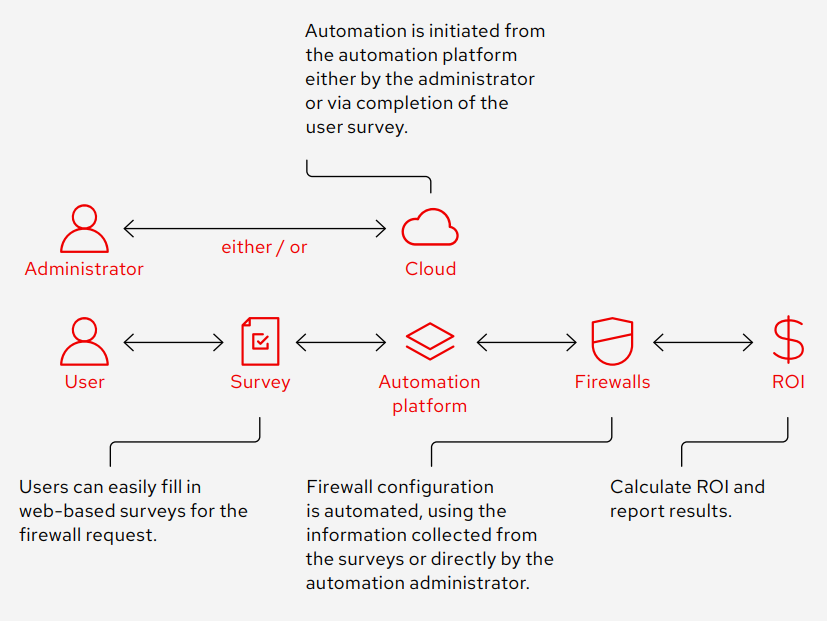
Figure 3 shows an example automation workflow. In this example, misconfigured firewall rules cause an increase in incident management tickets and change requests for network and IT teams.
Automation is applied to fix the issue and reduce the number of tickets and change requests. These reductions are then mapped to cost savings and improved IT customer service.
Governance is also applied through automation so that updates are made consistently and according to a defined, auditable process.
Finally, the measured metrics can be shared across the organization and with executives and business stakeholders to show the value of automation.