Skip to contentRed Hat

Navigation

AI
  • Our approach

    • News and insights
    • Technical blog
    • Research
    • Live AI events
    • Explore AI at Red Hat
  • Our portfolio

    • Red Hat AI
    • Red Hat Enterprise Linux AI
    • Red Hat OpenShift AI
    • Red Hat AI Inference Server New
  • Engage & learn

    • AI learning hub
    • AI partners
    • Services for AI
Hybrid cloud
  • Platform solutions

    • Artificial intelligence

      Build, deploy, and monitor AI models and apps.

    • Linux standardization

      Get consistency across operating environments.

    • Application development

      Simplify the way you build, deploy, and manage apps.

    • Automation

      Scale automation and unite tech, teams, and environments.

    • Explore solutions
  • Use cases

    • Virtualization

      Modernize operations for virtualized and containerized workloads.

    • Digital sovereignty

      Control and protect critical infrastructure.

    • Security

      Code, build, deploy, and monitor security-focused software.

    • Edge computing

      Deploy workloads closer to the source with edge technology.

  • Solutions by industry

    • Automotive
    • Financial services
    • Healthcare
    • Industrial sector
    • Media and entertainment
    • Public sector
    • Telecommunications

Discover cloud technologies

Learn how to use our cloud products and solutions at your own pace in the Red Hat® Hybrid Cloud Console.

Products
  • Platforms

    • Red Hat AI

      Develop and deploy AI solutions across the hybrid cloud.

    • Red Hat Enterprise Linux

      Support hybrid cloud innovation on a flexible operating system.

      New version
    • Red Hat OpenShift

      Build, modernize, and deploy apps at scale.

    • Red Hat Ansible Automation Platform

      Implement enterprise-wide automation.

  • Featured

    • Red Hat OpenShift Virtualization Engine
    • Red Hat OpenShift Service on AWS
    • Microsoft Azure Red Hat OpenShift
    • See all products
  • Try & buy

    • Start a trial
    • Buy online
    • Integrate with major cloud providers
  • Services & support

    • Consulting
    • Product support
    • Services for AI
    • Technical Account Management
    • Explore services
Training
  • Training & certification

    • Courses and exams
    • Certifications
    • Red Hat Academy
    • Learning community
    • Learning subscription
    • Explore training
  • Featured

    • Red Hat Certified System Administrator exam
    • Red Hat System Administration I
    • Red Hat Learning Subscription trial (No cost)
    • Red Hat Certified Engineer exam
    • Red Hat Certified OpenShift Administrator exam
  • Services

    • Consulting
    • Partner training
    • Product support
    • Services for AI
    • Technical Account Management
Learn
  • Build your skills

    • Documentation
    • Hands-on labs
    • Hybrid cloud learning hub
    • Interactive learning experiences
    • Training and certification
  • More ways to learn

    • Blog
    • Events and webinars
    • Podcasts and video series
    • Red Hat TV
    • Resource library

For developers

Discover resources and tools to help you build, deliver, and manage cloud-native applications and services.

Partners
  • For customers

    • Our partners
    • Red Hat Ecosystem Catalog
    • Find a partner
  • For partners

    • Partner Connect
    • Become a partner
    • Training
    • Support
    • Access the partner portal

Build solutions powered by trusted partners

Find solutions from our collaborative community of experts and technologies in the Red Hat® Ecosystem Catalog.

Search

I'd like to:

  • Start a trial
  • Manage subscriptions
  • See Red Hat jobs
  • Explore tech topics
  • Contact sales
  • Contact customer service

Help me find:

  • Documentation
  • Developer resources
  • Skills assessments
  • Architecture center
  • Security updates
  • Support cases

I want to learn more about:

  • AI
  • Application modernization
  • Automation
  • Cloud-native applications
  • Linux
  • Virtualization
ConsoleDocsSupportNew For you

Recommended

We'll recommend resources you may like as you browse. Try these suggestions for now.

  • Product trial center
  • Courses and exams
  • All products
  • Tech topics
  • Resource library
Log in

Sign in or create an account to get more from Red Hat

  • World-class support
  • Training resources
  • Product trials
  • Console access

A subscription may be required for some services.

Log in or register
Contact us
  • Home
  • Resources
  • CentOS Stream: A contribution path to Red Hat Enterprise Linux

CentOS Stream: A contribution path to Red Hat Enterprise Linux

January 13, 2022•
Resource type: Datasheet
Download PDF

CentOS Stream is an upstream open source development platform that lets you develop, test, and contribute to a continuously delivered Linux® distribution that tracks just ahead of Red Hat® Enterprise Linux. It provides more transparency and opportunities for community, partner, and customer participation. Because CentOS Stream code becomes the next minor release of Red Hat Enterprise Linux, you can contribute more quickly and directly to Red Hat Enterprise Linux and test your workloads in advance of new releases.

CentOS Stream is a key part of the enterprise Linux ecosystem

CentOS Stream exists between Fedora Linux and Red Hat Enterprise Linux in the open source code flow. By working within the fast-moving CentOS Stream project, Red Hat can create and release new versions of Red Hat Enterprise Linux more rapidly.

As a development platform for contributing to Red Hat Enterprise Linux, CentOS Stream lets you:

  • Share feedback on upcoming Red Hat Enterprise Linux releases prior to availability.
  • Test and prepare workloads for the next Red Hat Enterprise Linux minor release.
  • Work side by side with Red Hat Enterprise Linux engineers on patches and updates to benefit your use cases and interests.
  • Collaborate with industry peers and partners in special interest groups to move your use cases forward.
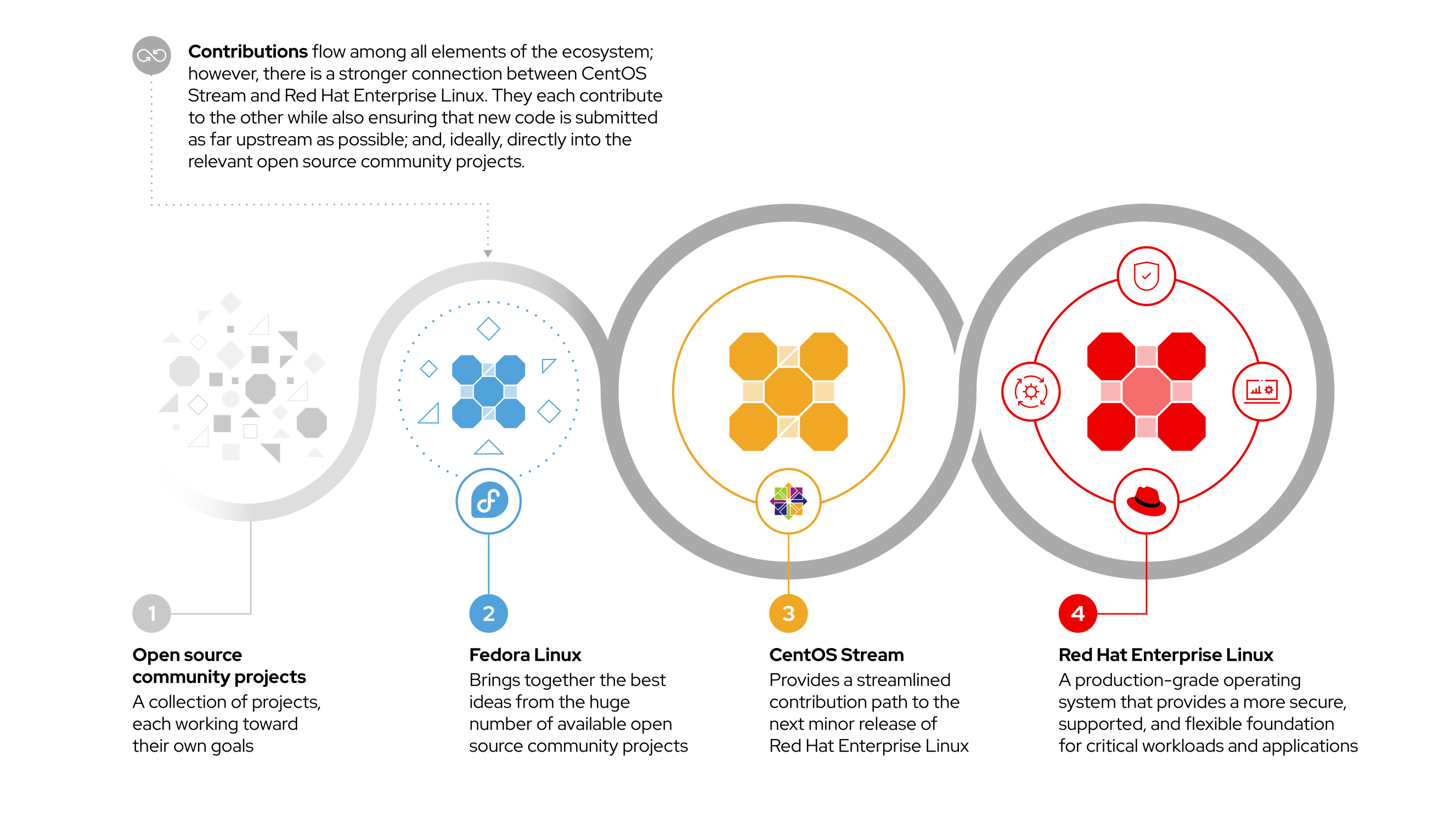
Figure 1. CentOS Stream has a strong connection with Red Hat Enterprise Linux, allowing each offering to contribute to the other

Contribute to Red Hat Enterprise Linux

CentOS Stream lets you contribute and make changes to Red Hat Enterprise Linux more quickly and effectively than before. It provides early access to the same code Red Hat developers and engineers use to produce the next version of Red Hat Enterprise Linux. This increased transparency lets you share feedback on upcoming minor releases before they are published. If you identify functionality that is not in the current version of Red Hat Enterprise Linux, you can propose a change to CentOS Stream. You can also provide code directly to CentOS Stream. Red Hat developers evaluate your proposal or code to determine next steps. Accepted changes are tested, verified, and included in CentOS Stream as well as the next minor release of Red Hat Enterprise Linux.

Validate your applications and processes

CentOS Stream gives you early access to code that will become Red Hat Enterprise Linux. As a result, you can develop and test workloads that target Red Hat Enterprise Linux prior to the next release. You can also contribute your tests to the CentOS Stream community to better understand whether future changes may impact your workload.

Connect with peers

CentOS Stream provides a place to collaborate with like-minded people and entities. Create or join a special interest group (SIG) to work on technologies and collaboratively solve specific challenges. Related technologies include features and functionality in Red Hat Enterprise Linux and capabilities that run on top of the operating system. Solutions generated through CentOS Stream SIGs may be considered for inclusion in Red Hat Enterprise Linux.

Learn more

CentOS Stream is an important part of the enterprise Linux ecosystem and provides a streamlined path for contributing to Red Hat Enterprise Linux.

  • Learn more about CentOS Stream: redhat.com/en/topics/linux/what-is-centos-stream
  • Running production workloads? Check out Red Hat Enterprise Linux: redhat.com/rhel

Which platform is right for your organization?

Each platform in the Red Hat Enterprise Linux open source development ecosystem fits different needs.

  • Fedora Linux: Linux operating system development and desktop use cases
  • CentOS Stream: Participation in Red Hat Enterprise Linux development

    Continuous integration and deployment (CI/CD) activities to prepare for the next Red at Enterprise Linux release
  • Red Hat Enterprise Linux: Enterprise and production workloads
  • Development and redistribution of containerized applications via Red Hat Universal Base Images

Tags:Communities, Application development and delivery, Open source

Red Hat logoLinkedInYouTubeFacebookX

Products & portfolios

  • Red Hat AI
  • Red Hat Enterprise Linux
  • Red Hat OpenShift
  • Red Hat Ansible Automation Platform
  • Cloud services
  • See all products

Tools

  • Training and certification
  • My account
  • Customer support
  • Developer resources
  • Find a partner
  • Red Hat Ecosystem Catalog
  • Documentation

Try, buy, & sell

  • Product trial center
  • Red Hat Store
  • Buy online (Japan)
  • Console

Communicate

  • Contact sales
  • Contact customer service
  • Contact training
  • Social

About Red Hat

Red Hat is an open hybrid cloud technology leader, delivering a consistent, comprehensive foundation for transformative IT and artificial intelligence (AI) applications in the enterprise. As a trusted adviser to the Fortune 500, Red Hat offers cloud, developer, Linux, automation, and application platform technologies, as well as award-winning services.

  • Our company
  • How we work
  • Customer success stories
  • Analyst relations
  • Newsroom
  • Open source commitments
  • Our social impact
  • Jobs

Select a language

  • 简体中文
  • English
  • Français
  • Deutsch
  • Italiano
  • 日本語
  • 한국어
  • Português
  • Español

Red Hat legal and privacy links

  • About Red Hat
  • Jobs
  • Events
  • Locations
  • Contact Red Hat
  • Red Hat Blog
  • Inclusion at Red Hat
  • Cool Stuff Store
  • Red Hat Summit
© 2025 Red Hat

Red Hat legal and privacy links

  • Privacy statement
  • Terms of use
  • All policies and guidelines
  • Digital accessibility