While many organizations seek cost-effective alternatives for their current VM infrastructure, most are also exploring container-native application development and deployment. In a recent Cloud Native Computing Foundation (CNCF) survey, 89% of respondents are adopting cloud-native techniques.4 Likewise, Gartner predicts that by 2027, more than 75% of all AI deployments will use container technology as the underlying compute environment, up from less than 50% today.5
Organizations supporting both VMs and containers face infrastructure and development challenges. They must cost-effectively manage traditional infrastructure environments (along with associated aging application development modalities and methodologies). At the same time they need to explore declarative frameworks with the continuous integration/continuous deployment (CI/CD) methodologies and tools common to containerized workloads.
Red Hat and Portworx facilitate this transition with a proven technology combination that supports VMs and containers. The solution is optimized to support AI workloads and MLOps on the same platform. A subscription model lets you select the right pricing model for your workloads, letting you optimize your cost structure so that you only pay for the services you need.
Red Hat OpenShift Virtualization
As an included feature of Red Hat OpenShift, OpenShift Virtualization delivers a modern platform for organizations to run and deploy their VM workloads. It allows for straightforward migration and management of traditional VM-based applications onto a trusted, consistent, and comprehensive hybrid cloud application platform. The platform offers a path for infrastructure modernization, preserving investments in existing virtualized applications while embracing hybrid cloud infrastructure and modern management and development principles.
Red Hat OpenShift Virtualization offers a range of advantages over other approaches, letting you:
- Ease migration. Red Hat OpenShift includes the migration toolkit for virtualization, which provides a simple way to migrate existing VMs from source providers. You can even migrate VMs to the cloud or between Red Hat OpenShift clusters in the hybrid cloud.
- Speed time to production. Red Hat OpenShift accelerates infrastructure and application delivery with a platform that supports self-service options and integrations of CI/CD pipelines. Developers can build, test, and deploy workloads in less time with Red Hat OpenShift.
- Manage everything from one platform. Red Hat OpenShift simplifies operations, providing a single platform for VMs, containers, and serverless workloads. Adopters can standardize infrastructure deployment and maintain all workloads using a common and consistent set of established enterprise tools.
- Modernize your infrastructure. Migrating VMs from other platforms to OpenShift Virtualization honors existing virtualization investments. Organizations can then capitalize on cloud-native architectures, streamline operations and management, and explore new development approaches.
Portworx Enterprise on Red Hat OpenShift
Modern enterprises need a hybrid cloud platform with cloud-native storage and data management solutions to keep pace with application volume and customer demand for new products and services. Portworx adds critical cluster data services to Red Hat OpenShift, providing unique value to business-critical applications. As an enterprise-grade storage solution, Portworx Enterprise meets the performance and scalability needs of virtualized workloads within Red Hat OpenShift. Portworx offers robust management of persistent volumes for VM disks while providing an onramp for stateful containerized workloads and emerging technology like MLOps and AI. The unified storage solution ensures operational efficiency, helping enterprise organizations:
- Accelerate time to revenue through one-click deployment and operation of multiple databases and storage, dramatically reducing application deployment time.
- Maximize application performance by running business-critical applications in production with maximum performance, built-in high availability, and on-demand scalability.
- Architect data resiliency with zero recovery point objective (RPO) disaster recovery across data centers and regions to reduce failover time, making your Red Hat OpenShift environment globally available, fault-tolerant, and resilient.
- Achieve data agility with infrastructure flexibility that enhances developer agility and provides self-service access to any storage or data services and cloud data portability.
- Rapidly scale Red Hat OpenShift in production with on-demand access to storage, high availability, and fault-tolerant performance.
Investment protection for future modernization
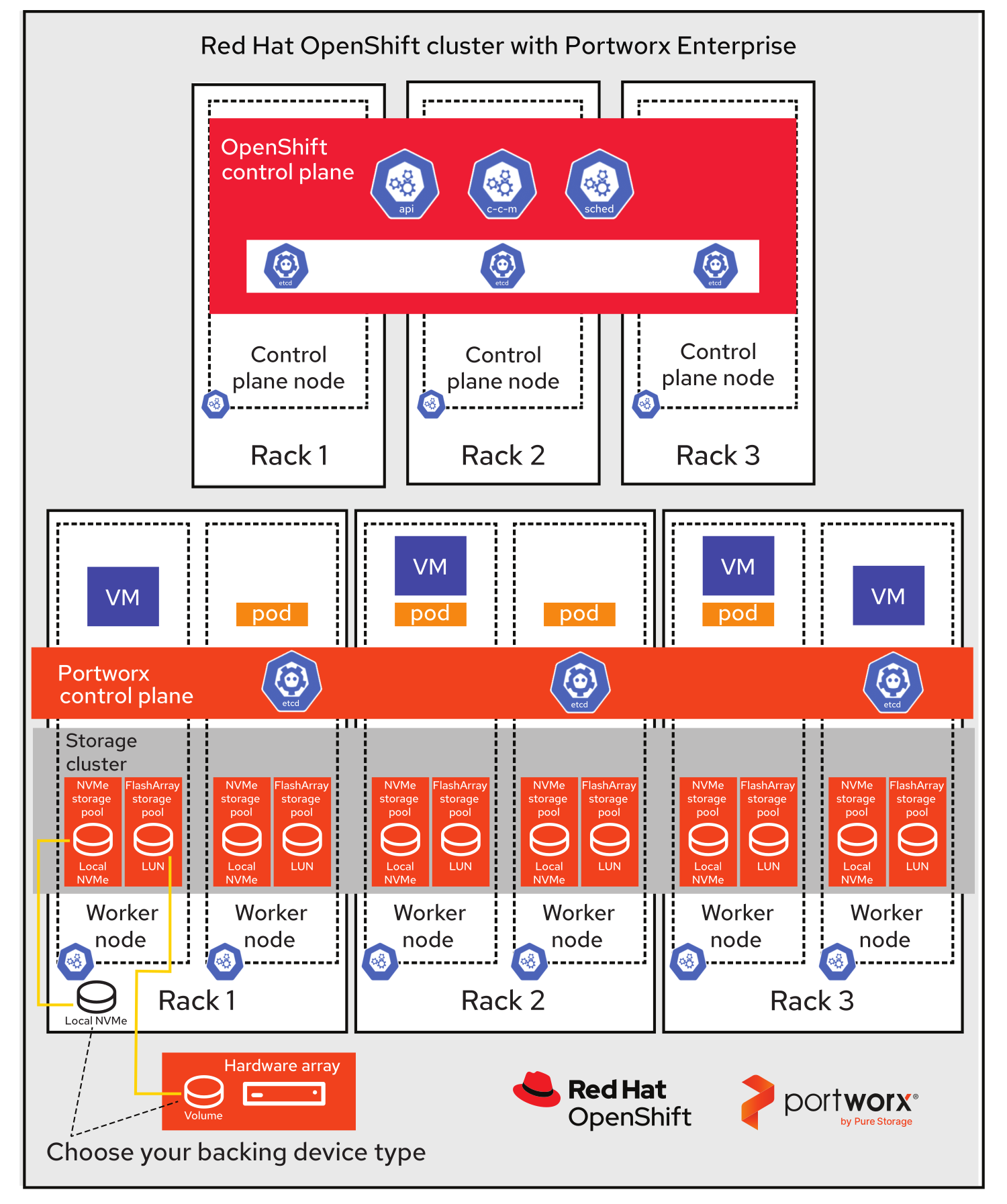
Because traditional workloads running in VMs are often not being replaced outright, it is undeniable that cloud-native and VM environments will continue to coexist for the foreseeable future. Supporting both environments is critical. The Red Hat and Portworx solution provides a unified platform where VMs and containers can run side by side (Figure 2) in the same Red Hat OpenShift cluster. This approach brings unified application management and dramatic simplification. It also provides a way to transition application components that are not easily containerized into Red Hat OpenShift. The solution offers:
- VMs for traditional stateful applications
- Containers for modern cloud-native microservices
- Portworx storage and data services for both VMs and containers
Red Hat OpenShift Virtualization integrates directly into existing Red Hat OpenShift clusters. It supports native Kubernetes paradigms such as the container network interface (CNI), container storage interface (CSI), custom resource definitions (CRD), and custom resources (CR). VM resources are scheduled, connected, and consumed as container-native.