Red Hat training
Go beyond knowledge—to mastery
82% of job postings for IT professionals with Linux® certification are for Red Hat® Certified Professionals. From training through certification, let us help you get the skills that are in demand.
Training and certification
Close the gap in your Red Hat Enterprise Linux skills
Red Hat Enterprise Linux is the leading open source platform for modern datacenters, with a stable, flexible foundation that adapts as your business changes. That’s just 1 of the reasons why more than 90% of Fortune 500 companies[1] use Red Hat products and solutions.
Our robust Linux curriculum is built on input from our support team and field personnel and delivers real-world skills development that can only come from Red Hat. Whether you're new to Linux, experienced in Linux, or a master of Linux, we have training and certifications for you. There's also no way to better prepare to earn your Red Hat Certified System Administrator (RHCSA®) and Red Hat Certified Engineer (RHCE®) certifications than by training with the experts at Red Hat.
[1]Red Hat client data and Fortune 500 list, September 2025. (purchase required)
New to Linux
Learn and build your core Linux skills
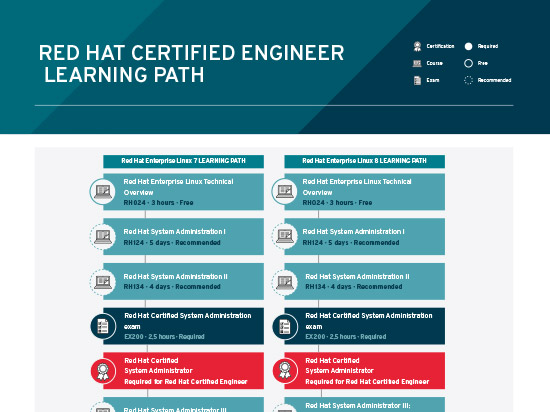
If you are new to Linux, build your Linux skills by taking our core curriculum courses and become an RHCSA.
- Red Hat Enterprise Linux Technical Overview (RH024)
- This series of free, on-demand videos offers a technical introduction to Linux for IT professionals.
- Red Hat System Administration I (RH124)
- Designed for IT professionals without previous Linux system administration experience, this course focuses on Linux administration “survival skills.”
- Red Hat System Administration II (RH134)
- This course builds on the foundation of core administration tasks needed to become a certified, full-time, enterprise Linux system administrator.
- Red Hat Certified System Administrator (RHCSA) exam (EX200)
- This test validates your mastery of the skills and knowledge that form the foundation for system administration across all Red Hat products.
Resources
Skill Assesment
Gauge your skills and find your gaps in Red Hat Enterprise Linux administration and troubleshooting.
Sneak peek video
Preview the video classroom version of our Red Hat System Administration I (RH124) course.
Experienced in Linux
Validate and expand your skills in Linux
If you have Linux skills, consider our advanced offerings on your way to by becoming a RHCE.
Designed for students who already have significant experience with Linux administration. The course reviews the tasks covered in Red Hat System Administration I (RH124) and II (RH134) at an accelerated pace.
Prove your skills and knowledge in the core system administration of Red Hat Enterprise Linux by taking the RHCSA exam (EX200). By passing this exam, you earn the RHCSA certification.
Red Hat System Administration III: Linux Automation for Red Hat Enterprise Linux 8 (RH294)
Find out how to automate, configure, and manage Linux system administration tasks with Ansible, allowing you to efficiently operate and scale your organization’s dynamic IT infrastructure.
Red Hat Certified Engineer (RHCE) exam for Red Hat Enterprise Linux 8 (EX294)
Validate your ability to manage and execute common system administration tasks across a number of systems with Ansible through this performance-based test of your skills and knowledge.
Through Red Hat’s training and certification program, I learned the real-world Linux and virtualization skills necessary for actual business more quickly and systematically.
Red Hat Learning Subscription
Get skilled. Get ready.
Get a year of unlimited access to every Red Hat Enterprise Linux online course plus access to training covering the hottest open source topics including Linux containers, Red Hat OpenStack® Platform, cloud computing, virtualization, Ansible, and more.
Questions?
The OpenStack® Word Mark and OpenStack Logo are either registered trademarks / service marks or trademarks / service marks of the OpenStack Foundation, in the United States and other countries and are used with the OpenStack Foundation's permission. We are not affiliated with, endorsed or sponsored by the OpenStack Foundation or the OpenStack community.
