Are you ready to expand your AI knowledge?
Join the Red Hat Cloud Native AI Deep Dive Series to explore the transformative potential of Red Hat open source AI technology within Telco. The series kicks off on the 19th of May and spots are limited so register your interest today!
These highly targeted and immersive virtual sessions are meticulously crafted to equip and empower telco AI specific roles like data scientists, developers and architects with the critical knowledge and tools essential for navigating the dynamic realm of cloud native AI app development.
Topics we’ll cover
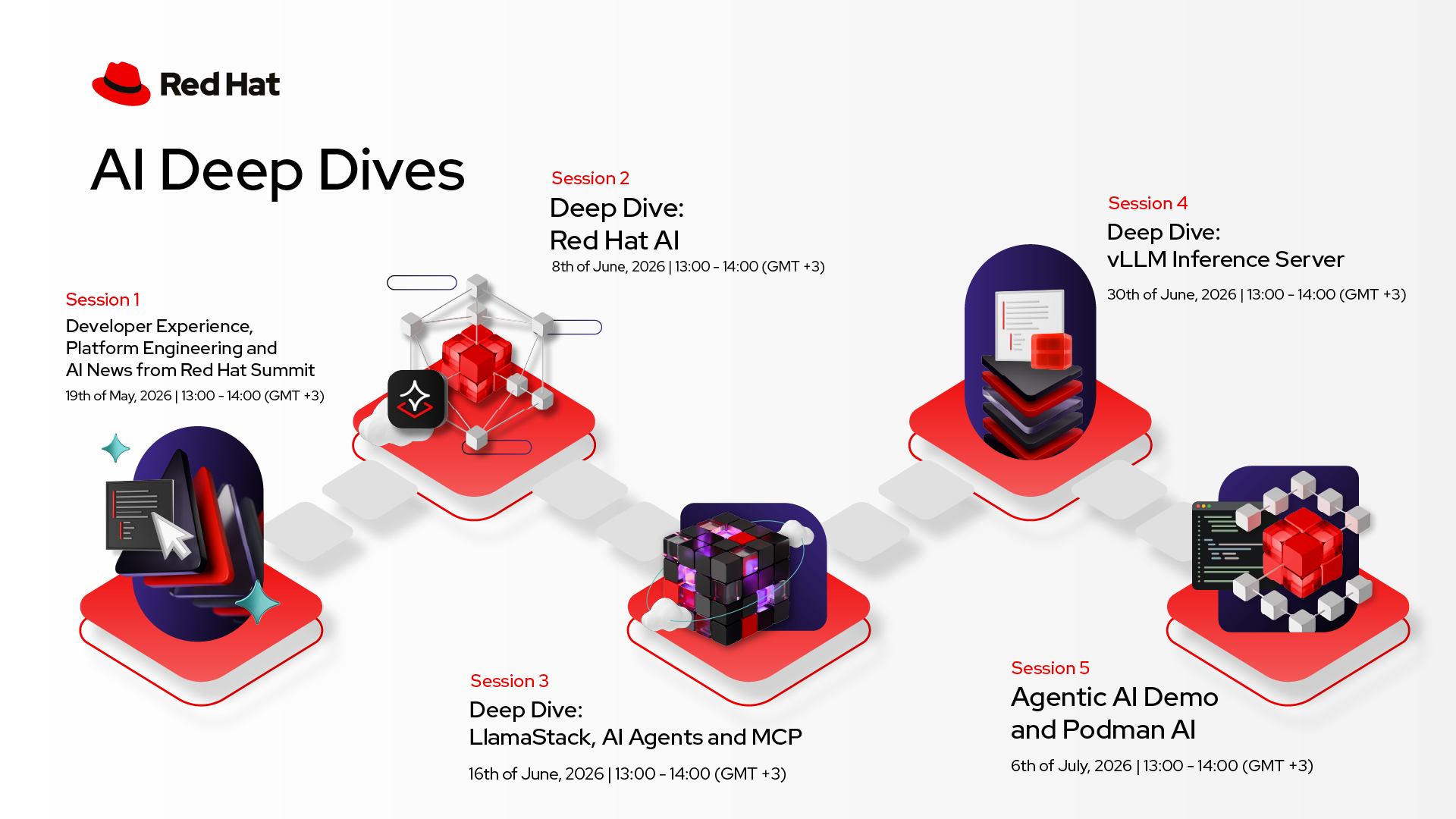
- Developer Experience, Platform Engineering and AI News from Red Hat Summit
- Deep Dive: Red Hat AI
- Deep Dive: LlamaStack, AI Agents and MCP
- Deep Dive: vLLM Inference Server
- Agentic AI Demo and Podman AI Introduction
Who should attend
- Data Scientists
- Developers
- Architects
- DevOps engineers
- AI/ML Engineers
- Platform engineers
What you’ll gain
- Enable Telco AI specialists to deliver business value faster and boost productivity
- Provide a consistent and intuitive developer experience across Red Hat platforms
- Discover Red Hat’s latest solutions for building applications with more flexibility, scalability, security and reliability.
Discover how Red Hat solutions can help you drive better business value through AI innovation.
Deep Dive Sessions
Session 1: Developer Experience, Platform Engineering and AI News from Red Hat Summit

Date : 19th May, 2026
An open source environment enables microservices, containers, Kubernetes, and AI to be deployed to optimize agility and speed at scale. The challenge can be staying ahead of the technology curve and positioning your enterprise for continued success. At Red Hat, hybrid cloud is the foundation of everything we do, leveraging open source in a multi-cloud environment to kickstart innovation.
The advent of Generative AI has acted as an accelerant to business transformation, increasing efficiency and productivity.
Join the Developer Advocates team, who will share a series of live demo innovations available today with OpenShift AI, OpenShift, and Developer Hub that will accelerate development cycles and optimize your releasing performance.
What you will learn:
- Latest news and announcements from Red Hat Summit
- Overall overview of Red Hat AI offerings and capabilities
- A nice overall demo about Red Hat AI platform
Speakers:

| Natale Vinto Senior Principal Developer Advocate Red Hat Dev Portal, Red Hat |

| Jochen Cordes Senior Specialist Solution Architect, Telco, Red Hat |

| Alessandro Arrichiello Senior Specialist Solution Architect, Red Hat |
Session 2: Deep Dive: Red Hat AI

Date : 8th June,2026
Learn the basics of AI/ML in an OpenShift development workflow. In this introductory workshop, you’ll learn how to use Red Hat OpenShift AI and use an object detection model in several different ways, deploy to OpenShift and use Gen AI open source models to create images and text.
Learn to quickly iterate in the developer “inner loop” and “outer-loop” with AI models, apply the Retrieval-Augmented Generation (RAG) pattern, and extend models with tools. We'll also cover testing custom models, optimizing costs, and leveraging generative AI for common applications use cases
What you will learn:
- Run and understand Kubeflow Pipelines
- Serve models with Model servers and hardware accelerators
- Creating app connected to models
- Create Inference APIs
- Use Software Templates to automate model deployments
- GitOps for MLOps
Speakers:
|
| Natale Vinto Senior Principal Developer Advocate Red Hat Dev Portal, Red Hat |
|
| Jochen Cordes Senior Specialist Solution Architect, Telco, Red Hat |
|
| Alessandro Arrichiello Senior Specialist Solution Architect, Red Hat |
Session 3: Deep Dive: LlamaStack, AI Agents and MCP

Date : 16th June, 2026
Agentic AI is a software system designed to interact with data and tools in a way that requires minimal human intervention. With an emphasis on goal-oriented behavior, agentic AI (also known as AI agents) can accomplish tasks by creating a list of steps and performing them autonomously.
Join this session to learn how Llama Stack and MCP servers on OpenShift AI help you get agentic AI to practice, by creating a system that provides an LLM with access to external tools, and algorithms that supply instructions for how the AI agents should use those tools.
What you will learn:
- What is Llama Stack
- What are MCP servers
- Delegating tasks to an AI agent
- Informed decision making - agentic AI uses machine learning to filter and process massive amounts of real time data–more than any human ever could. Gaining insights from larger pools of good data result in better predictions and strategies.
- Improved user experience
Speakers:
|
| Natale Vinto Senior Principal Developer Advocate Red Hat Dev Portal, Red Hat |
|
| Jochen Cordes Senior Specialist Solution Architect, Telco, Red Hat |
|
| Alessandro Arrichiello Senior Specialist Solution Architect, Red Hat |
Session 4: Deep Dive: vLLM Inference Server

Date : 30th June, 2026
vLLM is a high-throughput and memory-efficient inference and serving engine for large language models (LLMs), designed to optimize the performance of LLMs, particularly in serving and inference scenarios.
vLLM provides an HTTP server that implements OpenAI's most popular APIs such as Completions API and Chat API. This functionality lets you serve many LLMs and interact with them using an HTTP client and REST calls.
What you will learn:
- What is vLLM and why is important to you
- Understanding optimizations provided by vLLM and run models locally
- Connect apps to models
- Run models in production
Speakers:
|
| Natale Vinto Senior Principal Developer Advocate Red Hat Dev Portal, Red Hat |
|
| Jochen Cordes Senior Specialist Solution Architect, Telco, Red Hat |
|
| Alessandro Arrichiello Senior Specialist Solution Architect, Red Hat |
Session 5: Agentic AI Demo and Podman AI Introduction

Date : 6th July, 2026
Agentic AI is a software system designed to interact with data and tools in a way that requires minimal human intervention. With an emphasis on goal-oriented behavior, agentic AI (also known as AI agents) can accomplish tasks by creating a list of steps and performing them autonomously. You can think of agentic AI as a way of combining automation with the creative abilities of a large language model (LLM). To bring agentic AI to practice, you create a system that provides an LLM with access to external tools, and algorithms that supply instructions for how the AI agents should use those tools.
As a developer, you face the challenge of ensuring your application works consistently across different environments - from your local development setup to the standardized production infrastructure. Containers provide a solution to this problem, allowing you to package your application with its dependencies and configurations. Podman AI Lab takes it a step further by providing a user-friendly interface for managing containers, pods, Kubernetes deployments and AI models such as LLMs.
What you will learn:
- Creating app connected to models
- Delegating tasks to an AI agent
- Informed decision making - agentic AI uses machine learning to filter and process massive amounts of real time data–more than any human ever could. Gaining insights from larger pools of good data result in better predictions and strategies.
- Improved user experience
Speakers:
|
| Natale Vinto Senior Principal Developer Advocate Red Hat Dev Portal, Red Hat |
|
| Jochen Cordes Senior Specialist Solution Architect, Telco, Red Hat |
|
| Alessandro Arrichiello Senior Specialist Solution Architect, Red Hat |
Sessions Roadmap
Click on the map to view it in full scree