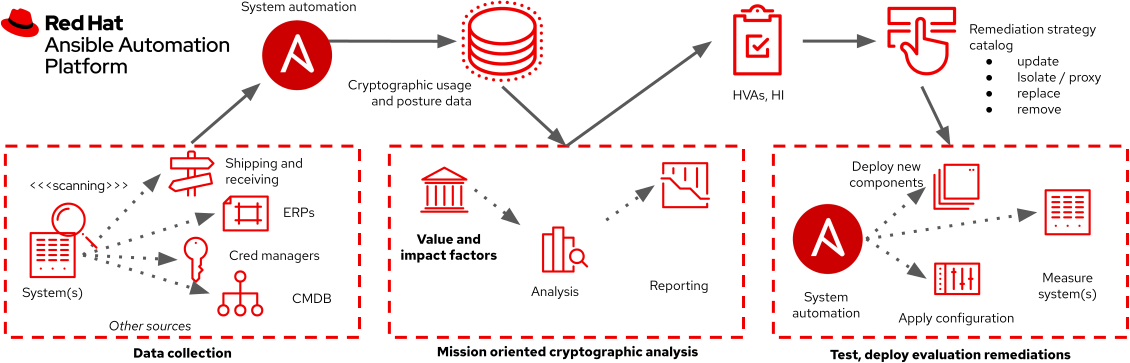
Red Hat’s strategy for DHA’s quantum transition focuses on 4 pillars: securing data in motion, hardening access layers for security, continuous cryptographic discovery using Cryptographic Bills of Materials (CBOMs), and automating the rollout process.
Instead of treating post-quantum migration as a single, overwhelming data-at-rest overhaul, Red Hat recommends sequencing remediation where the threat is most immediate and the fix is most attainable: securing data in motion and tightening data access controls at the platform layer. Achieving agility with this strategy will allow the DHA to migrate data and systems in the future without disrupting clinical operations that directly support warfighter readiness.
By building an automated foundation of crypto-agility using Red Hat® Enterprise Linux® 10, Red Hat OpenShift®, Red Hat OpenShift Virtualization, and Red Hat Ansible® Automation Platform, the DHA can systematically isolate and address quantum risks without interfering with active clinical care. This foundation checklist offers 4 detailed points to consider:
1. Securing data in motion
Data in transit is the most exposed attack surface. Every TLS session transporting patient files or telehealth data, such as connections between an MTF, MHS GENESIS, or a TRICARE network partner, is a prime target for encryption harvesting. Red Hat Enterprise Linux 10 natively supports all 3 NIST-finalized post-quantum cryptographic (PQC) algorithm families in its core cryptographic libraries—OpenSSL and Network Security Services (NSS):
- Module-Lattice-Based Key-Encapsulation Mechanism (ML-KEM or FIPS 203): Used for quantum-safe key exchange in TLS, immediately securing sessions moving data between MTFs, telehealth services, and MHS GENESIS.
- Module-Lattice-Based Digital Signature Algorithm (ML-DSA or FIPS 204): A lattice-based digital signature algorithm integrated for quantum-safe TLS authentication.
- Stateless Hash-Based Digital Signature Algorithm (SLH-DSA or FIPS 205): A stateless hash-based digital signature algorithm providing mathematical diversity for long-lived assets, including firmware and software attestation.
Red Hat OpenShift inherits these capabilities with Red Hat Enterprise Linux CoreOS, allowing DHA to deploy TLS 1.3 quantum-safe key exchanges across its entire container control plane, kubelets, and ingress controllers.
2. Hardening the access layer to restrict blast radius
Identity, authentication, and certificate issuance govern who and what can interface with a hyper-scale petabyte data storage estate. Implementing post-quantum signatures (ML-DSA and SLH-DSA) hardens access gateways against credential forgery and unauthorized entry, safely insulating data at rest without needing to touch underlying storage. Demonstrating this readiness, Red Hat successfully generated the 1st fully PQC-signed RPM Package Manager (RPM) package for Red Hat Enterprise Linux 10.1, proving that artifact authenticity can be enforced at the packaging level so that clinical nodes run only untampered software.
3. Using CBOMs for continuous discovery
DHA cannot protect what it cannot locate. Discovery is the foundational activity that makes this strategy executable, and Ansible Automation Platform is the natural orchestration layer for turning CBOM discovery from a one-time audit into a scalable, continuously maintained program. Once assembled, the CBOM becomes the basis for risk-ranking remediation work, surfacing which systems carrying PHI still depend on classical algorithms and should be addressed first.
Cryptography is typically embedded deep within application codes, container images, and existing vendor systems accumulated over decades without centralized tracking. Red Hat Enterprise Linux and Red Hat OpenShift address this lack of transparency by exposing core cryptographic configurations directly. Using standards like CycloneDX's CBOM specification, DHA can generate a structured, machine-readable inventory of cryptographic assets, key length, library versions, and certificates across the network, turning future reencryption tasks into scoped, risk-prioritized action.
4. Operationalizing with automation