Skip to content AI
  • Overview

    • AI news
    • Technical blog
    • Live AI events
    • Inference explained
    • See our approach
  • Products

    • Red Hat AI Enterprise
    • Red Hat AI Inference
    • Red Hat Enterprise Linux AI
    • Red Hat OpenShift AI
    • Explore Red Hat AI
  • Engage & learn

    • Learning hub
    • AI topics
    • AI partners
    • Services for AI
Hybrid cloud
  • Platform solutions

    • Artificial intelligence

      Build, deploy, and monitor AI models and apps.

    • Linux standardization

      Get consistency across operating environments.

    • Application development

      Simplify the way you build, deploy, and manage apps.

    • Automation

      Scale automation and unite tech, teams, and environments.

  • Use cases

    • Virtualization

      Modernize operations for virtualized and containerized workloads.

    • Digital sovereignty

      Control and protect critical infrastructure.

    • Security

      Code, build, deploy, and monitor security-focused software.

    • Edge computing

      Deploy workloads closer to the source with edge technology.

  • Explore solutions
  • Solutions by industry

    • Automotive
    • Financial services
    • Healthcare
    • Industrial sector
    • Media and entertainment
    • Public sector (Global)
    • Public sector (U.S.)
    • Telecommunications

Discover cloud technologies

Learn how to use our cloud products and solutions at your own pace in the Red Hat® Hybrid Cloud Console.

Products
  • Platforms

    • Red Hat AI iconartificial intelligence, Red Hat Enterprise Linux AI, Red Hat OpenShift AI, RHEL AI, machine learning38382025-03-12T19:43:40.963Zimage/svg+xmlRed Hat AI iconartificial intelligence, Red Hat Enterprise Linux AI, Red Hat OpenShift AI, RHEL AI, machine learningIconno2025-03-12T19:39:59.817ZTechnology iconStandardRed Hat AI

      Develop and deploy AI solutions across the hybrid cloud.

    • Red Hat Enterprise Linux iconRHEL, Linux platforms, CentOS2024-03-01T15:26:42.958ZpendingTRA3b65dd25-844d-49bb-93c1-30f5b34684f1Icon2024-03-01T15:26:42.958Ztruepending2024-03-21T00:40:29.326Zrhcc-audience:internalnoTechnology iconDER3b65dd25-844d-49bb-93c1-30f5b34684f1Standardyesrhcc-product:red-hat-enterprise-linuxTechnology iconimage/svg+xml2024-05-10T14:11:29.114ZRed Hat Enterprise Linux iconRHEL, Linux platforms, CentOSActivateActivate2024-05-10T14:11:29.836Zworkflow-process-serviceActivateworkflow-process-servicefalse2024-05-10T14:11:29.836Zworkflow-process-service2024-05-10T14:11:29.836ZUse technology icons to represent Red Hat products and components. Do not remove the icon from the bounding shape.Red Hat Enterprise Linux

      Support hybrid cloud innovation on a flexible operating system.

    • Red Hat OpenShift iconCloud, Containers, Kubernetes2024-03-01T15:26:53.684ZpendingTRA9ec76aa9-ef09-4c49-8816-01dd13970ca7Icon2024-03-01T15:26:53.684Ztruepending2024-03-21T00:39:44.126Zrhcc-audience:internalnoTechnology iconDER9ec76aa9-ef09-4c49-8816-01dd13970ca7Standardyesrhcc-product:red-hat-openshiftrhcc-product:red-hat-openshift-on-ibm-cloudrhcc-product:microsoft-azure-red-hat-openshiftrhcc-product:red-hat-openshift-service-on-awsrhcc-product:red-hat-openshift-container-platformrhcc-product:red-hat-openshift-platform-plusTechnology iconimage/svg+xml2024-05-10T14:18:23.703ZRed Hat OpenShift iconCloud, Containers, KubernetesActivateActivate2024-05-10T14:18:25.221Zworkflow-process-serviceActivateworkflow-process-servicefalse2024-05-10T14:18:25.221Zworkflow-process-service2024-05-10T14:18:25.221ZUse technology icons to represent Red Hat products and components. Do not remove the icon from the bounding shape.Red Hat OpenShift

      Build, modernize, and deploy apps at scale.

    • Red Hat Ansible Automation Platform iconManagement, edge2024-03-01T15:26:35.068ZpendingTRA759b57c4-760b-45a0-a939-821f47181964Icon2024-03-01T15:26:35.068Ztruepending2024-03-21T00:39:55.923Zrhcc-audience:internalnoTechnology iconDER759b57c4-760b-45a0-a939-821f47181964Standardyesrhcc-product:red-hat-ansible-automation-platformTechnology iconimage/svg+xml2024-05-10T14:04:00.014ZRed Hat Ansible Automation Platform iconManagement, edgeActivateActivate2024-05-10T14:04:01.784Zworkflow-process-serviceActivateworkflow-process-servicefalse2024-05-10T14:04:01.784Zworkflow-process-service2024-05-10T14:04:01.784ZUse technology icons to represent Red Hat products and components. Do not remove the icon from the bounding shape.Red Hat Ansible Automation Platform

      Implement enterprise-wide automation.

      New version
  • Featured

    • Red Hat AI Enterprise
    • Red Hat OpenShift Virtualization Engine
    • Red Hat Desktop
    • See all products
  • Try & buy

    • Start a trial
    • Buy online
    • Integrate with major cloud providers
  • Services & support

    • Consulting
    • Product support
    • Services for AI
    • Technical Account Management
    • Explore services
Training
  • Training & certification

    • Courses and exams
    • Certifications
    • Skills assessments
    • Red Hat Academy
    • Learning subscription
    • Explore training
  • Featured

    • Red Hat Certified System Administrator exam
    • Red Hat System Administration I
    • Red Hat Learning Subscription trial (No cost)
    • Red Hat Certified Engineer exam
    • Red Hat Certified OpenShift Administrator exam
  • Services

    • Consulting
    • Partner training
    • Product support
    • Services for AI
    • Technical Account Management
Learn
  • Build your skills

    • Documentation
    • Hands-on labs
    • Hybrid cloud learning hub
    • Interactive demos
    • Training and certification
  • More ways to learn

    • Blog
    • Events and webinars
    • Podcasts and video series
    • Red Hat TV
    • Resource library

For developers

Discover resources and tools to help you build, deliver, and manage cloud-native applications and services.

Partners
  • For customers

    • Our partners
    • Red Hat Ecosystem Catalog
    • Find a partner
  • For partners

    • Partner Connect
    • Become a partner
    • Training
    • Support
    • Access the partner portal

Build solutions powered by trusted partners

Find solutions from our collaborative community of experts and technologies in the Red Hat® Ecosystem Catalog.

ConsoleDocsSupport Search

I'd like to:

  • Start a trial
  • Buy a learning subscription
  • Manage subscriptions
  • Contact sales
  • Contact customer service
  • See Red Hat jobs

Help me find:

  • Documentation
  • Developer resources
  • Tech topics
  • Architecture center
  • Security updates
  • Customer support

I want to learn more about:

  • AI
  • Application modernization
  • Automation
  • Cloud-native applications
  • Linux
  • Virtualization
New For you

Recommended

We'll recommend resources you may like as you browse. Try these suggestions for now.

  • Product trial center
  • Courses and exams
  • All products
  • Tech topics
  • Resource library
Log in

Get more with a Red Hat account

  • Console access
  • Event registration
  • Training & trials
  • World-class support

A subscription may be required for some services.

Log in or register
Contact us
Red Hat logo
  • Home
  • Resources
  • From AI prototype to production

From AI prototype to production

April 23, 2025•
Resource type: E-book
Download PDF

Introduction: The potential of artificial intelligence for enterprise

Artificial intelligence (AI) is no longer a futuristic vision. It’s a present day force reshaping industries, optimizing operations, and redefining customer engagement—and it’s still growing. In fact, IDC forecasts AI infrastructure spending will reach US$223B by 2028, with servers deployed in cloud environments at 82% of the market total and accelerated servers around 74% of the total market spending.1

Generative AI (gen AI) in particular stands out among other forms for its ability to create text, images, code, and even business insights with unprecedented speed and accuracy. Organizations across industries are exploring how to adopt AI to increase organizational efficiency, enhance decision-making, and create new revenue streams. 

To bring new AI-enabled solutions to market, many organizations are adopting or expanding their use of public cloud. IDC research found that more than 50% of respondents stated that they are deploying AI applications and solutions in the public cloud.2

Yet, despite its promise, implementing and scaling gen AI across an enterprise presents a complex set of challenges. From navigating data privacy and governance requirements to integrating AI into existing workflows, businesses must carefully plan their approach to avoid inefficiencies, security vulnerabilities, and costly missteps. 

This e-book provides a practical roadmap for enterprises looking to move beyond experimentation and operationalize gen AI with confidence. We’ll explore key considerations, including infrastructure and model selection, ethics, compliance, and user adoption, to help organizations build an AI strategy that delivers measurable value.

Red cube with an AI/ML brain icon next to a cloud and document icon

55%

of leading digital organizations chose AI as a top new investment priority.3

Chapter 1 :The challenges of adopting generative AI

The key to a successful AI strategy isn’t just adopting AI, it’s understanding the challenges you are likely to encounter along the way so you can plan for them and navigate accordingly.

By identifying and addressing these pain points proactively, organizations can move beyond experimentation and unlock AI’s full potential.

Here are 4 common roadblocks organizations are likely to face: 

1. Cost

A considerable hurdle enterprises face when adopting gen AI is cost. Large Language Models (LLMs) provide powerful generative, predictive, and analytical functions, but can require significant computational resources and specialized infrastructure that comes with a significant price tag. 

2. Complexity

Fine-tuning gen AI with enterprise-specific data is a complex task. Many organizations struggle to align LLMs to their business requirements and private data due to the complex training and tuning processes that are specifically designed for data scientists. This alignment complexity slows down AI adoption and innovation.  

3. Flexibility

Enterprise AI strategies often evolve alongside business needs, requiring flexibility in how models get deployed. However, many enterprises find themselves locked into on-premise deployments or  single public cloud providers, limiting their ability to move AI workloads across environments. As a result, enterprises may incur higher costs, performance and productivity issues, and compliance risks as they try to scale AI solutions across different parts of their business.

4. Operationalization

Many organizations struggle to move past AI experimentation into real-world deployment. This is largely due to a lack of tools, processes, and cross-functional collaboration between stakeholders. In the absence of a streamlined process and tight collaboration, AI initiatives often get stuck in disconnected development streams, which cannot provide value for the business. 

These challenges highlight the need for a robust AI platform that provides the right automation tools and allows for clear governance frameworks to help organizations scale AI implementations successfully. 

Chapter 2: Red Hat and Microsoft: A foundation for innovation

Since 2015, the Red Hat and Microsoft partnership has brought open source solutions to the cloud for enterprises across every industry. Together, Red Hat and Microsoft empower customers to create a security-focused hybrid cloud environment, with cloud-native development capabilities, that allows them to build the high-quality applications their business needs.

Central to this partnership is Microsoft Azure Red Hat® OpenShift®, a fully managed, cloud-based application platform that allows organizations to focus on building, deploying, and scaling applications efficiently, instead of managing infrastructure.

This widespread adoption highlights the reliability and performance of both platforms in powering critical workloads, AI applications, and enterprise innovation.

With Azure Red Hat OpenShift, enterprises benefit from: 

  • A fully managed OpenShift environment, reducing operational complexity. 
  • Integrated security posture, compliance, and governance features. 
  • Streamlined hybrid and multicloud capabilities, supporting workloads across cloud and on-premise environments. 
  • A dedicated site reliability engineering (SRE) team for cluster management, and increasing developer productivity.  
  • A production-ready environment with integrated tools and services to accelerate time to value.

Microsoft Azure and Red Hat are trusted by the world’s largest organizations:

90%

of Fortune 500 companies rely on Red Hat technologies.4

95%

of Fortune 500 companies use Microsoft Azure.2

Learn more about Microsoft Azure Red Hat OpenShift.

Explore the video series

Chapter 3: Discover Red Hat AI

As you look to integrate AI into your operations, you will need a solution that is scalable, flexible, and cost-efficient so you can simplify model development and deployment across your hybrid cloud environments. 

To get the most from your AI strategy and accelerate adoption, Red Hat provides Red Hat AI, a comprehensive AI portfolio that includes Red Hat Enterprise Linux® AI and Red Hat OpenShift AI. 

What is Red Hat Enterprise Linux AI?

Red Hat Enterprise Linux AI is a platform for developing, testing, and running Granite family LLMs. It provides:

  • A streamlined approach to gen AI with open source models. 
  • A foundation suited for both gen AI and predictive AI with integrated tools designed for enterprise.
  • The ability to deploy AI across on-premise, public cloud, and edge environments.
  • Access for developers and domain experts, even with minimal data science expertise. 
  • Support for training and inference on production server deployments, reducing infrastructure complexity. 

What is Red Hat OpenShift AI?

An integrated MLOps platform, Red Hat OpenShift AI provides tools for managing the entire AI model lifecycle at scale. Key capabilities include: 

  • Support for both gen AI and predictive AI models, allowing you to bring your own models.
  • Collaborative workflows and model service, allowing you to work across teams efficiently. 
  • Scalability for training, deploying, and monitoring AI workloads across on-premise and public cloud environments, improving flexibility and compliance. 
  • Ability to develop smaller, task-specific models that require fewer computational resources to tune and run.

When combined with Azure Red Hat OpenShift, Red Hat AI provides an integrated MLOps and DevOps platform that allows you to efficiently manage AI model lifecycles, optimize infrastructure, and focus on innovation instead of platform management. 

Chapter 4: Augment your AI initiatives with Azure Red Hat OpenShift and Red Hat AI

As you scale your AI strategy, a security-focused, fully managed platform can simplify AI model development, help operationalize AI into your organization, and improve integrations. 

Azure Red Hat OpenShift and Red Hat AI provide the necessary tools and solutions to accelerate AI adoption, reduce complexity, and optimize costs–all while maintaining compliance across your hybrid cloud environments. 

The following key areas set it apart. 

1. A fully managed AI-ready platform

Azure Red Hat OpenShift is a fully managed platform, which means it is designed to reduce operational burden, so your teams can provision clusters on demand with a self-service model while benefiting from:

  • Ongoing management, including everything from infrastructure provisioning to daily operations.
  • Automated maintenance, updates, and lifecycle management handled by a team of expert SREs.
  • Built-in monitoring and proactive issue resolution, reducing downtime and streamlining AI deployments.
  • A 99.95% update service level agreement (SLA).

2. A comprehensive application platform 

More than just a Kubernetes platform, Azure Red Hat OpenShift provides fully integrated tools and services that increase developer productivity and operational efficiency. Built-in platform capabilities include: 

  • Built-in continuous integration and continuous delivery (CI/CD) pipelines for streamlined development.
  • Monitoring, logging, and security tools that eliminate the need for do-it-yourself integration.
  • An OpenShift Operator framework that lets developers choose from a variety of open source tools including  service mesh, serverless, third-party tools and developer tooling that streamlines application and AI model deployment.

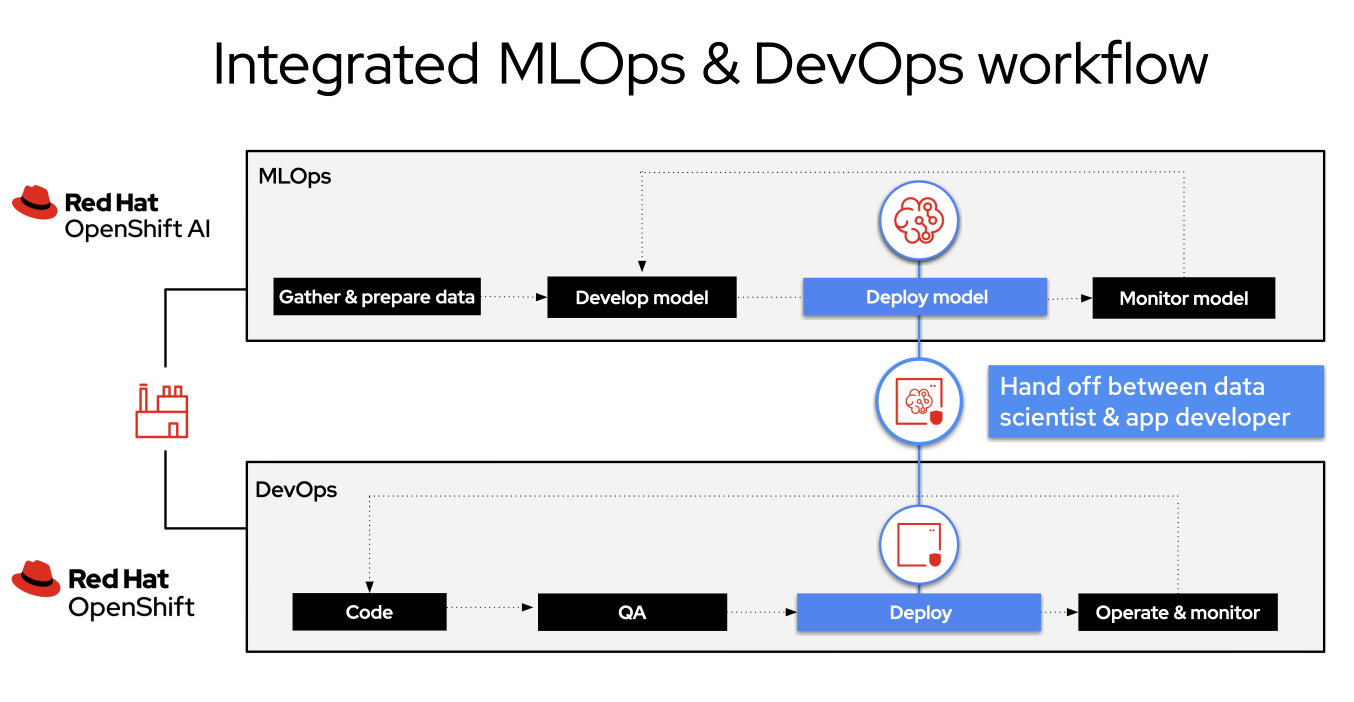
3. Integration of MLOps and DevOps workflows

When you’re ready to move your AI models from experimentation to production, collaboration between teams, including data scientists, ML engineers, and DevOps teams, can be a difference maker. Red Hat OpenShift AI extends Azure Red Hat OpenShift to help you connect these dots with: 

  • Integrated MLOps and DevOps workflows, helping pave the way for cross-team collaboration. 
  • A single, unified platform where AI models and applications are developed, deployed, and managed efficiently.
  • Robust model training, fine tuning, serving, and monitoring capabilities, which can help accelerate time to market and allow your organization to realize the value of your AI investment sooner. 

4. Hybrid cloud consistency and deployment flexibility

Having complete control over where and how your AI workloads run is essential to operationalizing AI. Azure Red Hat OpenShift supports: 

  • Different hardware accelerators, cloud providers, and on-premise servers. 
  • Flexible deployment options, including private datacenters, edge computing, and hybrid and multicloud environments. 
  • A bring-your-own-model (BYOM) approach, allowing your organization to tailor AI models with private enterprise data for specific business needs. 

A fully managed platform gives you:

50%

improvement in operational efficiency.5

70%

shorter development cycle, enabling teams to iterate and innovate faster.5

20%

increase in developer productivity.2

Read more about how to transform your applications with Azure Red Hat OpenShift. 

Download the e-book

OpenShift cloud services delivers more than

450%

return on investment (ROI) over 3 years with less than 6 months to payback.5

graph displaying An overview of how to integrate MLOps and Devops workflow with Red Hat.

Figure 1. An overview of how to integrate MLOps and Devops workflow with Red Hat.

4. Hybrid cloud consistency and deployment flexibility

Having complete control over where and how your AI workloads run is essential to operationalizing AI. Azure Red Hat OpenShift supports: 

  • Different hardware accelerators, cloud providers, and on-premise servers. 
  • Flexible deployment options, including private datacenters, edge computing, and hybrid and multicloud environments. 
  • A bring-your-own-model (BYOM) approach, allowing your organization to tailor AI models with private enterprise data for specific business needs.

5. Cost optimizations for smaller AI models 

Gen AI can be costly. Red Hat OpenShift AI helps to reduce expenses by supporting small, purpose-built AI models that: 

  • Are optimized with private enterprise data, enhancing accuracy while controlling costs. 
  • Reduce computational overhead, making them more cost-effective than large foundation models. 
  • Provide flexibility for business-specific AI tasks, improving efficiency and ROI.

6. First party, Azure-native solution

As a first-party Azure-native service jointly managed and supported by Red Hat and Microsoft, Azure Red Hat OpenShift integrates with key Azure services for application development, AI deployment, and security measures. This allows your organization to: 

  • Access 24/7 joint support from either Red Hat or Microsoft.
  • Benefit from simplified billing through Microsoft, with the ability to draw down on Microsoft Azure Consumption Commitment (MACC) committed spend. 
  • Gain native integration with Azure security and compliance standards. 

Explore all of the Azure integrations.

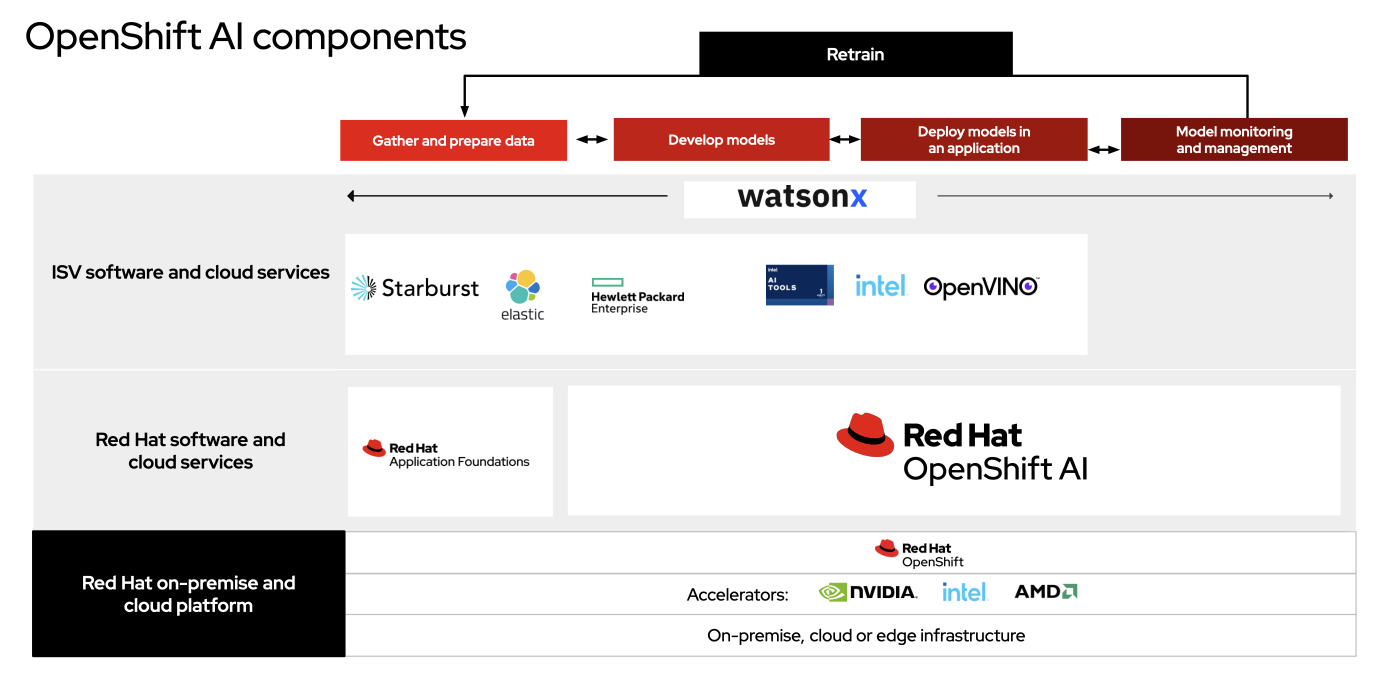
7. Benefit from an open AI ecosystem

Azure Red Hat OpenShift and Red Hat AI operate within an open source ecosystem, giving you more choice and control over your AI implementation. 

  • Gain a broad choice of AI hardware and software solutions tailored to your organization’s needs. 
  • Access a community of technology providers, independent software vendors (ISVs), and open source projects. 
  • Experience full transparency and control over your AI models, allowing your organization to modify and refine AI systems based on your business objectives. 
chart showing Red Hat OpenShift AI is supported by a robust ecosystem of partners.

Figure 2. Red Hat OpenShift AI supported by a robust ecosystem of partners.

8. Start your AI journey wherever you are

Your organization can adopt AI at your pace, as Red Hat provides support across all stages of the AI adoption process, including:

  • Enterprises that are just starting with AI. Red Hat AI streamlines AI deployment with prebuilt, ready-to-use models.
  • Advanced AI teams. Red Hat AI allows for custom model training and fine-tuning with enterprise data.
  • API-accessible AI models. AI models deployed in Red Hat AI are accessible through application platform interfaces (APIs), making them more straightforward to integrate into existing applications.

9. Built-in security focus and compliance 

No AI strategy is complete without a measured and ongoing effort to safeguard valuable data and meet necessary compliance requirements. Azure Red Hat OpenShift is designed with the highest level of security standards and attention to compliance, to help protect sensitive AI workloads. It meets critical industry standards, and compliance offerings including but not limited to:

  • PCI DSS
  • HiTrust
  • FedRAMP
  • SOC 2
  • ISO 27001
Two shiny red, four-pointed sparkles

With Red Hat Enterprise Linux AI, your organization gains access to open source IBM Granite LLMs, fully supported and indemnified by Red Hat under the Apache 2.0 license.

Chapter 5: AI in action: A finance company delivers innovation to customers faster

Headquartered in Rotterdam, Netherlands, Ortec Finance provides technology and Software-as-a-Service (SaaS) solutions for risk and return management to help clients manage their investment decisions.

To enhance its services, Ortec Finance sought to integrate advanced AI capabilities into its solutions. However, deploying and managing AI models at scale presented a number of challenges, including infrastructure complexity, prolonged deployment times, and a need for greater collaboration between its development and operations teams.

Ortec Finance, in collaboration with HCS Company, built the Ortec Finance Cloud Application (ORCA) platform on Azure Red Hat OpenShift. This solution provided a fully managed, cloud-native environment for deploying and scaling AI-powered financial solutions. The platform streamlined software deployment, enhanced access management, and allowed for scaling across regions while ensuring compliance. It also improved collaboration between development and operations teams, accelerating the transition of AI innovations from research to production.

With Azure Red Hat OpenShift, Ortec Finance cut software delivery lead times from days to minutes, reduced operational overhead, and freed teams to focus on AI innovation. Looking ahead, the company plans to adopt Red Hat OpenShift AI to further enhance its AI/ML capabilities, ensuring scalable, compliant, and efficient AI-powered financial solutions.

Modernizing our workloads and unifying our teams on Azure Red Hat OpenShift is already helping us be a faster-moving business and we can see how OpenShift AI on Azure Red Hat OpenShift will accelerate the transition of our AI-enhanced solutions from research and development labs into the hands of customers.

Joris Cramwinckel

Technologist, Ortec Finance

Read the complete customer story

Learn more

Ready to get started? 

Red Hat and Microsoft streamline AI adoption and application modernization with Red Hat OpenShift AI on Azure Red Hat OpenShift. 

This fully managed platform provides a unified foundation for AI-powered applications, with integrated MLOps and DevOps workflows, scalable AI model management, and built-in security measures and compliance. With a vast partner ecosystem, expert support, and streamlined hybrid cloud flexibility, you can develop, deploy, and operationalize AI with less effort—accelerating time to value and innovation.

> Learn how to operationalize AI in less time with this checklist

> Explore the interactive demo

> Try Red Hat OpenShift AI

> Get started with Microsoft Azure Red Hat OpenShift

  1. IDC press release. “Artificial Intelligence Infrastructure Spending to Surpass the $200Bn USD Mark in the Next 5 years, According to IDC,” 18 Feb. 2025.

  2. IDC White Paper, sponsored by Red Hat. “Why open source artificial intelligence platforms help enterprise business transformation.” Document #US51272823, Nov. 2023.

  3. IDC perspective. “AI Transformation Is Driving Digital Business,” Document #US51136823, Jun. 2024.

  4. Red Hat client data and Fortune 500 list, September 2024. 

  5. Forrester Total Economic Impact™ (TEI) report sponsored by Red Hat. “Microsoft Azure Red Hat OpenShift Provides More Value And Support To Cloud-First Organizations”, 19 Mar. 2024

Tags:Artificial intelligence

Red Hat logo

About Red Hat

Red Hat is the open hybrid cloud technology leader, delivering a trusted, consistent and comprehensive foundation for transformative IT innovation and AI applications. Its portfolio of cloud, developer, AI, Linux, automation and application platform technologies enables any application, anywhere—from the datacenter to the edge. As the world's leading provider of enterprise open source software solutions, Red Hat invests in open ecosystems and communities to solve tomorrow's IT challenges. Collaborating with partners and customers, Red Hat helps them build, connect, automate, secure, and manage their IT environments, supported by consulting services and award-winning training and certification offerings.

  • North America
  • Asia Pacific
  • Latin America
  • Europe, Middle East, and Africa
  • 888-REDHAT1
  • +6564904200
  • +5443297300
  • +0080073342835
  • www.redhat.com
  • apace@redhat.com
  • info-latam@redhat.com
  • europe@redhat.com
  • @red-hat
  • @redhat
  • @redhat
  • @red_hat

Copyright © 2026 Red Hat. Red Hat, the Red Hat logo, Ansible, and OpenShift are trademarks or registered trademarks of Red Hat, LLC or its subsidiaries in the United States and other countries. Linux® is the registered trademark of Linus Torvalds in the U.S. and other countries. The OPENSTACK logo and word mark are trademarks or registered trademarks of OpenInfra Foundation, used under license. All other trademarks are the property of their respective owners.

Red Hat logoLinkedInYouTubeFacebookXInstagram

Platforms

  • Red Hat AI
  • Red Hat Enterprise Linux
  • Red Hat OpenShift
  • Red Hat Ansible Automation Platform
  • See all products

Tools

  • Training and certification
  • My account
  • Customer support
  • Developer resources
  • Find a partner
  • Red Hat Ecosystem Catalog
  • Documentation

Try, buy, & sell

  • Product trial center
  • Red Hat Store
  • Buy online (Japan)
  • Console

Communicate

  • Contact sales
  • Contact customer service
  • Contact training
  • Social

About Red Hat

Red Hat is an open hybrid cloud technology leader, delivering a consistent, comprehensive foundation for transformative IT and artificial intelligence (AI) applications in the enterprise. As a trusted adviser to the Fortune 500, Red Hat offers cloud, developer, Linux, automation, and application platform technologies, as well as award-winning services.

  • Our company
  • How we work
  • Customer success stories
  • Analyst relations
  • Newsroom
  • Open source commitments
  • Our social impact
  • Jobs

Change page language

Red Hat legal and privacy links

  • About Red Hat
  • Jobs
  • Events
  • Locations
  • Contact Red Hat
  • Red Hat Blog
  • Inclusion at Red Hat
  • Cool Stuff Store
  • Red Hat Summit
© 2026 Red Hat

Red Hat legal and privacy links

  • Privacy statement
  • Terms of use
  • All policies and guidelines
  • Digital accessibility