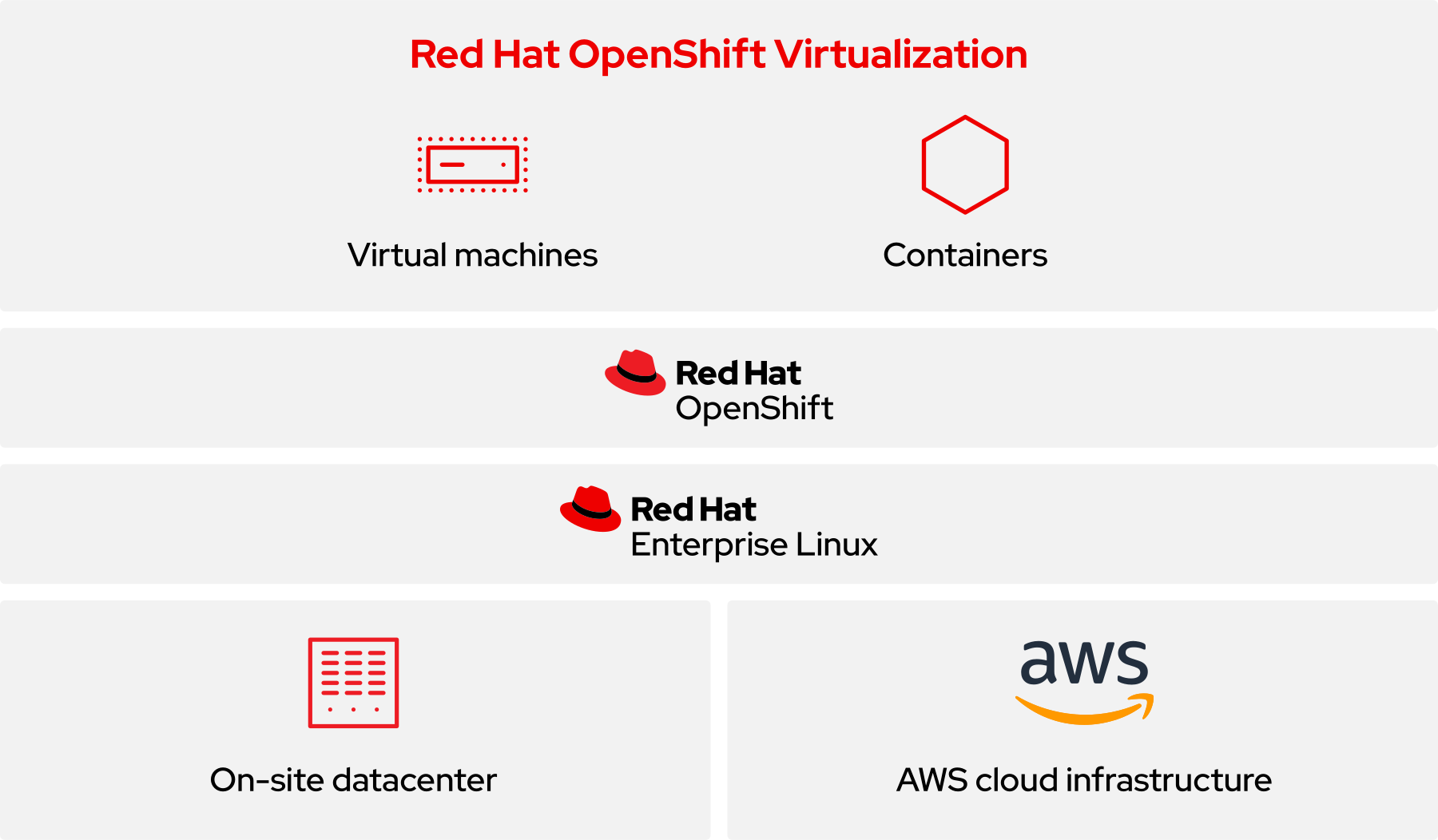
Here are 15 reasons to migrate your traditional virtual machines to a unified foundation based on OpenShift Service on AWS.
1 Maintain stability and support on a modern virtualization platform.
Migrating workloads from traditional to modern virtualization platforms can be complicated. To ensure a smooth and efficient migration process, you need to carefully consider virtual machine compatibility, possible configuration changes, and potential performance optimizations. Additionally, differences in virtualization platform deployment and management processes and tools need to be accounted for in your migration plans, especially when moving between cloud providers. Preemptively validating virtual machine compatibility, using warm migration capabilities, and transitioning multiple virtual machines at once can help you move workloads between virtualization platforms rapidly and with less effort.
The migration toolkit for virtualization simplifies and speeds the process of moving existing virtual machines to OpenShift Virtualization, saving you time and minimizing potential errors. Plus, by combining this toolkit with Red Hat Ansible® Automation Platform, you can automate the migration of groups of virtual machines and related infrastructure—like networking and storage—at scale and speed.
2. Operate consistently and cost-effectively across hybrid and multicloud environments.
One of the key advantages of adopting hybrid and multicloud environments is flexibility. During application deployment, these environments let you choose between various datacenter and cloud resources to balance scalability, performance, and cost according to your business objectives. Application platforms that run and migrate virtual machine workloads consistently across hybrid and multicloud cloud environments help you simplify application deployment, optimize resource use, and maintain operational consistency.
OpenShift Virtualization supports self-managed physical servers in datacenters, edge environments, and public cloud environments, so you can deploy and manage your virtual machines on the optimal infrastructure. Because Red Hat OpenShift runs consistently in datacenter and public, private, and hybrid cloud environments, you can choose the right location for each application and virtual machine, and move them as needs change. This consistency also simplifies the migration of on-site workloads and virtual machines to AWS.
Additionally, OpenShift Service on AWS helps you achieve the right balance of flexibility and cost for your organization with your choice of purchasing options. Simplify procurement with unified billing and purchase management through AWS. Use and pay only for the instances you need with on-demand pricing. Or take advantage of discounted pricing over a longer period of time with 1- and 3-year reserved instance purchasing models. OpenShift Service on AWS also fully qualifies for 100% of your spend with the AWS Enterprise Discount Program (EDP).
3. Simplify IT operations with a unified platform.
Managing separate platforms for virtual machines and containers can lead to increased complexity, resource fragmentation, and operational overhead. Unified platforms that streamline infrastructure deployment, management, and monitoring across both virtual machines and containers can help you optimize resource use, eliminate duplicate efforts, and quickly adapt to diverse workloads.
OpenShift Virtualization simplifies operations with a single platform for virtual machines, containers, and bare-metal and serverless workloads. Standardize infrastructure deployment and maintain all workloads using a common, consistent set of established, enterprise tools. You can also streamline Day 2 operations from provisioning to compliance to deprovisioning with Ansible Automation Platform.
Plus, you can continue to use your existing infrastructure with OpenShift Service on AWS via certified partner integrations. Deploy and manage your preferred applications more easily and confidently with certified operators and Helm charts that encompass detailed vendor expertise. For example, AWS offers a variety of operators for managing AWS services from within Red Hat OpenShift.